
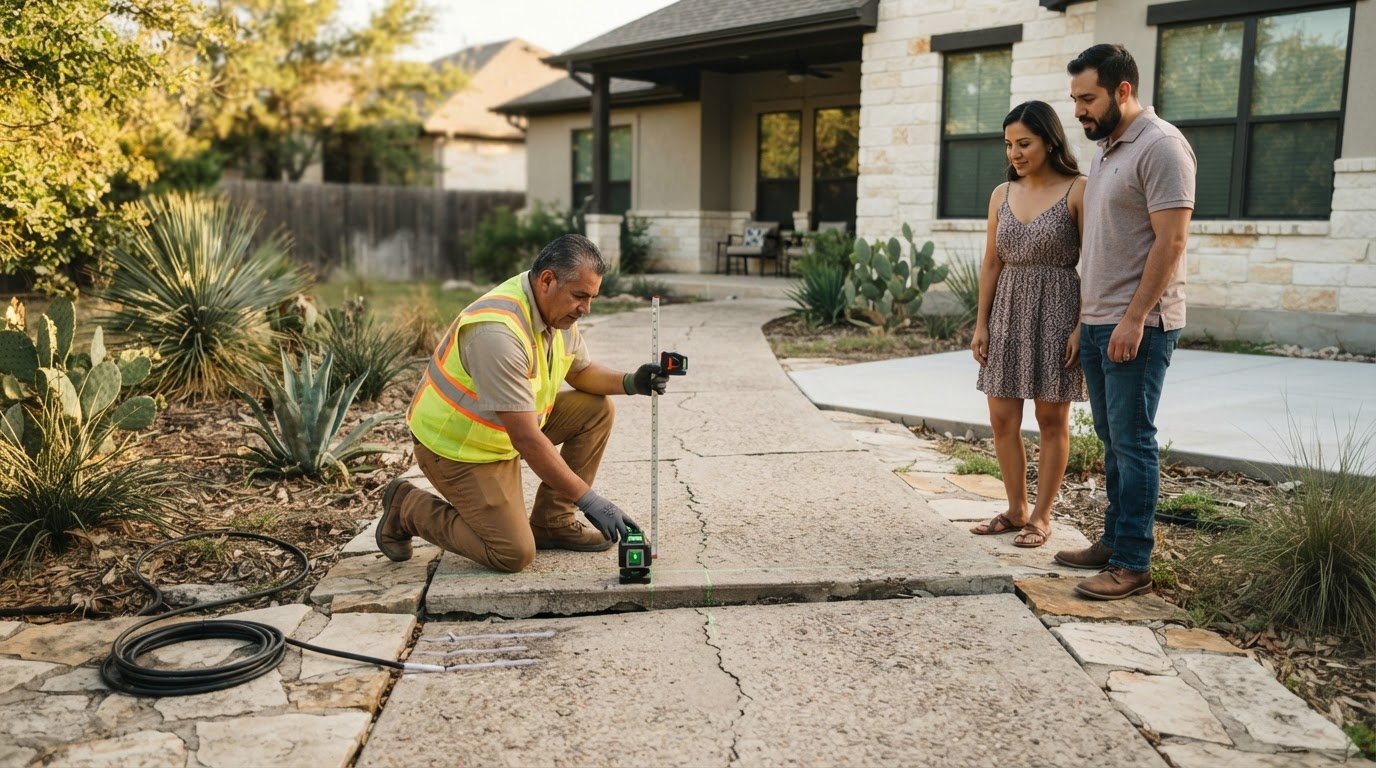
Replacing an uneven slab may seem like the surest way to fix it, but it isn’t always the right first step. Concrete leveling may be a practical option when the slab is still suitable to lift. Severe damage or a wider structural concern may point to a different solution. If a raised edge creates a trip concern or an uneven walkway makes access difficult, the key questions are what caused the movement and whether the concrete can be lifted safely.
It’s understandable to feel unsure when contractors mention mudjacking or polyurethane foam leveling, or recommend repair instead of replacement. The right choice depends on the slab’s condition and the site, not just the method’s name. This guide explains how concrete leveling works, what signs may make leveling or replacement more appropriate, and what to ask before hiring a contractor in South Texas. You’ll also learn what a careful assessment should cover, so you can compare recommendations and understand whether the issue appears limited to the slab or may involve a broader foundation concern.
Key Takeaways
- Learn how settled slabs can show up as uneven joints, sloping surfaces, or gaps, and why the conditions beneath the concrete matter.
- Compare concrete leveling approaches by how they work, the access they require, and whether they suit the slab’s condition.
- Weigh when lifting and reusing a slab may be appropriate, and when visible damage or wider concerns may call for another option.
- Prepare for a contractor assessment by documenting changes, noting drainage, and asking what may be causing the settlement.
- Compare estimates by asking about the proposed method, repair scope, and factors that could affect the result.
What Is Concrete Leveling, and Why Do Slabs Sink?
Concrete leveling raises or supports settled concrete by addressing the soil or other support beneath it, rather than removing and replacing the slab. The aim is to improve an uneven surface, but whether a slab can be lifted depends on its condition and what caused it to move. This overview of concrete leveling introduces common approaches and how they work.
Settlement can leave a height difference between adjoining panels, a walkway that slopes toward a doorway, or a gap where concrete meets a step or another surface. Possible contributors include moisture changes, erosion, poor drainage, tree roots, or fill beneath the slab that wasn’t compacted adequately. These are possibilities, not a diagnosis. The same visible change can have different causes, and a professional assessment can help clarify what’s happening below the concrete.
How can you tell concrete has settled?
Look for one panel sitting higher than the next, water pooling where it didn’t before, or a slab pulling away from a porch, step, or driveway. These observations can indicate movement, but they don’t identify its cause or confirm that lifting is appropriate.
Note when you first noticed the change and whether it appears to be progressing. Check nearby concrete as well. Similar movement across several surfaces can give a contractor useful context, though it still doesn’t establish the underlying issue.
When might the problem involve the foundation?
A driveway or walkway can settle independently of a home’s foundation. But if uneven exterior concrete appears alongside interior signs such as new or worsening cracks, doors that begin sticking, or floors that feel uneven, consider getting a professional evaluation. Those signs don’t prove the foundation is moving. They do make it important to assess the wider picture rather than treating the outdoor slab in isolation.
For more context on structural concerns involving a home’s slab, see this slab foundation repair guide. The distinction matters: leveling addresses settled concrete, while foundation movement may call for a broader repair assessment.
In short, leveling improves or adjusts the support beneath an existing slab. Replacement removes that slab and installs new concrete. A contractor should assess the slab and site conditions before recommending either option.
Concrete Leveling Methods Compared: What Changes Beneath the Slab?
Leveling methods differ mainly in what is placed beneath the concrete and how it is delivered. The useful comparison isn’t a contest between method names. Consider whether the slab is sound enough to lift, whether the material suits the site, and what the contractor can confirm about the support below. The Federal Highway Administration’s discussion of concrete leveling pads illustrates a related engineering principle: structures need stable support beneath them. See its technical discussion of concrete support.
How do grout-based methods and foam leveling differ?
Mudjacking and other grout-based approaches pump a flowable mixture beneath a slab through drilled access holes. Expanding foam methods inject material that expands below the concrete. Those general descriptions don’t establish which option suits a particular slab. Ask what material the contractor proposes, where access holes will go, and how they determine the amount and placement. Available methods and materials vary, so confirm local availability and suitability instead of assuming every contractor offers each approach. For example, specialized contractors such as Airlift Concrete Experts focus on polyurethane concrete leveling to raise and stabilize sunken surfaces.
| Method | General process | Potential fit | Limitations | What the contractor must verify |
|---|---|---|---|---|
| Mudjacking or grout-based injection | A flowable mixture is pumped beneath the slab through access holes. | A slab that may be liftable and has space beneath it for injected material. | Suitability depends on slab condition, voids, and access. Injection alone may not address the cause of movement. | Proposed material, hole locations, underlying support, and whether the slab can tolerate lifting. |
| Expanding foam injection | Injected foam expands beneath the slab to support or raise it. | A slab and site that the contractor determines are appropriate for the specific material. | Material performance and suitability are project-specific. Don’t assume claims about curing, weight, or longevity apply universally. | Material details, placement plan, site conditions, and the basis for the recommended lift. |
| Replacement | The existing slab is removed and new concrete is installed. | An alternative to assess when deterioration may make lifting unsuitable. | It replaces the slab, but the contractor should still explain how the underlying cause will be considered. | Extent of damage, reason leveling isn’t advised, and the full proposed scope. |
When should you compare leveling with replacement?
Extensive cracking, crumbling, or other deterioration may affect whether a slab can be lifted, but no single visible flaw automatically determines the answer. Ask what evidence from the site supports the proposed method and scope. A careful recommendation should account for the slab’s condition and the ground beneath it, rather than rely on a broad promise about cost or durability.
For a professional assessment of your slab and site conditions, learn more about Hercules Foundation Repair and its concrete leveling service.
Is Concrete Leveling or Replacement Right for Your Slab?
Concrete leveling can improve the position of a settled slab, but it may not correct every cause of movement. It’s worth considering when the existing concrete remains suitable to lift and the support beneath it can be addressed. If the slab is badly deteriorated, or the movement points to a broader structural concern, replacement or foundation repair may need to be discussed. An online checklist can help you prepare, but it can’t determine which option is right for your slab.
There are trade-offs to weigh:
- Potential advantages of leveling: It may allow the existing slab to be reused, with work focused on the settled area instead of replacing all the concrete. The actual scope depends on the site.
- Potential limitations: Lifting may not be suitable if the concrete is extensively cracked or crumbling, and it doesn’t automatically resolve the reason the slab moved. The finished surface may also retain visible wear or damage.
- Replacement considerations: New concrete may be an option if the existing slab is too deteriorated to lift. The underlying support and cause of movement still deserve attention, so don’t assume replacement alone will resolve them.
What conditions should a contractor assess before recommending leveling?
An on-site assessment should consider visible damage, where and how the slab has moved, the condition of adjoining surfaces, drainage patterns, and access for the proposed work. These details help the contractor judge whether the slab can be lifted safely and what the repair would involve. Ask how each observation informed the recommendation. A photo or online checklist can’t confirm the cause or establish that a specific slab is suitable.
What should make you ask about replacement or foundation repair?
Extensive deterioration is a reason to ask whether lifting is appropriate and whether replacement should be assessed. A broader pattern of movement, especially alongside changes in the home, is a reason to ask whether the concern extends beyond an exterior slab. One crack, gap, or uneven panel alone doesn’t diagnose a foundation problem. Foundation repair addresses structural movement; concrete leveling addresses settled concrete. They’re related services, but they solve different problems.
Suitability depends on the slab, the movement pattern, supporting soil, drainage, and the site assessment. Ask what evidence supports the proposed option, what work it includes, and what it won’t address. Timelines and expected performance also depend on project conditions, so be cautious of universal claims. A clear explanation should help you understand the recommendation and remaining uncertainties before deciding.
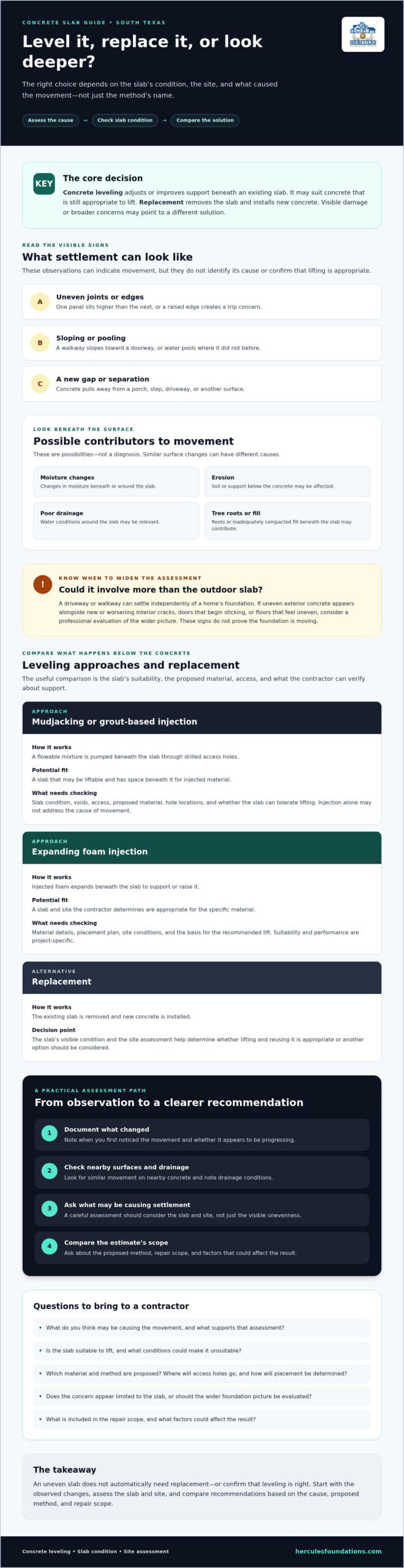
How to Evaluate a Concrete Leveling Estimate in South Texas
A useful estimate should explain more than the proposed work and total. It should connect what the contractor observed at your property to the recommended method, scope, and factors that could affect the result. Before the assessment, make a clear record of the problem so you can compare recommendations using the same information.
An on-site assessment matters because the right repair depends on the slab, its support, and the conditions around it, not just how uneven the surface looks.
Prepare for the assessment
- Identify the slabs. Note which areas are affected, such as a walkway, driveway panel, patio, or entry slab. Mark where each problem begins and ends.
- Record visible changes. Take photos and note uneven edges, cracks, gaps, or areas that appear to have shifted. Include when you first noticed the change and whether it seems to be progressing.
- Document drainage. Note where water collects after rain, where it flows, and whether the slab is near a downspout or another runoff source. Record what you observe without assuming it caused the settlement.
- List your questions. Write down concerns about access, nearby surfaces, the proposed work, and what to expect after the project.
What questions should you ask a concrete leveling contractor?
Ask the contractor to explain how they assessed the slab and what they think may be causing the movement. Which method do they recommend, why does it fit this slab, and what limitations should you understand? Ask what the estimate includes, such as the areas to be worked on, site preparation, and any steps planned after the main repair. If the recommendation relies on a particular site condition, ask the contractor to point it out and explain why it matters.
For a fair comparison, line up estimates by scope, not just total. Check whether each covers the same slabs and work, makes the same assumptions about access and preparation, and describes similar post-work expectations. Ask what is excluded or could change the proposed scope. Broad assurances aren’t a substitute for a clear explanation of the work and its limits.
What should a site assessment cover in South Texas?
South Texas properties can differ, so don’t assume that conditions at one home apply to another. Ask the contractor to consider drainage, visible soil conditions, recent changes around the slab, and whether nearby concrete shows a similar pattern. These observations can inform the assessment, but they don’t establish a cause by themselves. The property needs to be reviewed on site.
To discuss an assessment for your property, contact Hercules Foundation Repair about concrete leveling.
Professional Concrete Leveling in San Antonio, Austin, Houston, and Victoria
Choosing a contractor starts with finding out whether the company can assess the slab and clearly explain its recommendation. Hercules Foundation Repair is a family-owned and operated South Texas company that has served the region since 1980. Its listed residential and commercial services include concrete leveling and foundation repair.
The company lists San Antonio, Austin, Houston, and Victoria as service locations. Confirm current availability for your area when you reach out. Local context can be useful, but it can’t replace a review of your specific slab and site conditions.
What can you expect when discussing a leveling project?
Be ready to describe which slab is affected, what changes you’ve noticed, and where the property is located. For example, explain whether the issue is on a walkway, driveway, or another concrete surface, and when you first saw the change. Photos can show the visible condition and provide useful context for an initial conversation.
Photos and descriptions aren’t a substitute for an on-site assessment. Ask Hercules what its current estimate and assessment process involves, what information it needs from you, and what the next steps would be. The answers can help you understand how the slab and surrounding site will be evaluated before you consider a recommendation.
When should you contact a foundation repair specialist?
Consider professional input if uneven concrete is extensive, appears to be changing, or occurs alongside possible structural symptoms in the home. Those signs don’t establish the cause on their own. They do make it sensible to ask whether the concern is limited to an outdoor slab or may involve the building’s foundation.
Concrete leveling and foundation repair address related but distinct conditions. Hercules offers both, so an evaluation can help clarify which type of concern needs attention without assuming in advance which service is appropriate. Ask the contractor to explain what they observed, what they believe may be contributing to the movement, and how those observations support the proposed scope.
If you’re in a listed service area and want to discuss your slab or the appropriate assessment process, talk with Hercules Foundation Repair about your concrete leveling needs. Confirm current availability for your location when you get in touch.
Choose Your Next Step With Confidence
The right repair starts with understanding what’s moving. Concrete leveling may suit a slab that can be lifted, but the method and recommendation should reflect the slab’s condition, its support, and the site. Compare estimates by scope and reasoning, not just the final number. If movement appears alongside possible structural concerns, ask whether the issue may extend beyond the concrete surface.
Hercules Foundation Repair is family-owned and operated and has served South Texas since 1980. Its listed services include residential and commercial concrete leveling and foundation repair. Listed service locations include San Antonio, Austin, Houston, and Victoria. Confirm current availability for your property when you reach out.
Share what you’ve noticed and ask what an assessment would involve. Discuss your concrete leveling project with Hercules Foundation Repair to clarify your options and next steps.
Frequently Asked Questions
What is concrete leveling?
Concrete leveling corrects a settled slab by improving or adjusting its support from below. Unlike replacement, which removes the existing slab and installs new concrete, leveling works with the slab already in place. The method depends on the project and site conditions. Not every uneven surface is suitable for lifting, so a contractor needs to assess the slab’s visible condition and supporting conditions before recommending a repair.
How does concrete leveling work?
The process generally starts with assessing the slab and the area beneath it. Depending on the method, a contractor may create access points, place material beneath the concrete, adjust its position, and finish the access points afterward. Procedures differ by method and contractor. The slab’s condition, access, and site conditions influence the work, so ask the contractor to explain the proposed steps for your property.
Is concrete leveling better than replacing a slab?
Neither option is universally better. Leveling may be considered when the existing slab is in suitable condition to raise, while replacement may be discussed if deterioration or movement makes lifting inappropriate. A site-specific assessment helps determine which option fits and what the work would involve. Compare the reasoning and scope of each recommendation rather than relying on broad claims about savings, completion time, or repair life.
How long does concrete leveling last?
There’s no single service life that applies to every leveled slab. The result can depend on the slab’s condition, the underlying support, drainage, the method used, and whether the area continues to move. Ask the contractor which conditions could affect the outcome at your property and what expectations are reasonable. A clear explanation should address uncertainty without presenting a general lifespan or guarantee as certain for your project.
How much does concrete leveling cost?
An estimate depends on factors such as the area and condition of the slab, access, the proposed method, and the work required. For a project in San Antonio, Austin, Houston, or Victoria, ask for a site-specific estimate and confirm current service availability. Compare what each estimate includes, its assumptions, and any exclusions. An unexplained total alone doesn’t show whether contractors are proposing the same work.
Can concrete leveling fix a foundation problem?
No. Leveling a driveway, walkway, or other slab is different from repairing a building foundation. If uneven concrete appears alongside possible structural changes in the home, ask a foundation specialist to assess the broader concern. One crack or uneven surface alone can’t confirm foundation movement. The appropriate service depends on what an evaluation finds, so don’t assume that lifting an exterior slab will address a structural problem.
Does concrete leveling work for driveways and sidewalks?
Driveways and sidewalks are common surfaces property owners ask about, but not every slab is suitable for lifting. A contractor should assess its condition, settlement pattern, access, and supporting conditions before recommending a method. Discuss drainage separately, since raising a slab doesn’t necessarily correct the source or path of water. Ask what the proposed work is intended to address and what concerns may remain afterward.