
Is that thin crack above your door frame just a cosmetic nuisance, or is the shifting Texas clay starting to pull your home’s skeleton apart? It’s a question that keeps many homeowners awake at night, especially when you consider how volatile our local soil remains in 2026. You likely feel the weight of stress over your family’s safety and the fear of a massive, hidden repair bill. It’s completely normal to feel confused when you’re trying to distinguish between a simple settling crack and a serious need for slab foundation repair.
We’ve seen these same worries time and again since we started helping our neighbors back in 1980. You deserve a home that feels like a solid sanctuary, not a source of constant anxiety. This guide will help you master the essentials of protecting your property, from identifying early warning signs to choosing the right structural stabilization method for your specific area. We’ll walk through the technical details and transparent processes that lead to a stable, level home and the long-term peace of mind that comes with a transferable warranty.
Key Takeaways
- Understand how the “Active Zone” in South Texas clay soil forces your foundation to shift and how moisture management protects your structure.
- Identify the subtle interior and exterior warning signs of damage, from sticking door frames to the classic “stair-step” cracks in your home’s brickwork.
- Compare deep underpinning with concrete leveling to determine which method offers the permanent structural stabilization your property requires.
- Master the essentials of slab foundation repair estimates to ensure you receive transparent pricing and avoid unexpected expenses during the restoration process.
- Learn why prioritizing long-term structural integrity over quick fixes is the only way to secure lasting peace of mind and a transferable warranty.
Understanding Slab Foundation Failure in South Texas Clay
Texas homes are built differently than those in the north. Most houses in San Antonio and Austin rely on a Shallow foundation known as a slab-on-grade. It’s a cost-effective design that handles our heat well, but it puts your entire home at the mercy of the soil directly beneath it. Since we started Hercules Foundation Repair in 1980, we’ve seen how the ground in South Texas doesn’t just sit still; it breathes. This constant movement is the primary reason why homeowners eventually find themselves researching slab foundation repair options to protect their investment.
The Science of Expansive Clay Soil
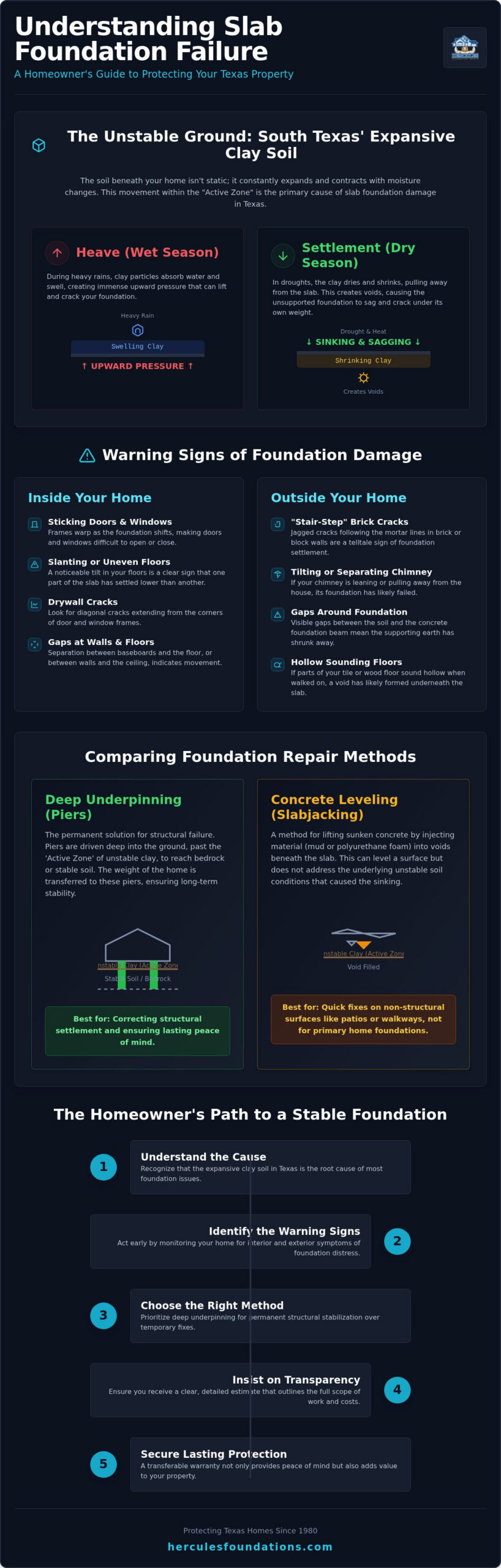
The clay particles under your feet are like tiny, powerful sponges. When South Texas gets hit with heavy rain, these particles soak up water and swell, pushing your home upward. This upward movement is known as “heave.” When the sun bakes the earth during our long summers, those same particles contract and shrink, leading to “settlement.” This constant tug-of-war happens in what engineers call the “Active Zone,” which is the layer of soil most vulnerable to moisture changes. In 2026, we’re seeing more intense weather patterns that accelerate this cycle, making it harder for older slabs to stay level without professional intervention. Understanding the difference between a house that is simply “settling” and one that is experiencing structural failure is the first step toward a permanent fix.
The Impact of Texas Climate on Your Home
Our drought cycles are particularly hard on concrete structures. As the soil dries out, it pulls away from the concrete, creating a literal gap under your home. Without the earth there to support it, the heavy slab begins to sag and crack under its own weight. On the flip side, flash flooding can cause rapid soil erosion around your home’s perimeter, leaving the edges of your slab hanging over empty space. Vegetation plays a role too. Transpiration is the process where tree roots pull moisture out of the soil from beneath your slab, causing localized shrinkage and structural sinking. These unique geological challenges in San Antonio and Austin mean that a generic fix won’t work. You need slab foundation repair that respects the power of Texas clay and provides long-term structural stabilization through proven methods like deep underpinning.
Identifying the Warning Signs of Slab Foundation Damage
Every house in South Texas will experience some degree of movement. It’s the nature of our local geology. However, there’s a fine line between the house “finding its seat” and a structural failure that requires slab foundation repair. Since we’ve been working with these structures since 1980, we’ve learned that your home usually tries to tell you when something is wrong long before a catastrophic failure occurs. The key is knowing which whispers to listen to and which ones are just the house aging gracefully.
Interior Red Flags You Shouldnt Ignore
The inside of your home often shows the first signs of stress. If you find yourself pushing hard against a bedroom door just to get it to latch, or if a door that used to stay shut now swings open on its own, your frame is likely out of alignment. You might also notice thin, diagonal cracks creeping out from the corners of window frames or door headers. These aren’t just paint issues; they’re symptoms of the slab pulling the wall studs in different directions. Check for gaps where the baseboards meet the floor. If you can see light coming through or notice a growing space between the ceiling and the wall, it’s time to consider a professional foundation inspection to assess the situation.
- Sticking Doors and Windows: Difficulty opening or closing is a classic sign of a shifted frame.
- Slanting Floors: If a marble rolls across your “level” kitchen floor, the slab has likely tilted.
- Drywall Cracks: Large, jagged cracks are more concerning than thin, straight hairline fractures.
Exterior and Structural Symptoms
Outside, the signs are often more dramatic. Look at your brickwork. If you see “stair-step” cracks following the mortar lines, the foundation beneath that wall has settled. One of the most serious red flags is seeing your chimney begin to tilt or separate from the rest of the house. Indoors, keep an ear out for “hollow” sounding spots when walking on tile or hardwood, which often indicates a void has formed beneath the subfloor. You should also walk the perimeter of your home and look for visible gaps between the soil and the foundation beam. While some shrinkage is normal in a South Texas summer, a deep void can leave the concrete unsupported.
If you’re unsure about a crack, use the “Fingertip Test.” While hairline cracks are often cosmetic, a crack wider than 1/4 inch is the typical threshold for professional inspection because it suggests the structural integrity of the concrete has been compromised. If you can fit your fingertip into a crack in your slab or exterior brick, it’s no longer just a blemish; it’s a structural red flag. Addressing these issues early with proper slab foundation repair can prevent the damage from spreading to your plumbing and roofline.
Comparing Slab Foundation Repair Methods: Piers vs. Leveling
Not every crack in your concrete requires the same solution. Choosing the wrong approach can lead to wasted money and recurring structural issues. In the world of slab foundation repair, we generally categorize fixes into two camps: structural underpinning for the main house and surface leveling for secondary slabs like patios or walkways. Understanding which one your home needs is the difference between a permanent fix and a temporary patch that fails when the next Texas drought hits. To explore the full range of options available to homeowners, our detailed overview of foundation repair services and structural stability methods can help you compare approaches before committing to a solution.
Structural Underpinning: Concrete and Steel Piers
When the heavy perimeter of your home begins to sink into the shifting clay, you need deep structural support. This process, known as underpinning, bypasses the “Active Zone” of the soil to reach stable strata. We often utilize pressed concrete piers because they provide a heavy-duty, cost-effective solution for many South Texas homes. These high-density cylinders are driven deep into the earth using the weight of the house itself. For properties sitting on more unstable or deeper soil profiles, steel push piers offer even greater depth and precision. Since 1980, Hercules Foundation Repair has focused on these methods because they offer long-term structural stabilization. We don’t believe in “quick leveling” that only addresses the symptoms; we want to ensure your home’s skeleton is anchored for decades.
- Pressed Concrete Piers: Ideal for most residential slabs, providing reliable support through friction and depth.
- Steel Push Piers: Used for deeper soil challenges, offering a high-strength alternative that reaches bedrock or load-bearing strata.
- Long-Term Focus: Structural repairs should always include a transferable warranty to protect your property’s future value.
Concrete Leveling for Non-Structural Slabs
If your front walkway has become a trip hazard or your garage floor is tilting, you might not need deep piers. Concrete leveling is a faster, less invasive way to correct sunken surfaces that don’t support the weight of the house. Polyurethane injection, often called polyjacking, is the modern standard for this type of work. We drill small, penny-sized holes in the concrete and inject a specialized foam that expands to lift the slab back into place. It’s much lighter than traditional mudjacking, which uses a heavy cement slurry that can actually cause the soil to sink further under the added weight. Modern foam injection is also waterproof, meaning it won’t wash away during a flash flood. This method allows you to use your driveway or patio almost immediately after the slab foundation repair is complete, offering a seamless way to restore your home’s curb appeal without heavy excavation.
The Homeowners Buying Guide: Costs, Estimates, and Contractors
Facing a structural issue is stressful enough without the added confusion of complex financial estimates. In 2026, the landscape of home maintenance has changed, with shifting labor markets and material availability impacting the bottom line. When you’re looking for slab foundation repair, you aren’t just buying concrete and steel; you’re investing in the long-term safety of your family’s biggest asset. Understanding how to navigate these bids is essential to avoiding the “hidden costs” that often plague low-quality work.
Evaluating Foundation Repair Estimates
When you receive a bid, don’t just look at the final number. A common mistake is focusing solely on the quantity of piers rather than the intended depth and the quality of the stabilization method. A contractor might offer a lower price by using fewer supports, but if those piers don’t bypass the active clay zone we discussed earlier, your slab foundation repair won’t provide the permanence you need. You should also watch for costs like permit fees or landscape restoration that might not be included in the initial quote. Before signing, ask your contractor about their specific plan for internal plumbing checks and how they handle unforeseen soil anomalies. The cheapest bid often leads to the most expensive re-repairs down the road because it lacks the precision required for South Texas soil.
Selecting a Local Texas Contractor
National franchises have big marketing budgets, but they often lack the deep-rooted understanding of San Antonio and Austin geology. We believe local references are far more valuable than national brand recognition. A company with a 45-year history, like ours, has seen every drought cycle and flood event since 1980. This longevity is your best defense. Being family-owned means we have a personal stake in every job we do. We don’t hide behind corporate layers when it comes to warranties; our accountability is direct and local. A transferable warranty is a non-negotiable requirement in 2026, as it protects your home’s resale value and gives the next owner the same peace of mind you enjoy today. If you’ve noticed common signs your foundation needs professional repair, it’s better to act while the solution is still manageable.
Your home deserves the protection of a specialist who understands exactly how our local earth behaves. Don’t leave your structural integrity to chance with a generalist or a newcomer who hasn’t weathered the Texas climate. If you’re ready for a transparent, professional assessment of your property, schedule your expert foundation inspection today and get a clear path toward a stable home.
The Hercules Advantage: Steadfast Protection for Your Home
Since 1980, Hercules Foundation Repair has served as a guardian for Texas homeowners. We’ve spent over 45 years studying the unique behavior of clay in San Antonio, Austin, Houston, and Victoria. This isn’t just a business for us; it’s a family legacy built on the promise of structural stability. When you choose us, you’re hiring a team that has weathered every major Texas drought and flood cycle for nearly half a century. We handle the heavy lifting and the technical complexities of slab foundation repair so you can focus on what matters most: your family’s safety and comfort.
A Legacy of Structural Stability
We believe that true mastery comes from focus. That’s why we’re dedicated foundation contractors, not generalists who dabble in a dozen different trades. To maintain our high standards for structural mastery, we explicitly exclude services like plumbing or roofing. We aren’t here to fix your leaks or shingles; we’re here to ensure the ground beneath your feet stays where it belongs. Our “Steadfast Protector” approach means we treat every residential slab as if it were supporting our own home. We prioritize long-term structural stabilization over the “quick fixes” that often fail after the first heavy rain. This specialized focus allows us to provide a level of precision that general contractors simply can’t match.
Next Steps: Securing Your Foundation
Taking the first step toward a stable home shouldn’t be a source of stress. When you’re ready to address your concerns, scheduling a professional slab evaluation is a straightforward process. During our first visit, we perform a methodical inspection of your property’s perimeter and interior. We look for the red flags we discussed earlier, like stair-step cracks and misaligned frames, but we also look deeper into the soil’s current state. Our goal is to give you a clear, honest assessment of what your home needs to remain secure for the next 45 years. We’ll walk you through our findings and explain the best path forward without any high-pressure sales tactics.
Protect your home with a Hercules Foundation Repair estimate today and let our family protect yours.
Securing Your Home’s Future in South Texas
Your home is more than just a building; it’s the foundation of your family’s life. Navigating the challenges of South Texas clay requires a partner who understands the deep science of soil movement. By identifying warning signs early and choosing permanent structural stabilization over temporary fixes, you can prevent minor settling from becoming a major catastrophe. Our specialized experts focus exclusively on the integrity of your concrete, ensuring your property remains level and safe regardless of the 2026 weather cycle.
Since 1980, we’ve stood as a steadfast protector for homeowners in San Antonio, Austin, and beyond. With over 45 years of experience as a family-owned and operated business, we bring a level of accountability and local knowledge that national franchises simply can’t match. Don’t let the stress of slab foundation repair weigh on your mind any longer. Take the first step toward long-term peace of mind and structural mastery today. Request Your Professional Foundation Evaluation and let us help you protect what matters most. You’ve worked hard for your home; we’ll work hard to keep it standing strong.
Frequently Asked Questions
How much does slab foundation repair typically cost in Texas?
The total investment for slab foundation repair depends on several variables, including the number of piers required and the depth of the stable soil strata. Each home in San Antonio or Austin presents a unique geological challenge. While minor corner repairs are less intensive, full-perimeter stabilization requires more materials and labor. We provide transparent estimates that break down these structural needs so you understand exactly what your investment covers for your specific property.
Will my homeowners insurance cover slab foundation repair?
Standard homeowners insurance policies in Texas typically don’t cover repairs related to soil movement or settling. These are usually classified as maintenance issues caused by the natural environment. However, if the damage is the direct result of a covered event, such as a sudden plumbing leak, you might have a claim. It’s best to review your specific policy or speak with your agent to determine if structural stabilization falls under your coverage limits.
How long does the average slab repair project take?
Most residential projects are completed within two to five days. The timeline depends on the number of piers being installed and the complexity of the excavation required to reach stable earth. Simple concrete leveling for a patio or walkway might take only a few hours. We work methodically to ensure structural integrity while minimizing the disruption to your daily routine. Our experienced crews focus on efficiency without sacrificing the precision required for long-term stabilization.
Can I stay in my home while the foundation is being repaired?
You don’t need to move out during the repair process. Most of our work happens around the exterior perimeter of your home. While there will be some noise from the equipment and crews on-site, the interior of your house remains safe and habitable throughout the project. We take great care to protect your landscaping and keep the work area organized. Our team will guide you through the schedule so you know exactly what to expect.
What happens if I ignore cracks in my slab foundation?
Ignoring structural cracks often leads to much higher repair bills in the future. Small fissures can grow into major gaps that compromise your home’s skeleton, leading to broken window seals, roof leaks, and jammed doors. In the extreme heat of a South Texas summer, soil shrinkage can accelerate these issues rapidly. Addressing the problem early with professional slab foundation repair prevents secondary damage to your home’s interior finishes and preserves your property’s overall market value.
Do foundation repairs come with a lifetime warranty?
We provide a transferable warranty on our structural stabilization work to ensure long-term peace of mind for you and future owners. This is a critical feature if you ever decide to sell your home, as it gives the buyer confidence in the property’s integrity. Since we’ve been operating since 1980, our neighbors know we’ll be here to stand behind our work. Always verify that your contractor offers a written guarantee that stays with the house.
How do I know if I need piers or just concrete leveling?
If the main structure of your home is sinking or tilting, you likely need deep underpinning with piers to reach stable soil. Concrete leveling is usually reserved for non-structural surfaces like driveways, sidewalks, or pool decks that have settled over time. During our professional evaluation, we distinguish between these two needs. We use specialized techniques to lift sinking slabs without heavy excavation when the problem is limited to a surface-level area rather than the main foundation.
Does foundation repair affect the resale value of my home?
Completing a professional slab foundation repair actually protects your home’s resale value by removing a major red flag for potential buyers. Most mortgage lenders and inspectors require structural issues to be resolved before a sale can proceed. By providing a transferable warranty from an established company with over 45 years of experience, you turn a potential liability into a verified asset. It proves to buyers that the home is stable and well-maintained.