
Imagine waking up to find a thin, jagged crack tracing its way across your living room wall, or noticing the front door suddenly sticks every time you try to leave for work. In South Texas, where the expansive clay soil shifts with every season, these aren’t just cosmetic annoyances. They’re warning signs that your home’s skeleton is under stress. It’s completely normal to feel a pit in your stomach when you think about structural issues or the need for foundation repair services; you worry about your property value plummeting or being stuck in a messy construction zone for weeks on end.
We believe your home should be your sanctuary, and protecting it requires the strength of a legend. This guide will demystify the repair process, helping you regain peace of mind without the stress of the unknown. You’ll learn how to identify early warning signs before they become disasters, compare the latest piering technologies, and choose a service that offers a transferable warranty for future resale. We’ll walk you through the entire process, from the first inspection to the final level, so you can move forward with the confidence of a stable, secure home.
Key Takeaways
- Discover why Texas clay soil creates “active zones” that threaten your home’s skeleton and how to spot the early warning signs before they escalate.
- Learn the critical differences between slab and pier-and-beam foundation repair services to choose the most effective stabilization technology for your home.
- Find out if your sinking driveway or patio requires a full structural fix or if faster concrete leveling is a viable, cost-effective option.
- Get a step-by-step preview of the professional repair process, from the initial structural evaluation to the measures taken to protect your landscaping.
- Protect your long-term investment by understanding how a level home and a transferable warranty impact your property’s future resale value.
Understanding Foundation Damage in Texas Clay Soil
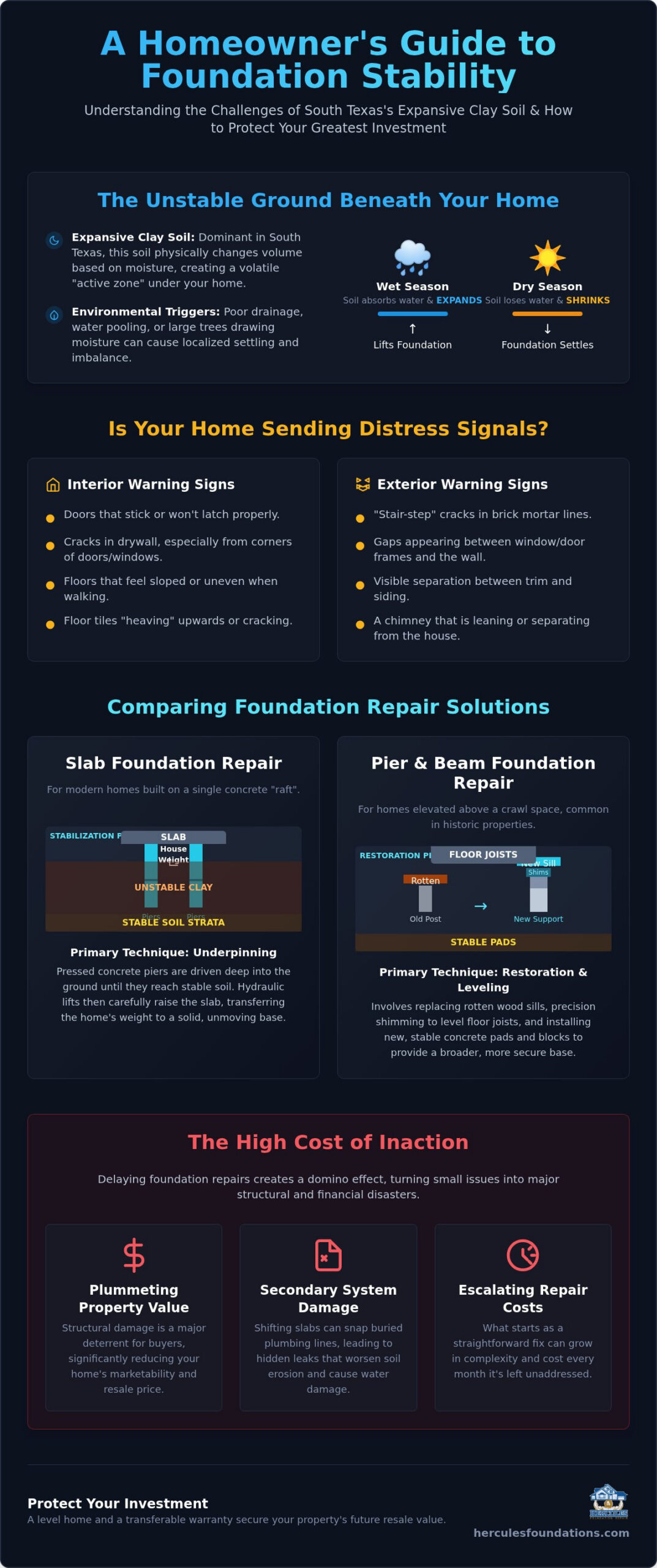
Texas soil is a force of nature. In regions like Houston and San Antonio, the ground is dominated by expansive clay, a material that physically changes volume based on moisture levels. This isn’t just a minor shift. As the soil absorbs water, it expands with enough force to lift heavy concrete slabs. Conversely, during the brutal Texas summer droughts, it shrinks away, leaving the home’s Foundation (engineering) unsupported. This cycle creates a volatile “active zone” under your home where the earth is never truly still.
Localized settling often happens when large trees pull moisture from under one side of the house or when poor drainage allows water to pool. These environmental factors make professional foundation repair services essential to restore balance. Small cracks might seem like a simple cosmetic fix, but they’re often the first indicators of a deeper structural struggle that won’t resolve itself. We’ve seen how the “Hercules” strength of a home is tested by these invisible shifts every single day.
Warning Signs Every Texas Homeowner Should Know
Your home talks to you. You just need to know how to listen. If you notice doors that suddenly stick in the frame or windows that won’t latch, the frame is likely out of square. Drywall cracks, especially those radiating from the corners of door frames, are classic red flags that the interior structure is under tension. On the exterior, look for “stair-step” cracks in the mortar between your bricks or gaps appearing between the trim and the siding. If you feel a subtle slope while walking across a room or see floor tiles “heaving” upward, your slab is actively moving and requires an expert eye. Our slab foundation repair guide for Texas homeowners can help you distinguish between minor settling cracks and serious structural warning signs that demand immediate attention.
The Long-Term Risks of Delayed Repair
Waiting to address these issues is a gamble with your biggest investment. By 2026, buyers will be even more cautious about structural integrity, making a damaged foundation a significant barrier to home resale and marketability. Beyond the value of the house, a shifting slab puts immense stress on internal systems. It can snap plumbing lines buried underneath, leading to hidden leaks that further erode the soil and worsen the problem. Structural instability creates a domino effect where every month of delay increases the complexity and cost of the eventual fix. Investing in professional foundation repair services early prevents these secondary disasters from taking root.
Comparing Slab and Pier & Beam Foundation Repair Methods
Most South Texas homes are built on either a slab-on-grade or a pier and beam foundation. Slabs are modern concrete “rafts,” while pier and beam systems elevate the structure above a crawl space. Because Expansive soils in our region cause both types to shift, the permanent solution involves a process called underpinning. This method effectively transfers the weight of your home from the unstable surface dirt down to deeper, more reliable soil strata that aren’t affected by seasonal moisture changes.
Slab Foundation Stabilization Techniques
For concrete slabs, we typically use pressed concrete piers to provide deep-earth support. These piers are driven into the ground using the weight of the house itself as leverage until they hit a point of refusal. Once the piers are secure, hydraulic lifting allows us to carefully raise the slab back toward its original level. It’s a precise operation that requires a steady, experienced hand. Localized patching or just filling cracks with grout is rarely a permanent solution because it doesn’t address the underlying soil movement. You need a system that anchors the home’s skeleton to something that won’t move, providing the long-term stability your family deserves. For a deeper look at the methods and technologies used to protect concrete slabs, our detailed slab foundation repair guide walks through every stabilization option available to Texas homeowners in 2026.
Pier and Beam Restoration and Leveling
Historic Texas homes often feature pier and beam foundations with crawl spaces. These require a specialized touch that many modern contractors overlook. Over time, wooden sills can rot from moisture, or the original support posts might settle into the soft earth. Restoration involves replacing damaged wood and using precision shimming to level the floor joists. We also install new concrete pads and blocks to provide a broader, more stable base than the original construction might have offered. A healthy crawl space also needs proper ventilation and drainage to prevent moisture buildup. Without these, even the best repairs can be undermined by wood rot and further settling over time.
Choosing between concrete and steel piers depends on your home’s weight and the depth of the stable soil layers in your specific neighborhood. While steel is often used in deep-soil scenarios, pressed concrete remains a reliable, cost-effective choice for residential foundation repair services across South Texas. If you aren’t sure which system your home uses or what method is best for your situation, our team at Hercules Foundation Repair can provide a professional evaluation to determine the best path forward for your property. We bring over 45 years of experience to every job site, ensuring your home stands on a foundation as strong as its name suggests.
Concrete Leveling: A Faster Alternative for Non-Structural Surfaces
Not every crack in your concrete requires the heavy-duty intervention of full foundation repair services. While the previous sections focused on the structural skeleton of your home, your property also relies on non-structural surfaces like driveways, patios, and walkways. When these areas sink or tilt, it’s often due to the same expansive clay soil issues, but the solution is much less invasive. Identifying when a surface needs leveling versus a full structural fix is the first step toward a safer, more attractive property.
Safety is the primary driver for many homeowners in San Antonio and Houston. A sunken section of a walkway creates a trip hazard that can lead to injuries; a sloping patio can even direct rainwater toward your home’s main slab, causing the very moisture problems we want to avoid. Professional concrete leveling restores your curb appeal instantly. It eliminates those jagged “lips” in the driveway without the dusty, loud, and expensive mess of a full demolition and repour.
The Concrete Lifting Process Explained
The beauty of modern concrete lifting lies in its simplicity and precision. Our technicians drill small access holes, often no larger than a penny, into the sunken sections of the slab. We then inject a specialized stabilizing material through these holes. As the material expands, it fills the voids created by shrinking Texas soil and gently nudges the concrete back to its original grade. We monitor the lift with extreme precision to ensure your surfaces match up perfectly with existing walkways. One of the biggest advantages is the turnaround time. Most leveled surfaces are ready for foot traffic within minutes and can support the weight of a vehicle in just a few hours.
Leveling vs. Replacement: Making the Economical Choice
Choosing to level your existing concrete is almost always the more economical path. A new concrete pour requires days of site preparation, framing, and waiting for the material to cure; it also leaves you with a driveway that doesn’t match the color of your older paths. Leveling preserves what you already have, making it a much faster investment. There’s an environmental benefit as well. By lifting your existing slabs, you keep tons of old concrete out of local landfills. Concrete leveling is a restorative process that preserves your existing surfaces rather than a destructive one that requires total removal.
If you’ve noticed your front walk is no longer flush with your porch, don’t wait for a guest to trip. While these issues are non-structural, they still benefit from the same level of expertise we bring to our primary foundation repair services. We treat every walkway and patio with the “Hercules” level of care, ensuring your entire property is as stable and level as the day it was built. Whether you’re in Victoria or Austin, a quick evaluation can determine if a simple lift is all you need to protect your home’s value and safety.
The Professional Foundation Repair Process: From Inspection to Completion
A stable home isn’t the result of luck. It’s the result of a methodical, engineered process that begins long before a single shovel hits the dirt. Understanding the steps involved in professional foundation repair services helps strip away the anxiety often associated with structural work. We treat your property with the same respect we’d show our own family’s home, ensuring every phase is transparent and precise. From the first measurement to the final cleanup, our goal is to restore the “Hercules” strength your house was meant to have.
What Happens During Your Free Structural Inspection?
The first step is a comprehensive evaluation. We don’t just walk around and look at cracks; we use high-precision altimeters to measure floor elevations throughout your entire home. This data allows us to create a topographical map of your slab’s current position. By identifying exactly where the house has dipped or heaved, we can pinpoint the root cause of the movement. Whether it’s a drainage issue or a pocket of volatile clay soil, this inspection results in a custom repair plan tailored specifically to your home’s unique footprint.
Once the plan is set, site preparation begins. Our crews work carefully to protect your landscaping, often transplanting bushes or using plywood paths to minimize the impact on your lawn. We then excavate small, strategic holes at the pier locations. After the piers are driven to stable strata and the house is carefully lifted back toward its level position, we finish the job with a thorough backfill and cleanup. We don’t consider the job done until your flower beds look as close to original as possible and the site is clear of debris.
Repair Day Logistics: What Homeowners Should Expect
Most residential projects in 2026 are completed within one to three days. While the process involves heavy machinery and can be noisy, we manage the site to minimize disruption to your daily life. You don’t usually need to move out, though you’ll hear the rhythmic sound of the pier driver and the occasional creak as the house is lifted. The final phase is the walkthrough. Together, we’ll verify that your doors now latch correctly, windows open smoothly, and the floor feels solid underfoot. If you’re ready to experience the highest standards of foundation repair services in South Texas, schedule your structural evaluation with our local experts today.
Why Hercules Foundation Repair is the Trusted Choice in South Texas
Choosing a partner for your home’s structural health is a significant decision that impacts your property’s value for decades. Since 1980, Hercules Foundation Repair has stood as a steadfast protector for homeowners across South Texas. We aren’t general handymen who dabble in a dozen different trades. We are dedicated structural experts. Our focus remains solely on providing the highest quality foundation repair services, ensuring that your home remains level and secure regardless of how the earth shifts beneath it. We believe in providing strength you can stand on.
Our approach is built on a foundation of honesty and technical mastery. We understand the stress that comes with seeing cracks in your walls, so we prioritize a pressure-free experience. You’ll never deal with aggressive upselling or “flavor of the week” technologies that haven’t been proven in Texas soil. Instead, we offer time-tested engineering and a commitment to structural integrity that has been our hallmark for over 45 years. We treat every project as a mission to preserve a family’s sanctuary.
A Legacy of Strength and Reliability Since 1980
Being a family-owned and operated business means our reputation is built into every pier we drive. We’ve seen every type of soil failure the Texas climate can produce, from record-breaking droughts to tropical deluges. This multi-generational experience allows us to identify subtle issues that younger companies might overlook. Working with a local business means you’re getting experts who are accountable to the community. We prioritize transparent communication and expert workmanship because we know our neighbors rely on us. We don’t just fix slabs; we build lasting trust through every phase of the repair.
Serving San Antonio, Austin, Houston, and Victoria
Every region in Texas presents a unique challenge. The “Houston gumbo” clay reacts differently than the rocky terrain in parts of Austin or the expansive soils in San Antonio and Victoria. Our localized teams live and work in these communities, so they understand the specific environmental stressors that affect your neighborhood. We’re committed to protecting Texas homes for the next 45 years with the same dedication we’ve shown since our founding. Your home’s value and your family’s safety are too important to leave to chance. Professional foundation repair services require a deep understanding of local geology, and that is exactly what we bring to every job site.
Schedule your professional foundation evaluation with Hercules today and take the first step toward a stable, worry-free home.
Securing Your Home’s Future and Value
Your home is likely your most significant investment. Protecting it from the volatile movements of Texas clay requires more than just a quick fix; it demands a deep understanding of local geology and engineered stability. We’ve explored how identifying early warning signs, choosing the right underpinning method, and opting for professional foundation repair services can save you from the stress of structural failure. Whether you’re dealing with a modern slab in Houston or a historic pier and beam home in Victoria, the goal remains the same: a level, secure sanctuary for your family.
Since 1980, our family has dedicated itself to providing this stability for our neighbors across San Antonio and Austin. With over 45 years of experience, we bring the Hercules strength needed to defend your property against shifting soils. Don’t let uncertainty linger while the damage compounds. Get a Professional Foundation Evaluation from Hercules today to ensure your home stands strong for generations to share. You deserve the peace of mind that comes with a truly solid foundation.
Frequently Asked Questions
How much does foundation repair typically cost in Texas?
Foundation repair costs in the Texas market vary significantly based on the severity of the structural settling and the number of piers required for stabilization. Industry data suggests that homeowners in cities like San Antonio, Austin, and Houston may see a wide range of costs depending on local soil conditions and the specific depth of the clay. Because every home’s footprint is unique, a professional evaluation is the only way to determine the specific investment needed for your property.
Will foundation repair damage my plumbing or interior walls?
Lifting a slab back to its original position can sometimes cause minor cosmetic issues like new drywall cracks or sticking doors as the frame realigns. While we take every precaution to protect your home’s integrity, the movement can also stress older plumbing lines. It’s common for homeowners to schedule a separate plumbing test after the lift is complete to ensure everything remains watertight. We focus on stabilizing the structure to prevent these issues from worsening over time.
How long does it take to complete a residential foundation repair?
Most residential foundation repair services in the San Antonio and Houston areas take between one and three days to complete. The exact duration depends on the number of piers required and the depth of the stable soil strata. While the process involves excavation and heavy machinery, our crews work efficiently to minimize the disruption to your daily routine. We prioritize a thorough cleanup phase to ensure your landscaping looks its best once the structural work is finished.
Does my homeowners insurance cover foundation repair services?
Standard homeowners insurance policies in Texas rarely cover foundation repair services caused by normal soil expansion or contraction. Coverage is typically only available if the damage resulted from a specific covered peril, such as a sudden internal plumbing leak or a fire. It’s best to review your specific policy or speak with your agent to understand your coverage limits. We recommend addressing issues early to prevent the high costs associated with secondary structural damage that insurance won’t cover.
Is it better to repair a foundation before or after a drought?
It’s generally better to address foundation issues as soon as they’re discovered rather than waiting for a specific season. Texas drought cycles cause clay soil to shrink dramatically, which can lead to rapid settlement and increased structural damage. Repairing the foundation during a dry spell allows us to stabilize the home when the soil is at its most retracted state. Waiting often leads to more expensive interior repairs and a more complex piering process later on as the house continues to sink.
Can I sell my house if it has a history of foundation repair?
You can absolutely sell a house with a history of foundation work. In fact, many buyers in the Texas market feel more confident purchasing a home that has already been professionally stabilized. The key is providing documentation of the repair and a transferable warranty. This proof of structural integrity protects the home’s market value and gives the new owners peace of mind that the building’s skeleton is supported by experienced experts who understand South Texas soil.
What is the difference between house leveling and foundation repair?
Foundation repair refers to the structural process of installing piers to support the home’s weight on stable soil. House leveling is the actual lifting of the structure back to its original, level plane after those supports are in place. While people often use the terms interchangeably, repair is the technical fix and leveling is the desired result. Our team performs both to ensure your home isn’t just supported but is also functionally straight, square, and safe for your family.
How do I know if a crack in my foundation is serious?
Hairline vertical cracks are often just a sign of concrete shrinkage and aren’t usually a structural threat. However, cracks wider than one quarter of an inch or those that follow a stair-step pattern in your brickwork are serious red flags. Horizontal cracks are particularly concerning as they often indicate high pressure from expanding soil. If you notice these signs alongside sticking doors or sloping floors, it’s time to call for a professional structural evaluation to protect your investment.