

Could a sticking door or hairline crack be a sign of foundation trouble, or just a seasonal change? In Texas, it can be hard to tell. Expansive clay soil swells when wet and shrinks during dry spells, so some movement may be expected. Look for a pattern of signs of foundation issues: one isolated change doesn’t automatically mean your foundation is damaged, but several changes appearing or worsening together deserve attention.
If you’re unsure what to make of what you see, you’re not alone. This guide covers common signs inside and outside the home, how Texas soil and weather can contribute, and what details to record as changes unfold. You’ll also learn when it makes sense to seek professional guidance. Tracking cracks, sticking doors and windows, uneven floors, and gaps can help you choose a sensible next step without jumping to conclusions.
Key Takeaways
- One crack or sticking door alone doesn’t confirm structural damage. Look for changes that appear together or worsen over time.
- Expansive clay and shifts in soil moisture may contribute to signs of foundation issues, but conditions vary by property.
- Track what you notice, where it appears, and when it changes. Photos and weather notes can help reveal a pattern.
- Persistent or progressing symptoms are a reason to seek professional foundation guidance rather than guess.
- Foundation type, observed movement, and project conditions help shape repair options.
What Are the Common Signs of Foundation Issues in a Home?
A crack, sticking door, or uneven spot by itself can’t confirm foundation damage. Homes experience everyday wear, and a single change can have more than one explanation. Pay attention to what changed, where it appears, and whether other changes show up nearby or develop over time. The types of building foundations vary, so the same observation may need different context depending on how a home is built.
Which interior changes can signal foundation movement?
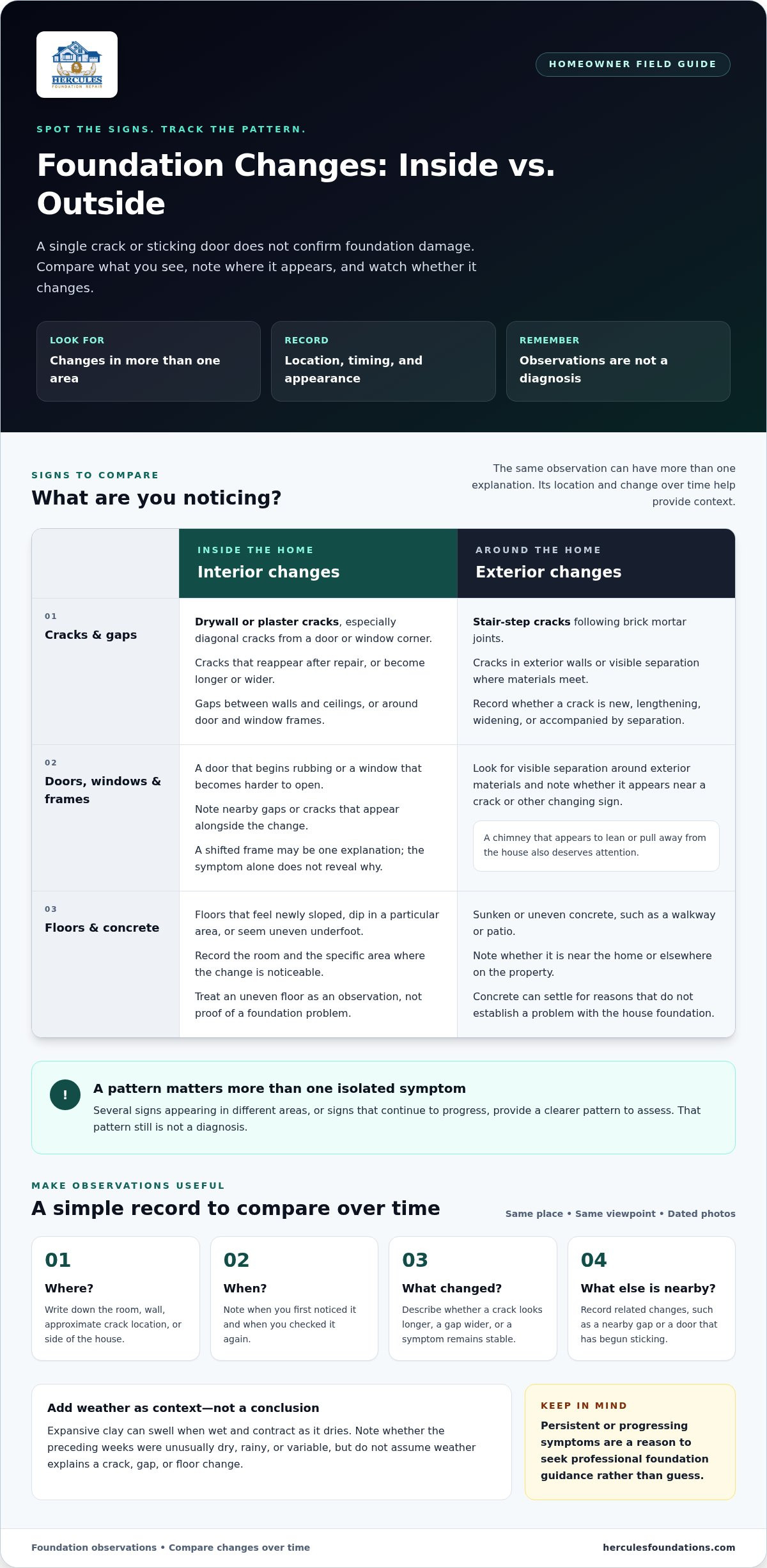
Inside, note cracks in drywall or plaster, especially if they extend diagonally from a door or window corner, reappear after repair, or become longer or wider. Gaps between walls and ceilings, or around door and window frames, are also worth tracking. A door that begins rubbing or a window that becomes harder to open may indicate a shifted frame, though the symptom alone doesn’t reveal why. Treat newly sloping or uneven floors as observations to record, not proof of a foundation problem.
What exterior signs should homeowners look for?
Walk around the home and look for stair-step cracks following brick mortar joints, cracks in exterior walls, or visible separation where materials meet. A chimney that appears to lean or pull away from the house also deserves attention. Record whether a crack is new, lengthening, widening, or accompanied by separation. A crack that looks much the same over time is different from one that visibly progresses, but appearance alone can’t provide a diagnosis. For more context on slab-related concerns, see our guide to slab foundation repair.
What floor or concrete changes are worth noting?
Notice whether floors feel newly sloped, dip in a particular area, or seem uneven underfoot. Outside, look for sunken or uneven concrete, such as a walkway or patio, and note whether it is near the home or elsewhere on the property. A concrete surface can settle for reasons that don’t establish a problem with the house foundation. Record its location and any changes so it can be considered in the broader picture.
Make observations specific. Instead of writing “the wall is cracked,” note the room, wall, approximate crack location, and whether it has changed since you first saw it. Take a dated photo from the same position when you check again. Record related details, such as a nearby gap or a door that has also begun sticking.
A cluster of changing signs deserves more attention than one isolated symptom because it gives a clearer pattern to assess. That pattern still isn’t a diagnosis. It is useful information to share when seeking foundation guidance, particularly if changes appear in more than one area or continue to progress.
How Can Texas Soil and Weather Affect Foundation Warning Signs?
Soil and weather can help explain why foundation observations change, but they don’t identify the cause on their own. Expansive clay absorbs water and swells, then contracts as it dries. If the soil around a home changes volume unevenly, it may contribute to movement near the foundation. The effect depends on the property, foundation, and local conditions, so a weather change alone isn’t proof of damage.
Why can clay soil matter for South Texas foundations?
Some clay soils respond noticeably to changing moisture levels. That response can matter beneath or beside a home, but soil isn’t uniform from one property to the next. Conditions in San Antonio, Austin, Houston, and Victoria can differ, and even nearby homes may sit on different ground. A city or neighborhood can’t diagnose a particular house. Use local soil as context for what you observe, not as a conclusion.
Foundation design and construction are shaped by applicable building requirements. The International Code Council’s overview of the International Residential Code provides background on residential building codes for foundations. Texas doesn’t have one statewide residential building code; municipalities adopt and amend codes locally. That broader context still can’t tell you what is happening beneath an individual property.
How should homeowners interpret wet and dry periods?
Use weather as a timeline. A long dry spell followed by rainfall, or a period of consistently wet conditions, may help you understand when a visible change appeared. Timing doesn’t prove that moisture caused a crack, gap, or floor change. Note whether the observation stays stable, seems different after weather shifts, or continues to change regardless of conditions.
A simple record can make those patterns easier to discuss:
- Write down when you first noticed a change and when you checked it again.
- Note whether the preceding weeks were unusually dry, rainy, or variable, without assuming weather explains the symptom.
- Record the exact location, such as a particular room, exterior wall, or side of the house.
- Describe what changed, including whether a crack appears longer or a gap looks wider.
Use the same viewpoint for comparison photos where possible. A dated picture can help distinguish a lasting change from an impression that’s difficult to recall later. Keep separate notes for different areas, too. If a door sticks after a dry period while a nearby crack remains unchanged, that’s different information from several changes progressing together. Signs of foundation issues are most useful when considered alongside their timing and location, rather than attributed to one season.
For persistent changes, Hercules Foundation Repair provides foundation repair for homeowners and commercial property owners in San Antonio, Austin, Houston, and Victoria. Learn about Hercules Foundation Repair’s foundation services. Keep your notes handy so the conversation can focus on what you’ve observed, rather than guesswork about weather alone.
When Do Foundation Symptoms Look Like a Pattern Rather Than an Isolated Issue?
A single crack that looks unchanged over time is different from several changes that appear or progress together. A crack by itself may have more than one possible explanation. If it widens while nearby doors begin sticking and a floor feels newly uneven, the combination gives you a clearer reason to pay attention and seek guidance. It still doesn’t confirm foundation damage. The purpose of tracking signs of foundation issues is to describe what’s changing, not diagnose the cause yourself.
Which combinations of signs deserve closer attention?
Look across the home rather than focusing on one mark. A widening crack in one room, a new gap near a frame elsewhere, and a door that no longer closes as it did are separate observations that may provide useful context together. Note whether they began around the same time or are progressing independently. An assessment can determine whether they share an underlying cause or need follow-up.
This simple record can help organize what you see:
| Observation | What to record | Why follow-up may be useful |
|---|---|---|
| Crack appears longer or wider | Location, approximate length, date, and comparison with an earlier photo | A visible change is more informative than presence alone. |
| Door or window begins sticking | Which opening, what changed, and whether it continues | It helps show whether a change is isolated or occurring alongside other symptoms. |
| Floor feels uneven in a new area | Room, approximate location, and when you first noticed it | Its location can be considered with changes elsewhere in the home. |
| Several symptoms appear in different areas | Each location and the sequence in which changes appeared | A group of observations gives more context for professional evaluation. |
What does a changing crack or gap tell you?
It tells you to document a change, not what caused it. Crack appearance alone can’t establish the cause, severity, or whether repair is needed. Record the location and approximate length, then take photos from a consistent angle and distance so later images are easier to compare. Don’t rely on memory or treat a particular width as a universal threshold for concern.
Describe stable and changing observations differently. If a crack appears much the same when you check it, note that. If it becomes visibly longer or wider, or another change appears nearby, record that too. Use dates rather than guesses about how long it has been present. A sequence of photos and notes can explain the pattern clearly without turning it into a diagnosis.
Several signs changing together deserve closer attention, but only a professional assessment can determine whether they point to foundation movement. If you notice a developing cluster, bring your observations forward for guidance rather than assuming every crack means structural trouble.
What Should You Do After Noticing Possible Foundation Issues?
Start with clear observations, not a repair decision. An online symptom list can help you notice changes, but it can’t show what’s happening beneath your home or identify the right response. Don’t cut, brace, lift, or otherwise alter structural components based on a symptom description. A measured record gives you more useful information to share if changes persist.
How can you document signs without attempting a diagnosis?
Keep a simple log and label what you see, not what you think caused it. For example, write “new diagonal crack above the bedroom doorway” rather than “foundation is sinking.” Add the date, location, and relevant weather context, then take a photo from a consistent angle and distance. This makes later comparisons more useful.
For each observation, record:
- Where it appears, such as a specific room, wall, doorway, or exterior side of the home.
- What you can see or feel, including whether a crack, gap, or uneven area looks different.
- When you first noticed it and the dates you checked it again.
- Whether a nearby door or window has also begun to stick or change.
- Recent weather context, such as a dry spell or a period of rainfall, without assuming it explains the change.
Compare photos taken from the same viewpoint, but don’t treat small visual differences as a measurement or diagnosis. If a door sticks, describe when and where it catches. Separating direct observations from assumptions keeps the record accurate and gives a foundation professional a clearer picture of the changes you’ve noticed.
When is it sensible to seek professional foundation guidance?
Seek professional guidance when changes persist, visibly progress, or appear together in different parts of the home. A crack that seems stable is different from one changing alongside a new gap or a floor that feels uneven. These signs of foundation issues don’t confirm a cause, but a developing pattern is a sensible reason to ask for an informed assessment.
Give prompt attention to sudden, substantial changes, particularly if they affect the safe use of a part of your home. Don’t wait for a symptom checklist if you have an immediate safety concern. First keep people away from an area that may be unsafe, then seek appropriate professional guidance.
Bring your notes and dated photographs to the conversation. Hercules Foundation Repair provides residential and commercial foundation repair, including slab and pier-and-beam foundation work. Discuss your observations with Hercules Foundation Repair to consider a next step based on the changes you’ve documented.
How Can Foundation Repair Address Signs of Structural Movement?
Not every visible crack or uneven surface calls for the same response. Repair selection depends on the foundation type, the movement observed, and the conditions of the project. The goal is to understand the pattern first, then match the work to the issue rather than treating every symptom as a repair plan. Hercules Foundation Repair provides residential and commercial foundation repair, including structural stabilization, slab repair, and pier-and-beam repair.
How do repair needs differ for slab and pier-and-beam foundations?
A slab foundation is a concrete base, while a pier-and-beam system supports the structure above a crawl space using piers and beams. Because these systems are built differently, their repair needs depend on what’s happening and where movement is observed. Hercules Foundation Repair works on both types. For more background on slab-specific concerns, explore the Texas slab foundation repair guide.
Even within one foundation type, the right scope can vary. A crack’s appearance alone doesn’t show whether the structure has moved, what contributed to it, or which work is appropriate. A considered repair decision takes account of the broader observations and foundation system, rather than relying on a single sign. Treat signs of foundation issues as information to assess, not an automatic instruction to install a particular repair.
When is concrete leveling relevant to uneven surfaces?
Concrete leveling addresses sunken or uneven concrete surfaces, such as a walkway or other slab on the property. It’s distinct from repairing the home’s structural foundation. An uneven outdoor surface doesn’t by itself establish that the house foundation has moved, and leveling that surface isn’t the same as structural stabilization. The concrete leveling options guide offers a focused look at surface-level approaches.
Keeping the distinction clear helps direct the discussion. If the concern is a sunken concrete surface, concrete leveling may be relevant. If observations involve movement in the house structure, foundation repair may need consideration. A property can have more than one concern, but each should be understood on its own merits. A professional assessment can help determine what the observed changes mean and whether work is appropriate.
Hercules Foundation Repair is a family-owned company serving South Texas for over 45 years, with residential and commercial foundation expertise. Sharing what you’ve noticed can start a practical discussion about the next step, without assuming a diagnosis from one symptom. Discuss your foundation concerns with Hercules Foundation Repair.
Take the Next Step With Confidence
Noticing signs of foundation issues doesn’t mean you need to decide on a repair by yourself. Your notes and photos can turn uncertainty into a clearer conversation about what’s changing and what deserves attention. Keep your observations factual, and let a professional assessment guide decisions about the structure and suitable next steps.
If changes persist or several concerns develop together, bring the details you’ve recorded to a team experienced in residential and commercial foundation repair. Hercules Foundation Repair also provides concrete leveling for uneven or sinking concrete surfaces, a separate consideration from structural foundation work.
Talk with Hercules Foundation Repair about your foundation concerns and discuss a practical next step.
Frequently Asked Questions
Can foundation issues exist without visible cracks?
Yes. A foundation concern may not show up as a visible crack. You might instead notice that a floor feels different underfoot, a door no longer latches smoothly, or a gap appears where materials meet. These signs of foundation issues can have other explanations, so treat them as reasons to pay attention rather than proof. If changes persist or occur together, record them and seek professional guidance.
Are foundation cracks always a sign of structural damage?
No. Cracks can develop for different reasons, including ordinary material changes, and their appearance alone can’t confirm structural damage. A fine line in a finish, for example, doesn’t tell you what is happening beneath the home. Note where the crack is, what material it crosses, and whether it changes. A qualified assessment can consider that information alongside the building and other observations.
Can foundation problems affect doors and windows?
They can. If movement affects the surrounding frame, a door may rub against its jamb or a window may become difficult to open. But sticking can also result from changes in the door, hardware, or frame that aren’t related to the foundation. Note which opening is affected and whether other areas show changes too. A single stubborn window doesn’t establish a structural cause.
Do foundation issues get worse during drought?
Dry conditions can reduce moisture in some soils, and moisture shifts may contribute to soil movement near a foundation. That doesn’t mean drought automatically causes damage or explains a particular symptom. Soil and site conditions differ across San Antonio, Austin, Houston, and Victoria, and from property to property. If a change coincides with a dry period, note the timing as context, then consider it alongside the symptom’s progression.
Can a new home develop foundation issues?
Yes. A home’s age alone can’t rule out foundation movement. New construction still sits on a specific site with its own soil and drainage conditions, and building materials can also change as a home settles into use. This doesn’t mean a new home has a defect. If you notice a new or progressing change, document it and review any builder or warranty records before seeking appropriate guidance.
What happens if possible foundation issues are ignored?
If structural movement is present and continues, it may affect other building elements over time, such as interior finishes, openings, or connected surfaces. The outcome depends on the cause and conditions, so it can’t be predicted from one symptom. Ignoring a change also makes it harder to establish when it began. Keep a record and seek guidance if observations persist, progress, or appear together.
Is it safe to stay in a home with signs of foundation movement?
Routine observations, such as a small crack or a door that sticks, don’t by themselves establish that a home is unsafe. Sudden, substantial changes are different, especially if they affect a ceiling, wall, floor, or the safe use of an area. If you believe there’s immediate danger, leave the affected area and contact emergency services. For less urgent concerns, arrange professional guidance and describe what has changed.