
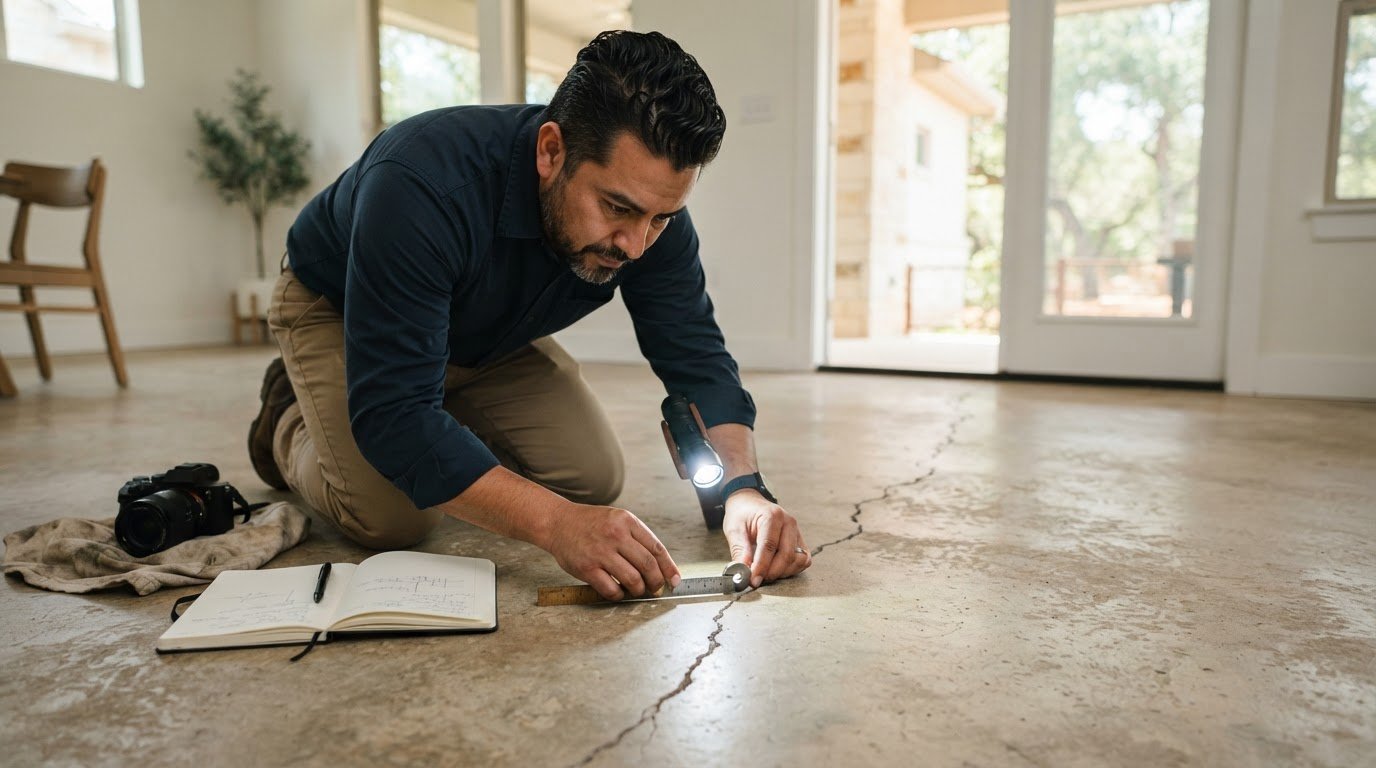
Could a thin line in your concrete be harmless shrinkage, or an early sign of movement? Cracks in foundation slab can look similar at first, but their pattern and changes over time offer more useful clues than appearance alone.
It’s understandable to worry when you spot a crack, especially in Texas, where clay soil can swell when wet and shrink during dry weather. A single crack doesn’t automatically mean your home has a structural problem. Its direction and location, whether it changes, and other signs around the house can help put it in context.
This guide explains what common crack patterns may indicate, what to record as you monitor a crack, and when a professional assessment can help clarify whether the slab may be moving. Take dated photos, note the crack’s location, and watch for changes such as uneven floors or doors that begin to stick. These observations can help you take a measured next step instead of guessing from the crack alone.
Key Takeaways
- Cracks in foundation slab can have different causes, and a visible crack alone doesn’t confirm structural failure.
- Use the crack’s location and pattern as clues, not as a diagnosis on their own.
- Watch for widening, displacement, or repeated changes that may warrant closer professional assessment.
- Build a useful record with dated photos, the crack’s location, and notes about visible changes over time.
- Slab foundation repair differs from concrete leveling, which addresses uneven or sinking concrete surfaces.
What Cracks in a Foundation Slab Can, and Cannot, Tell You
A foundation slab is a concrete base that supports a building. A crack is a visible break or line in the concrete, but seeing one doesn’t automatically mean the slab has failed or that the home is unsafe. Concrete can crack for several reasons, and the line alone doesn’t reveal whether the cause is ordinary drying, changing ground conditions, or movement that deserves closer attention.
A crack is evidence to observe, not a diagnosis by itself. Consider how concrete behaves as it cures, the conditions around the home, and whether other signs suggest a broader change. An overview of Concrete Slab Foundations can explain how slabs are built, but general information can’t determine what caused a particular crack in your home.
Why concrete slabs can crack as they cure
As freshly placed concrete dries and hardens, it loses moisture and contracts slightly. This shrinkage can produce small cracks, even when a crack doesn’t point to a structural problem. That’s one reason not to treat every visible line as urgent. There isn’t a universal width rule that identifies the cause, either. Appearance alone can’t show what’s happening below the surface or whether the crack is changing. During new construction, builders focus heavily on proper site preparation and curing to minimize these issues; homeowners planning a ground-up build can review specialists such as otbxcustombuilders.com to see how foundation and structural standards are managed from the start.
Why local soil and weather belong in the context
Ground conditions matter because soil moisture changes with rainfall, dry spells, and drainage. Some soils expand as they absorb water and shrink as they dry, which may affect support beneath a slab. South Texas properties don’t all share the same soil or drainage conditions, so a crack’s location isn’t proof of expansive-soil movement. Local context helps frame the question, but it doesn’t settle the answer.
These factors are possible explanations, not a checklist that confirms a cause. A small crack could relate to curing, while a crack in a home with changing ground conditions may call for a closer look. Neither conclusion follows from a single photograph or quick glance. Consider the evidence together: the concrete around the crack, whether the surfaces appear offset, and whether the line changes over time.
This measured approach helps avoid two common mistakes: assuming every crack means serious damage, or dismissing one without noticing signs of movement. Start by observing rather than altering the area. The next sections explain how pattern and location add context, what changes deserve attention, and how to keep a useful record for a professional assessment. Hercules Foundation Repair serves South Texas, including San Antonio, Austin, Houston, and Victoria, and brings regional experience to slab foundation concerns without treating location alone as a diagnosis.
Read the Crack Pattern, Location, and Possible Cause
Where a crack appears helps organize what you observe, but location alone can’t explain its cause. A line across the slab’s interior, one near an outside edge, and damage at a corner describe different situations. Look at the concrete around the crack, too. Is the surface even, or do the sides appear offset? Record what you see rather than trying to diagnose it from a single feature.
Crack location becomes more useful when considered alongside change over time. A stable pattern differs from one that widens, shifts, or appears with other changes. Interpret these clues together.
Surface cracks, perimeter cracks, and corner damage
A surface crack may run across the interior of the slab, while a perimeter crack appears near an outside edge. Some slabs have a thicker perimeter beam, so a crack in that area needs context rather than an automatic severity label. At a corner, look for a chipped or broken section and note whether the surrounding concrete remains level. Observe from a safe position. Don’t chip, pry, or dig at the area.
A crack is not the same as displacement. If one side appears higher than the other, or the concrete looks uneven near the line, record that separately. An uneven or sinking concrete surface raises a different question from a crack alone, and the appropriate assessment depends on the conditions present. The American Concrete Institute (ACI) Guidelines offer technical resources on concrete, but general information can’t determine what’s happening at a specific home.
What crack direction may suggest, and what it cannot prove
A mostly vertical line, a diagonal crack, or branching lines can each provide useful information about the pattern. They don’t identify one cause on their own. Shrinkage, settlement, and soil movement can produce different crack contexts, and similar-looking lines may have different explanations. Direction is one observation to record, not a diagnosis.
For a clearer picture, note these details together:
- Whether the crack is on the slab surface, near its edge, or at a corner.
- Whether the line is straight, diagonal, branching, or irregular.
- Whether the concrete appears level on both sides or shows visible displacement.
- Whether you’ve noticed changes over time or seasonal shifts in moisture around the property.
In South Texas, soil and drainage conditions vary from property to property. Seasonal moisture changes may affect the ground beneath a slab, so a professional may consider local conditions alongside the crack pattern and its progression. A crack near an edge doesn’t prove that soil movement caused it.
If your observations suggest possible movement, a professional assessment can help put the pattern in context. Hercules Foundation Repair’s slab foundation experience can help homeowners understand what visible signs may mean and whether slab repair or another approach fits the concern.
When a Slab Crack Deserves Closer Attention
A crack that looks unchanged is different from one that appears to be widening, developing an offset, or changing in repeated observations. That difference doesn’t diagnose the slab, but it can show whether the condition appears stable or is changing. A hairline crack may remain visually consistent, while a changing crack gives a professional more reason to assess the slab and surrounding conditions.
There’s no universal width or time cutoff that tells every homeowner when a crack needs attention. Don’t rely on a single photo or memory of how it looked weeks ago. Compare consistent observations and note what has changed. Don’t try to force the crack wider or press tools into it to measure it.
Stable appearance versus visible change
Progression is often more informative than one glance. Take photos from the same position, include the date, and use a fixed nearby feature as a visual reference. Note visible differences in length, width, or alignment without assuming the cause. If the crack appears to change more than once, or the concrete on either side looks offset, arrange a closer professional assessment rather than judging urgency by a width rule.
Other observations that can add useful context
Look at the details around the crack. Does nearby flooring seem uneven? Has a finish beside the crack separated or changed? Does a nearby door bind when it didn’t before? Each detail has possible explanations beyond slab movement, so none is proof on its own. Together, they give an assessor a fuller picture of what you’ve noticed and where changes are occurring.
Use a simple dated list to keep observations distinct:
- Appearance: Does the crack look consistent, or has its visible shape changed?
- Alignment: Do the concrete surfaces appear level, or is there an observable offset?
- Nearby conditions: Have you noticed localized unevenness in flooring, a changed finish, or a nearby door that now binds?
- Progression: What does each dated photo show compared with the previous one?
This framework helps organize cracks in foundation slab, but a list of observations cannot replace an on-site assessment. Photos show surface changes; they can’t fully reveal the slab’s condition or establish why a change occurred. A foundation professional, such as Crown Leveling Inc., can consider the crack, the surrounding area, and your dated observations together.
Repeated widening or visible displacement deserves closer attention, especially when it appears alongside nearby changes. That doesn’t mean a serious problem is certain. It means the evidence is worth evaluating in context, so your next step is based on the slab and surrounding area rather than one alarming-looking line.
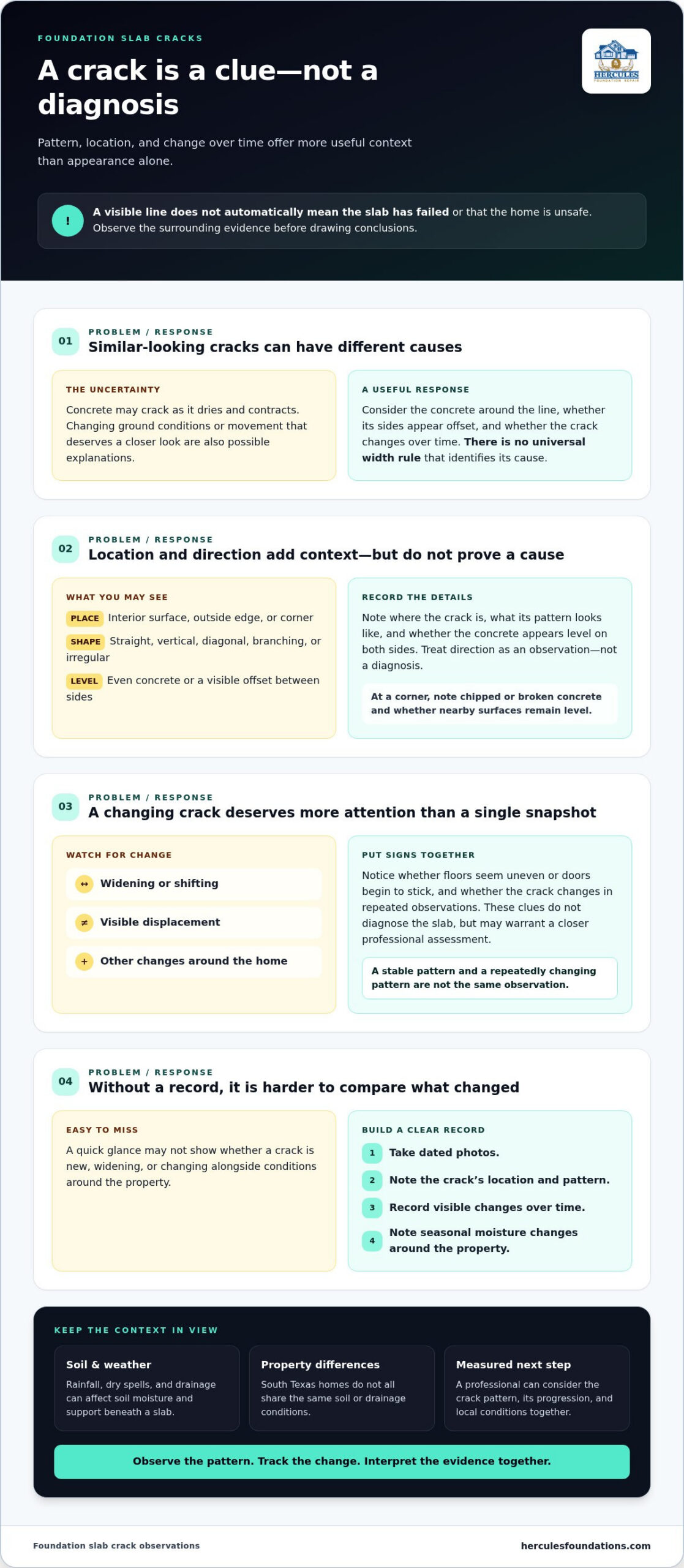
How to Document a Crack in Your Foundation Slab
A simple record makes changes easier to describe and helps a professional understand what you’ve observed. Keep it factual: capture the crack’s appearance, location, and any nearby conditions that change. You don’t need to decide whether the crack is structural before documenting it. Consistent notes are more useful than a confident guess.
Create a clear photo and observation record
Use the same basic sequence each time. A broad view shows where the crack sits in the room or slab; a closer photo shows its path and visible edges. Choose a fixed feature, such as a wall corner or floor joint, to frame later photos from a similar angle. Don’t mark, widen, or otherwise disturb the crack to create a reference point.
- Photograph the area: Take a well-lit overview, then a closer image that captures the crack’s direction and nearby concrete.
- Add the date: Save the date with each photo or write it in a log so you can compare images in order.
- Describe the location: Use a consistent label, such as “living room, beside the interior wall,” and note whether the crack is near an edge or corner.
- Record visible changes: Note what you can see, such as a longer line, a visible offset, or no apparent change. Avoid labeling it as structural damage.
- Add nearby context: Note relevant changes in floor level, finishes, or nearby door operation, along with known moisture or drainage changes around the property.
Keep each entry brief and specific. For example: “Photo from the same doorway; crack appears longer toward the floor joint; no visible height difference.” If you can’t tell whether it changed, write that rather than estimating from memory. This keeps the record dependable and leaves interpretation to a professional assessment.
Avoid quick fixes that hide useful evidence
Covering or sealing a crack before documenting it can make later visual comparison harder. A cosmetic fill may change the surface appearance, but it doesn’t establish why the crack formed or resolve an underlying structural cause. Don’t treat a quick patch as proof that the slab is stable. First preserve a clear record of what’s visible, then seek an assessment if the crack is changing or other observations raise concern.
Your notes and photos can make a conversation about cracks in foundation slab more focused. For broader context on how assessment and repair fit together, explore the slab foundation repair guide. If your observations suggest possible movement, request a slab foundation assessment from Hercules Foundation Repair to discuss the visible conditions and appropriate next steps.
How Hercules Foundation Repair Assesses and Addresses Slab Cracks
A crack is one part of the picture. Hercules Foundation Repair considers its location and pattern, whether it has visibly changed, and the surrounding slab conditions when assessing a concern. Dated photos and notes help show what you’ve observed, but images alone can’t establish the crack’s cause or confirm whether the slab has a structural issue. A professional assessment brings those details together with conditions at the property.
From recorded observations to a professional assessment
Bring your photos and notes, including where the crack appears and what has changed since you first noticed it. This gives the assessment a useful point of reference. The goal is to understand the visible condition in context, not to diagnose from a photograph or assume every crack needs the same response.
Local context matters, too. Hercules serves homeowners in San Antonio, Austin, Houston, and Victoria, communities with varied soil and drainage conditions. Regional experience can inform the questions considered, but it doesn’t mean every property has the same ground conditions or that a crack has the same cause. Observations at the individual home guide the assessment.
Match the repair approach to the observed condition
If an assessment identifies a concern about foundation stability, structural foundation repair addresses it. Concrete leveling serves a different purpose: it addresses uneven or sinking concrete surfaces. It isn’t a solution for every crack in a foundation slab, and a visible crack alone doesn’t establish that leveling is appropriate. The right approach depends on what the slab is doing, not just what the surface looks like.
If the main issue is an uneven or sinking concrete surface, Hercules’ concrete leveling service addresses that separate concern. An assessment helps determine whether the observed issue points toward structural slab repair, concrete leveling, or a different conclusion based on the conditions present.
Hercules Foundation Repair is family-owned and has served South Texas for over 45 years. That experience provides regional perspective, while each property still calls for an individual assessment. If your dated observations show possible movement or repeated change, request a professional slab assessment to discuss the visible conditions and a measured next step.
Take the Next Step With Confidence
You don’t have to determine the cause of cracks in foundation slab on your own before asking for help. Share what you’ve noticed and get an informed perspective on whether the slab may need attention. A clear conversation can replace guesswork with a better understanding of the conditions at your property.
If you’re unsure what your observations mean, or you’ve noticed a change that concerns you, talk with Hercules Foundation Repair about your slab concerns. A professional assessment can help clarify whether the issue calls for structural attention, relates to uneven concrete, or needs a different response. The goal is a measured decision based on the actual condition, not alarm over a single line in the concrete.
Talk with Hercules Foundation Repair about your slab concerns and take a steady, informed step toward protecting your home.
Frequently Asked Questions
Are hairline cracks in a foundation slab normal?
Hairline cracks can form as concrete dries and cures, so their presence alone doesn’t establish a structural problem. A fine line in a newer slab that remains unchanged is different from one accompanied by visible shifting or other changes. There’s no single width that identifies the cause in every home. If you’re unsure, keep a record and consider the full condition of the slab.
Can Texas weather cause cracks in a concrete foundation slab?
Weather can influence ground moisture, which may affect soil beneath a slab, but weather alone doesn’t prove why a crack formed. Alternating dry spells and rainfall can create changing moisture conditions, while drainage around the home also matters. Conditions can differ between San Antonio, Austin, Houston, and Victoria, and from one property to the next. Consider the local context, but don’t assume it explains a particular crack without assessment.
How can I tell if a foundation slab crack is getting worse?
Look for a clear difference between dated observations, such as a longer line, a gap that appears wider, or a change in the concrete’s alignment. Use the same camera position and lighting where possible, and keep photos in date order. If images don’t make a change clear, describe what you’ve noticed to a professional. Don’t rely on memory or a single snapshot to decide what’s happening.
What happens if I seal a crack in my foundation slab?
Sealing may cover the visible line, but it doesn’t show whether the underlying cause has been addressed. A filled crack can also make later visual comparisons less clear, particularly if you haven’t photographed it first. Before applying a product, document the crack and note any visible movement or nearby changes. If the slab appears displaced or the crack is changing, seek an assessment rather than treating a surface fill as proof of stability.
Can a crack in the garage slab indicate a foundation problem?
It can be a reason to look more closely, but a garage-floor crack doesn’t automatically mean the home’s foundation is affected. The garage floor may relate to the home’s foundation differently depending on how the structure was built. Note whether the crack is near the connection to the home, whether the surfaces appear offset, and whether there are nearby changes. A professional can assess those details in context.
Is a foundation slab crack covered by homeowners insurance?
Coverage depends on the policy, the circumstances behind the damage, and the insurer’s review. Don’t assume every crack is covered or excluded based on its appearance. Check your policy language and ask your insurer how to report the issue and what documentation it needs. Keep dated photos, records of when you first noticed the crack, and any assessment or repair documents. These details can support a clear claim discussion.
Do slab cracks affect a home’s resale or inspection?
A visible crack may lead to questions during a sale or inspection, especially if there’s evidence of movement or related damage. Keep records of when you noticed it, any professional assessment, and work completed. An inspection report can document visible conditions, while a foundation assessment may address slab concerns in greater depth. Clear documentation helps explain what you observed and what steps, if any, were taken.