

Leveling can improve a home’s position, but it can’t guarantee the ground beneath it will never shift again. If you’re wondering how long for house to settle after leveling, it’s reasonable to watch for changes and feel concerned when a crack appears or a door starts sticking. Some minor adjustment may happen, but there isn’t one timeline that applies to every home.
What happens next depends on why the house moved, the repair performed, and conditions below the foundation, including changes in soil moisture. A new symptom doesn’t automatically mean the repair failed, but movement that’s new, worsening, or recurring deserves attention. It’s also important to distinguish concrete lifting from movement in the home’s structural foundation, since they aren’t the same issue.
This article explains what post-leveling stability can and can’t tell you, which conditions may influence further movement, and how to track changes over time. You’ll learn what to document and when to request a professional evaluation, so you can respond with useful information instead of guessing.
Key Takeaways
- There’s no universal answer to how long for house to settle after leveling; completing the lift and achieving lasting stability are different things.
- The original cause of movement, soil conditions, drainage, and foundation type can influence what happens next.
- Compare stable conditions with new or worsening changes, while remembering that one symptom alone can’t confirm foundation movement.
- Use a consistent observation routine to track changes, and keep repair records and project-specific follow-up guidance together.
- Continuing or worsening movement may warrant a professional evaluation of the foundation and contributing conditions.
How Long Does a House Take to Settle After Leveling?
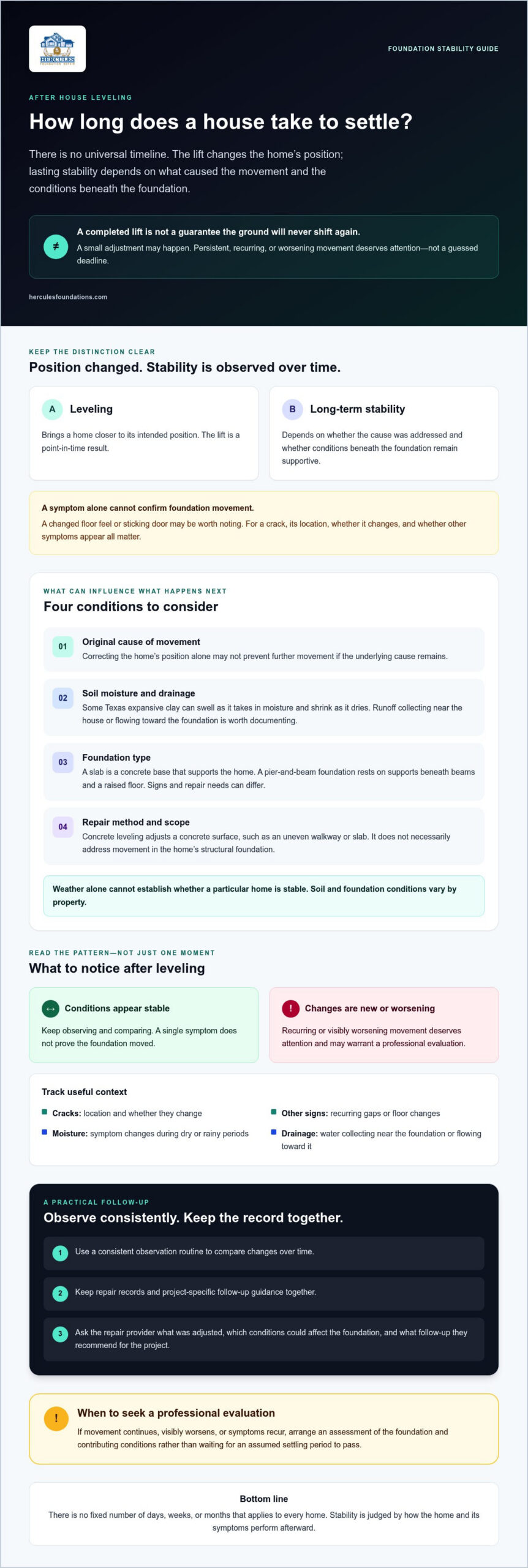
There’s no single reliable settling period for every leveled house. The work may bring a home closer to its intended position, but that doesn’t determine how the foundation will perform over time. A small adjustment after the lift can occur; persistent or worsening movement needs a professional assessment, not a guessed deadline.
Leveling changes a home’s position; long-term stability depends on whether the cause of movement has been addressed and conditions beneath the foundation remain supportive. This distinction helps answer “how long for house to settle after leveling” without promising that every repair follows the same schedule.
What does settling after house leveling actually mean?
Structural settlement is downward movement of a building as the ground or supporting elements shift. It differs from a minor adjustment as a raised structure takes its new position. Structural settlement can vary across a building. Uneven movement, sometimes called differential settlement, may affect the structure differently from uniform movement.
A floor that feels different or a door that sticks doesn’t, by itself, prove the foundation has moved. But don’t dismiss a new crack as routine. Its location, whether it changes, and whether other symptoms appear all matter.
Why is there no universal post-leveling timeline?
Expectations depend on the foundation type, the leveling method, and what caused the original movement. Lifting a concrete slab and adjusting supports beneath a pier-and-beam home involve different structural conditions. If the underlying cause remains, correcting the home’s position alone may not prevent further movement.
Soil moisture is another factor. In Texas, periods of dry weather and heavy rainfall can change moisture conditions in the ground, which may contribute to soil movement. The effect varies by site and foundation, so weather alone can’t establish whether a particular home is stable.
A fixed number of days, weeks, or months can therefore be misleading. The lift is a point-in-time result; stability is judged by how the home and its symptoms perform afterward. Ask the repair provider what was adjusted, which conditions could affect the foundation, and what follow-up they recommend for your project. If movement continues or visibly worsens, arrange an assessment rather than waiting for an assumed settling period to pass.
What Affects How Stable a House Is After Leveling?
Leveling corrects a home’s position, but lasting stability depends on what caused the movement and whether that cause is still active. Soil conditions, drainage, foundation type, and the repair approach all shape what happens afterward. These factors explain why “how long for house to settle after leveling” doesn’t have one answer for every property.
How soil moisture and drainage influence movement
Some Texas soils contain expansive clay, which can swell as it takes in moisture and shrink as it dries. Those changes may affect the support beneath a foundation, though soil conditions vary by property. Runoff that repeatedly collects near the home or drains toward the foundation is worth documenting and discussing with a professional. Moisture and drainage matter because changing soil conditions can affect the support a foundation relies on.
| Condition | Possible effect | What to observe |
|---|---|---|
| Soil moisture changes | Ground may expand or shrink, potentially affecting support. | Note whether symptoms change alongside dry or rainy periods. |
| Runoff near the house | Repeated wetting in one area may contribute to changing ground conditions. | Watch for water collecting near the foundation or flowing toward it. |
| Unresolved original cause | Movement may continue even after the home’s position is corrected. | Record recurring or worsening cracks, gaps, or floor changes. |
Why foundation type and repair method matter
A slab foundation is a concrete base that supports the home, while a pier-and-beam foundation rests on supports beneath beams and a raised floor. Because the structures differ, the signs of movement and the work needed to address it can differ too. The original cause matters as much as the foundation type: correcting the position may not resolve ongoing soil or drainage conditions.
Concrete leveling and structural foundation repair address different concerns. Concrete leveling adjusts a concrete surface, such as an uneven walkway or slab. It doesn’t necessarily address movement in the home’s structural foundation. If the house itself appears to be shifting, an evaluation can help clarify whether the concern is surface-level concrete or structural movement before next steps are considered.
Keep notes about visible changes and where water collects, but don’t treat observations as a diagnosis. A professional assessment can consider the foundation, repair history, symptoms, and site conditions together. If you need help distinguishing a concrete concern from a foundation concern, foundation repair and concrete leveling are relevant services to ask about.
Is Movement After House Leveling Normal or a Sign of a Problem?
A single sticking door or hairline crack can’t tell you whether a foundation has moved. Doors and finishes can be affected by factors beyond the foundation. Look for patterns instead: are symptoms stable, or are they recurring, spreading, or appearing alongside other changes? That distinction is more useful than trying to label one sign “normal.”
Conditions that remain unchanged are generally less concerning than changes that keep progressing, but only a professional can assess what they mean for a specific home. Also distinguish a lifted concrete surface from the house’s structure. An uneven walkway or other concrete surface may call for concrete leveling; new or worsening movement affecting the home may warrant a foundation assessment. The work and the underlying concern aren’t necessarily the same.
Which changes should a homeowner document?
Keep a simple record rather than relying on memory. Note when you first spot a change, where it is, and whether it looks different later. Take photos from similar angles and distances so you can compare the same area over time. Document a crack before patching or repainting it, since covering it can make its progression harder to track.
- Cracks: Record the location and date, and note any visible change in length or width.
- Doors and windows: Write down which ones stick, when it happens, and whether the issue returns after seeming to improve.
- Other changes: Note new gaps, uneven areas, or symptoms that appear together, along with observations such as water collecting near the home.
These notes can help explain what you’ve observed, but they don’t diagnose the cause. The question of how long for house to settle after leveling can’t be answered from one symptom alone; the pattern and repair history matter.
When should movement prompt a professional review?
Contact the contractor who completed the work with questions about the repair, its records, or the follow-up recommended for that project. If several changes appear together, a crack visibly worsens, or recurring symptoms continue, ask a qualified foundation professional to assess the concern. Share dated photos and notes, and explain whether the issue affects the home’s structure or an exterior concrete surface. This gives the professional useful context without asking you to diagnose the problem yourself.
How to Monitor Your House After Leveling
A simple record can help you see whether a change is stable or progressing and give your contractor clearer details if you have questions. Keep observations non-invasive: you’re tracking visible conditions, not testing or diagnosing the foundation yourself. There’s no need to set an arbitrary deadline for deciding whether the home has settled.
A practical post-leveling observation routine
Choose a few consistent places to check, such as a previously visible crack, a door that used to stick, or an area of flooring that felt uneven. Photograph each location from a similar angle and distance, and add the date and a brief note. For cracks, record where they are and whether their visible length or width appears to change. Note recurring door or window issues without assuming they prove foundation movement.
- Compare the same areas in each set of photos rather than relying on memory.
- Write down when symptoms return or appear alongside other visible changes.
- Note where rainwater collects, where runoff flows, or when you observe a notable change in moisture around the home.
These observations can help explain what you’ve seen, but they can’t confirm the cause. Don’t make structural adjustments based on photos or notes alone. For slab-specific context, see this slab foundation repair guide.
Questions to ask your foundation contractor
Project details matter more than a generic expectation about how long for house to settle after leveling. Ask the contractor what the completed work was intended to correct and which contributing conditions, if any, were outside its scope. Clarify which changes should prompt follow-up for your particular repair, and ask whether the project has recommended check-ins.
Keep available project records, including the repair description and any notes or measurements provided. Ask what documentation is available and have any stated follow-up terms explained clearly. If you contact the contractor later, share dated photos and observation notes so they can understand what has changed since the work was completed.
If you’re unsure whether a concern involves a concrete surface or the home’s structural foundation, a professional can help clarify what should be evaluated. Ask Hercules Foundation Repair about foundation or concrete concerns and what information may help assess them.
When to Call a Foundation Professional After House Leveling
Consider requesting a professional assessment if changes keep getting worse, return repeatedly, or appear in several areas of the home. A widening crack alongside new gaps or persistent door and window issues gives more reason to seek follow-up than one symptom in isolation. These signs don’t prove the foundation has moved, but they are useful reasons to have the concern evaluated rather than rely on a general answer to “how long for house to settle after leveling.”
A useful evaluation considers the foundation type, the repair already completed, the symptoms you’ve observed, and conditions around the home that may contribute to movement. It should also clarify whether the concern involves the home’s structural foundation or a separate concrete surface. Those issues can look similar to a homeowner but may call for different next steps.
What to prepare before requesting an evaluation
Bring the information you’ve gathered so the professional can understand the changes and repair history. Clear records are more helpful than trying to interpret the symptoms yourself.
- Gather available repair documents, dated photos, and a short timeline of what changed and when.
- Note whether the home has a slab or pier-and-beam foundation, or whether the concern is an exterior concrete surface.
- Describe observed drainage or moisture changes, such as runoff collecting near the home, without assuming they caused the symptoms.
How a local foundation contractor can help
A foundation contractor can consider whether the reported concerns may relate to structural foundation movement or another condition, and explain what further steps may be appropriate. No assessment can promise a particular outcome based on a symptom alone. The goal is to replace guesswork with a clearer understanding of the home and its repair history.
Hercules Foundation Repair is family-owned and operated, has served South Texas for over 45 years, and provides foundation repair and concrete leveling. The company serves homeowners in San Antonio, Austin, Houston, and Victoria. If you’re in one of these areas and continuing changes have you concerned, you can contact Hercules Foundation Repair to discuss foundation repair or concrete leveling needs and ask about appropriate next steps.
Use Clear Signs to Guide Your Next Step
There’s no universal timeline for how long for house to settle after leveling. The lift may be complete, but lasting stability depends on the original cause of movement, the foundation, and conditions around the home. A single sticking door or crack doesn’t confirm a problem; recurring or worsening changes deserve closer attention.
Keep dated photos and notes, and hold on to your repair records. Share what you’ve observed with a professional who can consider the foundation, symptoms, and contributing conditions. Clarify whether the concern involves structural foundation movement or a separate concrete surface, since the two may call for different services.
Hercules Foundation Repair is family-owned and operated, has served South Texas for over 45 years, and provides foundation repair and concrete leveling. If you have concerns about your home, contact Hercules Foundation Repair to discuss your foundation or concrete leveling concerns. Clear information can help you take a steadier, more confident next step.
Frequently Asked Questions
How long does it take a house to settle after leveling?
There’s no reliable timeline that applies to every home after leveling. The lift may be complete, but long-term stability depends on the foundation type, the original cause of movement, and conditions in the soil. Small adjustments may occur, but ongoing or worsening movement shouldn’t be dismissed as routine settling. Keep dated notes and photos, and ask the contractor what follow-up makes sense for your specific repair.
Is it normal for a house to move after foundation leveling?
A minor adjustment may occur after leveling, but repeated or worsening movement deserves attention. One sticking door or a single crack doesn’t prove the foundation has shifted, since other factors can cause those symptoms. Look for changes that recur, grow, or appear alongside other signs, such as new gaps or uneven flooring. Document what you see and ask a foundation professional to assess the pattern rather than trying to diagnose it yourself.
Can a house settle more after it has been leveled?
Yes, a house can continue to move after leveling if the original cause wasn’t fully addressed or if conditions beneath the foundation change. Soil moisture fluctuations, drainage patterns, and the foundation’s condition can all be relevant. Leveling corrects position, but that alone can’t establish how the home will perform over time. If movement continues or becomes more noticeable, gather your repair records and request professional follow-up.
What happens if cracks appear after house leveling?
A new crack doesn’t automatically mean the repair failed, but don’t assume it’s harmless either. Note where it appears and when you first see it, then take dated photos from a consistent angle to track visible changes. A crack that grows or appears with other symptoms, such as new gaps or recurring door problems, warrants professional attention. Share your records with the contractor or a foundation professional for context.
How can I tell if my foundation is still settling?
You can watch for patterns, but visible symptoms alone can’t confirm foundation movement. Track whether cracks change, doors or windows repeatedly stick, floors feel increasingly uneven, or gaps appear in more than one area. Photograph comparable locations and record dates so you can describe the progression accurately. If several changes appear together or worsen, have a professional consider the foundation, repair history, symptoms, and site conditions.
Does concrete leveling stop a house foundation from settling?
No, concrete leveling addresses uneven concrete surfaces and doesn’t necessarily correct movement in a home’s structural foundation. A lifted walkway or other concrete slab is different from the foundation supporting the house. If the home itself shows signs of movement, it needs an assessment focused on the foundation and possible contributing conditions. Clarifying which structure is affected helps determine whether concrete leveling or foundation repair is relevant.
Should I contact my contractor if my house changes after leveling?
Yes, contact the original contractor if changes continue, worsen, or raise questions about the completed work. Share dated photos, repair records, and a brief timeline, and ask which symptoms should prompt follow-up for your project. If you’re in San Antonio, Austin, Houston, or Victoria, Hercules Foundation Repair provides foundation repair and concrete leveling. A professional can help clarify whether your concern involves the home’s foundation or a separate concrete surface.