The fastest-looking fix isn’t always the right one for an uneven warehouse floor. A raised joint, settled slab, or recurring forklift jolt may point to different underlying issues. Choosing warehouse floor leveling San Antonio without understanding how the slab has moved can mean unnecessary work or more disruption than the facility needs.
It’s reasonable to want a durable repair that keeps equipment moving and stored goods protected. First, pinpoint where the floor has shifted, how uneven areas affect daily traffic, and whether settlement may be connected to San Antonio’s expansive clay soil.
This guide explains what to look for, how to compare repair approaches, and how to plan around forklifts, pallet jacks, racking, and operating schedules. You’ll also learn when commercial concrete leveling may be a practical option and when broader foundation concerns deserve attention. Hercules Foundation Repair is a family-owned business serving South Texas for over 45 years, with commercial foundation repair and concrete leveling experience to help inform a project-focused next step.
Key Takeaways
- Map floor changes and note where they affect equipment movement, foot traffic, or material handling.
- Look beyond the concrete surface: support conditions, moisture changes, and construction conditions can help explain settlement.
- Compare localized leveling, joint-focused work, and broader slab or foundation repair based on the movement pattern and repair objective.
- Plan warehouse floor leveling San Antonio around operating hours, traffic routes, equipment access, inventory, and restricted work zones.
- Hercules Foundation Repair brings over 45 years of South Texas experience to commercial foundation repair and concrete leveling projects.
Warehouse Floor Leveling in San Antonio: How Uneven Slabs Affect Operations
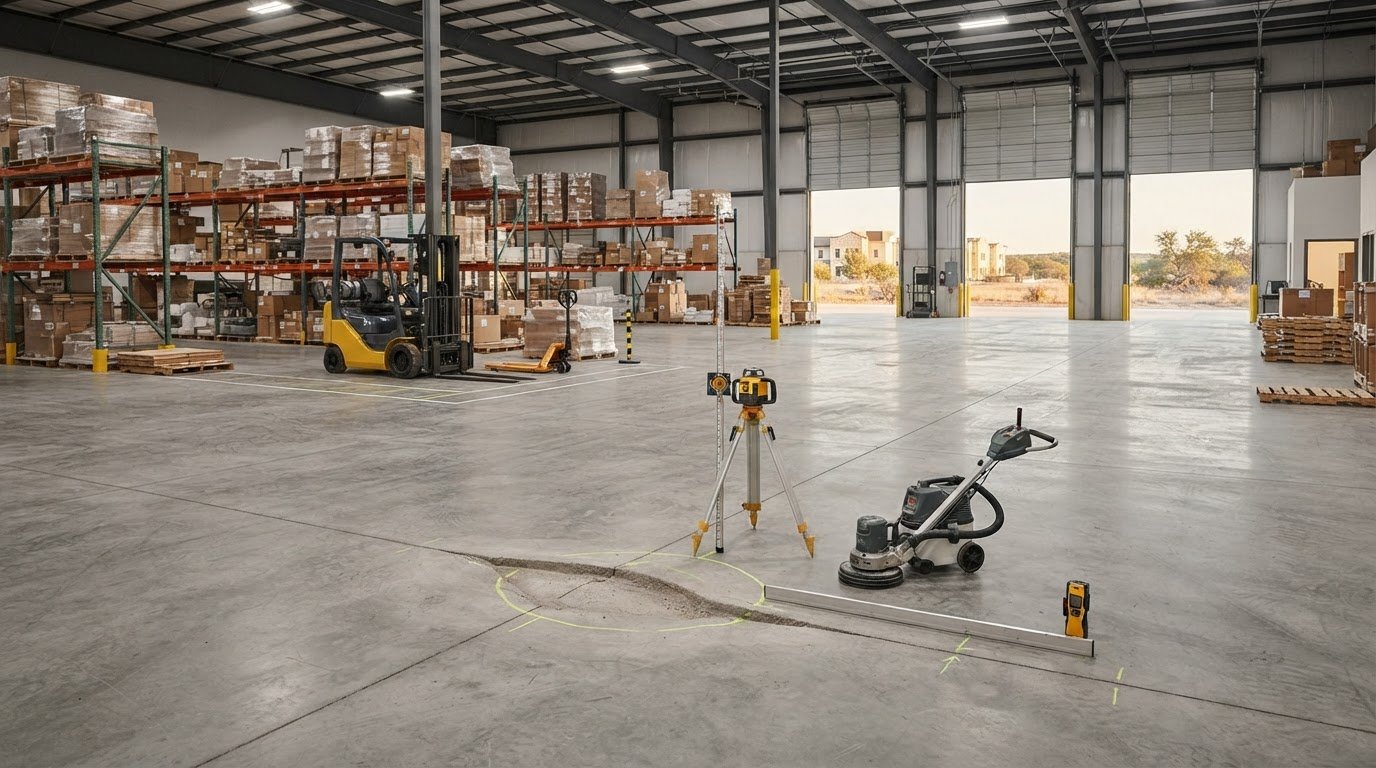
A slab that rocks under a passing forklift, a sudden height change across an aisle, or a crack that keeps widening deserves attention. So do uneven transitions at loading areas and joints that seem to shift when pallet jacks or loaded carts cross them. Even a small trouble spot can interrupt routine movement.
In a warehouse, trouble spots matter because people and equipment follow repeated routes. A raised edge in a main aisle may affect every shift, while a low area near a loading door may complicate goods transfer. A rough transition beside a work area can slow cart movement or require staff to adjust how they move materials. Mapping each affected location and its use helps clarify which issues deserve priority.
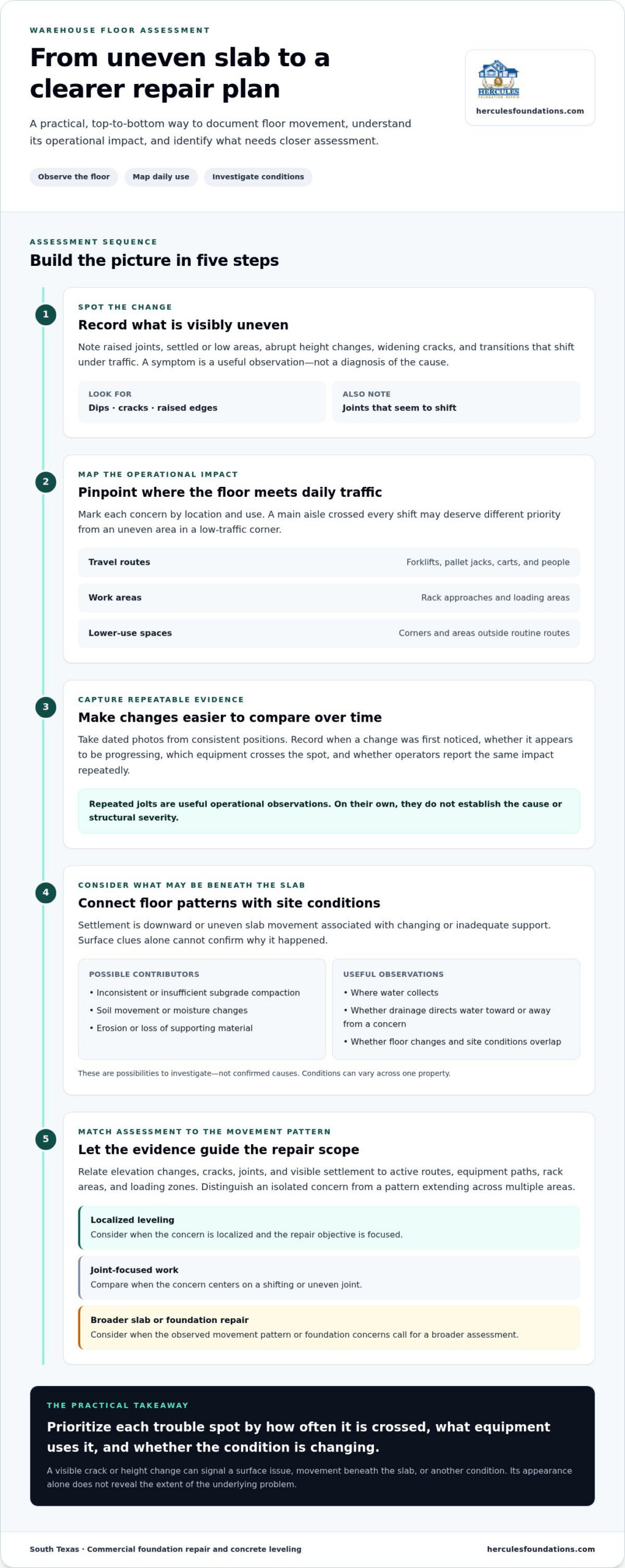
Start by recording what’s visible and where it occurs. Note whether the symptom is on a travel route, at a rack approach, near a loading area, or in a low-traffic corner. Dated photos taken from consistent positions can help show whether the condition changes. Repeated jolts or impacts are useful operational observations, but they don’t establish the cause or structural severity on their own.
Which warehouse floor symptoms deserve attention?
Watch for recurring slab movement, abrupt level changes, and joints that seem to shift under traffic. Record which equipment crosses the area, whether operators report the same impact repeatedly, and whether the condition changes over time. This creates a clearer picture than a general note that “the floor is uneven” and helps distinguish an isolated location from a pattern affecting connected routes.
For warehouse floor leveling San Antonio, separate what operators experience from what the symptoms may mean structurally. A visible crack or uneven joint can signal a surface issue, movement beneath the slab, or another condition. Its appearance alone doesn’t show how extensive the underlying problem is.
Why does uneven concrete matter beyond appearance?
Changes in floor level can affect how smoothly forklifts, pallet jacks, carts, and people move through a space. Operators may need to slow down or adjust routes around a rough joint. Repeated impacts may also matter to facility managers monitoring equipment movement and work continuity. These are reasons to document and assess the area, not proof that a particular injury or equipment failure will occur.
In general, structural settlement describes movement involving a structure and its support. The concept can help frame questions about a warehouse slab, but cracks and height changes alone don’t identify the cause. A focused assessment considers the location, extent, and pattern of movement alongside how the facility uses the floor.
Floor irregularities can turn a small area of concrete into a recurring interruption along a busy warehouse route. Prioritize locations by how often they’re crossed, what equipment uses them, and whether the observed condition is changing. That practical record helps guide the next step without assuming every uneven spot calls for the same repair scope.
What Causes Warehouse Floor Settlement in San Antonio?
Settlement is downward or uneven slab movement associated with changing or inadequate support beneath the concrete. A warehouse floor can show a dip, a height difference across a joint, or a developing crack, but those surface clues don’t reveal the cause on their own. Support conditions below the slab, how the concrete was built, and how the site has changed over time all matter.
Possible contributors include insufficient or inconsistent subgrade compaction, soil movement, erosion or loss of supporting material, and construction conditions that left support uneven. Moisture changes may also affect soil beneath a slab. Rainfall, dry periods, and drainage patterns can be relevant to a particular site, but none should be treated as the confirmed cause without evidence. Conditions can vary across one property, so a general description of San Antonio weather or soil can’t diagnose an individual warehouse.
How can soil and moisture affect a warehouse slab?
Soil can respond to changes in moisture, which may alter how evenly it supports concrete. If support shifts or becomes inconsistent, part of a slab may move differently from an adjacent area. Water movement around a building may also be worth noting, especially where drainage appears to direct water toward or away from a problem area. These are possibilities to investigate, not conclusions to draw from a crack or dip alone.
Keep observations specific: note where water collects, where the floor looks different, and whether the areas overlap. Don’t assume a dry spell, a storm, or a drainage feature caused the movement simply because it occurred nearby in time. Establishing a cause requires looking at the floor pattern and site conditions together.
What should a floor assessment examine?
A useful assessment relates floor observations to the warehouse itself. Map elevation changes, cracks, joints, and visible settlement patterns, then mark active routes, equipment paths, rack areas, loading zones, and other spaces where floor condition affects daily work. This helps distinguish a localized concern from a pattern that extends across multiple areas.
Record when changes were first noticed and whether they appear to be progressing. Compare dated photos and notes rather than relying on memory. Include relevant site observations, such as recurring water accumulation, while keeping those separate from confirmed causes. OSHA’s warehousing hazards guidance discusses whole-body vibration associated with uneven floors for powered industrial truck operators, underscoring why affected routes matter as well as the slab itself.
For related background on slab behavior and repair concepts, review this slab foundation repair guide. A well-documented assessment can help determine whether warehouse floor leveling San Antonio is an appropriate scope or whether broader slab or foundation concerns need attention. Hercules Foundation Repair provides commercial foundation repair and concrete leveling in San Antonio. Visit Hercules Foundation Repair to discuss the floor conditions at your facility.
Compare Warehouse Floor Leveling and Other Slab Repair Scopes
The right repair scope depends on what has moved, how much of the floor is affected, and what the facility needs the area to do. A localized low spot, a troublesome joint, and movement across a larger slab area can look similar during daily operations, but they may call for different objectives. The comparison below is a planning guide, not a diagnosis. Site conditions and professional assessment determine which scope fits.
| Repair scope | Observed movement and affected area | Support and facility considerations | Primary objective |
|---|---|---|---|
| Localized concrete leveling | A limited section appears low or uneven compared with adjacent concrete. | Consider the condition beneath that area and whether it sits on a key forklift route, work zone, or loading path. | Address an uneven slab area where leveling suits the site conditions. |
| Joint-focused repair | A slab edge or joint is the main concern, such as a transition that changes under traffic. | Review how the joint behaves, the neighboring slab sections, and the equipment that repeatedly crosses it. | Focus the repair scope on the joint or transition rather than treating the whole floor as one problem. |
| Broader slab or foundation repair | Movement, cracking, or level changes extend across a wider area or appear in a related pattern. | Assess slab support and potential structural concerns alongside warehouse layout and use. | Address a broader contributing condition when evidence points beyond a surface-level concern. |
When might localized concrete leveling fit the problem?
Localized leveling may be worth assessing when an uneven area is the primary observed concern and the surrounding slab doesn’t show a broader pattern of movement. The size of the affected area and the support beneath it still matter. The floor’s role matters, too: a small uneven patch on a heavily used route may deserve closer attention than a similar area outside active operations. Explore a broader concrete leveling options guide to understand how approaches can differ.
When should the repair scope look beyond the surface?
Consider a wider evaluation when unevenness appears in several connected areas, changes over time, or occurs alongside a pattern of cracks or slab movement. These signs don’t prove a structural problem, but they can justify examining support and stability before defining the repair. Surface correction and addressing an underlying condition are different objectives, so the proposed scope should explain which concern it is intended to address.
Matching repair scope to the cause helps keep the plan focused on the condition affecting the facility. For warehouse floor leveling San Antonio, commercial concrete leveling can be considered alongside broader foundation concerns. Not every uneven slab needs the same response. Hercules Foundation Repair provides commercial foundation repair and concrete leveling in San Antonio. Explore commercial concrete leveling for your warehouse.
Plan Warehouse Floor Leveling Around San Antonio Facility Operations
A sound project plan connects the floor condition to the way your warehouse runs. Before work is scheduled, gather information that helps define the affected areas, then coordinate access, inventory, and traffic so the proposed scope can be reviewed against operating needs. Work sequencing and potential disruption depend on site conditions and repair scope, so don’t assume a fixed timeline before those details are understood.
What information helps define the project scope?
Start with a clear record of what’s happening, where it’s happening, and how it affects daily activity. A facility map with marked locations makes it easier to compare observations with routes and work zones.
- Map the floor concerns. Mark affected slabs, joints, cracks, and changes in level. Add dated notes or photos when conditions appear to change.
- Gather operator observations. Record recurring impacts, where they occur, and which equipment or tasks are affected. Keep reported symptoms distinct from assumptions about their cause.
- Describe facility use. Note forklift and pallet-jack routes, cart traffic, loading activity, operating hours, and periods when access is especially important.
- Share useful site information. Provide relevant layout plans and prior repair records if available. Include access restrictions and areas where inventory or equipment limits movement.
This preparation gives the project discussion a practical basis. It relates the proposed work area to the routes and tasks that depend on it, rather than viewing the slab in isolation.
How can a warehouse prepare for repair work?
Before work is planned, identify inventory, equipment, and routes that may need temporary coordination. Consider how materials can be moved around a restricted zone, whether nearby work areas will remain accessible, and who needs to know about the proposed boundaries. These are planning questions, not promises about how much a facility can keep operating during the project.
- 5. Identify operational constraints. Outline operating windows, essential routes, equipment access, inventory locations, and any restricted work zones.
- 6. Review the proposed scope. Confirm which locations are included, what areas may need to be cleared or controlled, and how the work sequence relates to warehouse activity.
- 7. Align safety planning. Review applicable workplace safety requirements for the facility and consult current OSHA guidance where relevant. Don’t rely on outdated summaries or assume one set of controls fits every site.
For warehouse floor leveling San Antonio, a clear scope should identify the affected areas and reflect how the facility uses them. Develop the work plan and access arrangements around site conditions, without assuming zero downtime, a fixed duration, or immediate return to traffic. Discuss your warehouse floor project with the team.
Choose Hercules for Warehouse Floor Leveling in San Antonio
An uneven warehouse floor can raise practical questions quickly: Is the concern limited to one slab area, does a joint need attention, or could broader foundation movement be involved? Hercules Foundation Repair helps San Antonio facilities work through those questions with commercial foundation repair and concrete leveling. The family-owned and operated business has served South Texas for over 45 years.
The goal is to connect what’s happening on the floor with a repair scope suited to the site, rather than assume every low spot calls for the same response. That means considering the affected slab and relevant site conditions alongside how the facility uses the space. Forklift paths, pallet-jack routes, loading zones, and other operational needs help put floor concerns in context.
What does a Hercules Foundation Repair commercial concrete leveling evaluation consider?
A project-focused evaluation considers the affected concrete and conditions relevant to its movement. The location and extent of uneven areas, nearby cracks or joints, and how the floor relates to the surrounding slab can help determine whether concrete leveling is appropriate or whether broader foundation repair should be considered.
Warehouse use matters, too. An area on a frequent equipment route may have different operational importance from a similar area away from active work. Sharing how operators use the space, which equipment crosses the affected locations, and what access constraints apply gives the project discussion a clearer, facility-specific basis.
No single visible symptom determines the repair scope. The recommendation should reflect observed floor conditions and the needs of the building, without assuming a particular repair method or promising a specific result. Hercules Foundation Repair provides commercial foundation repair and concrete leveling for commercial projects with a considered, site-focused approach.
What is the next step for a San Antonio warehouse?
Start with a concise summary of the affected areas and what facility staff have observed. A marked-up floor plan, dated photos, or notes about recurring issues can help describe the concern. Include which routes or work activities are affected, the equipment involved, and any access or operating constraints that could shape project planning.
Use that information to discuss the floor condition and clarify what the proposed scope is intended to address. The appropriate repair plan is tailored to project conditions, including observed slab movement and the facility’s use of the space. A clear understanding of both can help facility leaders compare the proposed work with operational priorities and determine a practical path forward.
If uneven concrete is affecting warehouse operations, discuss the affected areas and your facility’s needs with Hercules Foundation Repair. Discuss warehouse floor leveling in San Antonio and the repair scope that fits your project.
Turn Floor Concerns Into a Clear Next Step
A warehouse floor plan can do more than mark problem areas. Use it to decide which locations need attention first and align facility leaders around the operational impact. Note areas that affect essential routes, identify what staff have observed, and keep the information together so the project discussion starts with shared facts rather than assumptions.
That preparation also keeps the decision focused. The goal isn’t simply to make the floor look even, but to understand which repair scope fits the observed conditions and the way your facility works. For warehouse floor leveling San Antonio, a practical discussion about affected slabs, equipment, and access needs can help turn uncertainty into a plan.
Hercules Foundation Repair brings commercial foundation repair and concrete leveling experience to warehouse projects in San Antonio. Share what your team has noticed and discuss a practical next step with a South Texas family-owned business serving the region for over 45 years.
Discuss your San Antonio warehouse floor leveling needs. A clear starting point can make the path forward easier to manage.
Frequently Asked Questions
How much does warehouse floor leveling cost in San Antonio?
There isn’t one standard price for warehouse floor leveling in San Antonio. The project scope depends on the affected area and its condition. A localized slab concern differs from work involving multiple sections or broader foundation issues. To discuss your facility’s needs, gather a map of affected locations, photos, and notes about operating constraints. That information helps frame a project-specific discussion without relying on a generic per-square-foot figure.
How long does warehouse floor leveling take?
The schedule depends on the size and condition of the affected areas, the repair scope, and access within the facility. A single isolated area and work spanning several active routes involve different planning needs. Before setting internal expectations, discuss which zones may be restricted, how inventory or equipment could affect access, and what steps determine when an area can return to use. Don’t assume a fixed duration without a scope tailored to the site.
Can warehouse floor leveling fix cracks as well as uneven slabs?
Leveling may address uneven concrete, but it doesn’t automatically resolve every crack. A crack could be a surface issue or a sign of movement that needs a different repair scope. For example, if a crack crosses a slab near a height change, the relationship between the two conditions matters. Consider the crack pattern and uneven area together so the proposed work addresses the observed concern rather than appearance alone.
Is warehouse floor leveling suitable for every concrete slab?
No. The appropriate approach depends on the slab’s condition, the support beneath it, and what the area must accommodate. A slab with isolated unevenness differs from one with extensive deterioration or signs of broader movement. Warehouse floor leveling San Antonio projects should be planned around site conditions and facility use, not selected from a general description. A site-focused assessment helps determine whether leveling fits the problem or a broader repair scope is warranted.
What causes warehouse concrete floors to sink or become uneven?
Unevenness can develop when support beneath the concrete changes or is inadequate. Possible contributors include inconsistent soil compaction, moisture-related soil movement, erosion, or construction conditions. For instance, a low area near a drainage path may prompt questions about water movement, but proximity alone doesn’t prove the cause. The pattern across the slab and relevant site history help guide assessment. Similar symptoms can have different explanations, so avoid choosing a repair based on appearance alone.
Can warehouse floor repairs be planned around business operations?
Project planning can account for operational needs, but the work sequence and possible disruption depend on site conditions and repair scope. Identify high-priority routes, equipment access, inventory that may need moving, and areas that could be temporarily restricted. A facility in San Antonio, Austin, Houston, or Victoria can use this information to discuss practical coordination for its site. Don’t assume a repair can happen without downtime or that every area can reopen immediately.
What information should I prepare before requesting a warehouse floor evaluation?
Prepare a floor plan marked with affected locations, plus dated photos if available. Note when each issue appeared, whether it has changed, and what operators observe as equipment crosses the area. Include equipment types, traffic patterns, operating windows, access limits, and relevant prior repair records. You don’t need to diagnose the cause first. Clear observations help focus the discussion on the slab condition and how it affects your facility’s day-to-day work.