A concrete lift can often be completed in hours, not days: most residential mudjacking jobs take a few hours. For homeowners comparing slabjacking contractors in Houston, the timeline depends on the lifting method, the slab’s size and condition, and the work required beneath it.
It’s reasonable to want a clear idea of how long your driveway, walkway, pool deck, or business entrance may be out of use. Lifting settled concrete differs from pouring a replacement slab, and the method affects both the work process and when you can use the area again.
This guide explains how mudjacking compares with polyurethane foam lifting and concrete replacement, what can affect the schedule, and how residential and commercial foundation repairs differ. You’ll have a practical framework for understanding the work and deciding what may suit your property.
Key Takeaways
- Learn how concrete lifting, slabjacking, and mudjacking relate, and which areas around a home may benefit from leveling.
- Most residential mudjacking jobs take a few hours, while the method and scope of work shape the overall timeline.
- Understand how soil conditions and slab damage can help determine whether lifting or concrete replacement is the better fit.
- See how repair planning differs for homes and commercial properties, including ways to limit disruption to business operations.
Is concrete lifting the same as slab lifting or mudjacking?
These terms describe related ways to raise settled concrete, but they can refer to different methods. Mudjacking raises a sunken slab by pumping cement-based slurry through small holes beneath it. The injected material fills voids below the slab and supports it as it moves toward level. In everyday use, “concrete lifting” is the broad term, while “mudjacking” refers to a specific injection method.
The same basic approach can apply to residential flatwork and larger paved areas. A driveway may settle near the garage entrance, while a sidewalk or walkway can develop an uneven joint and a trip hazard. Patio and garage slabs can also sink when they lose support beneath the concrete. Lifting raises the settled slab itself, but it doesn’t necessarily repair every crack or underlying soil issue.
- Driveways and parking lots: Mudjacking can lift drive lanes and larger paved areas by filling voids beneath settled slabs.
- Sidewalks and walkways: Raising a sunken panel can reduce abrupt height changes along a pedestrian route.
- Patios and garages: Leveling can address uneven sections that affect how the surface meets adjoining concrete.
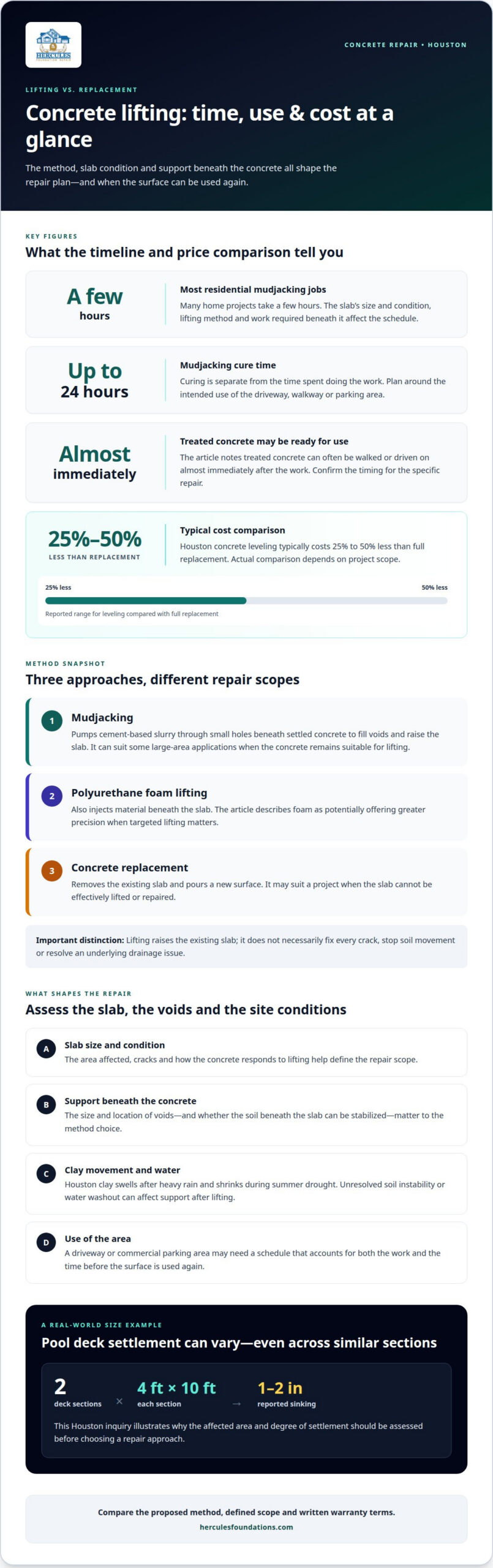
- Pool decks: A Houston inquiry described two deck sections, each 4 feet by 10 feet, with areas sunk by 1 or 2 inches.
- Stairs: Where a concrete stair landing or adjoining slab has settled, the difference in elevation helps define the repair area.
Pool decks show why the affected area matters: two slabs of the same dimensions can settle in different ways. Mudjacking can also be used for sidewalks, drive lanes, and plaza areas, where voids beneath broad slabs can lead to uneven surfaces. An assessment can help distinguish localized settlement from movement affecting a larger slab system.
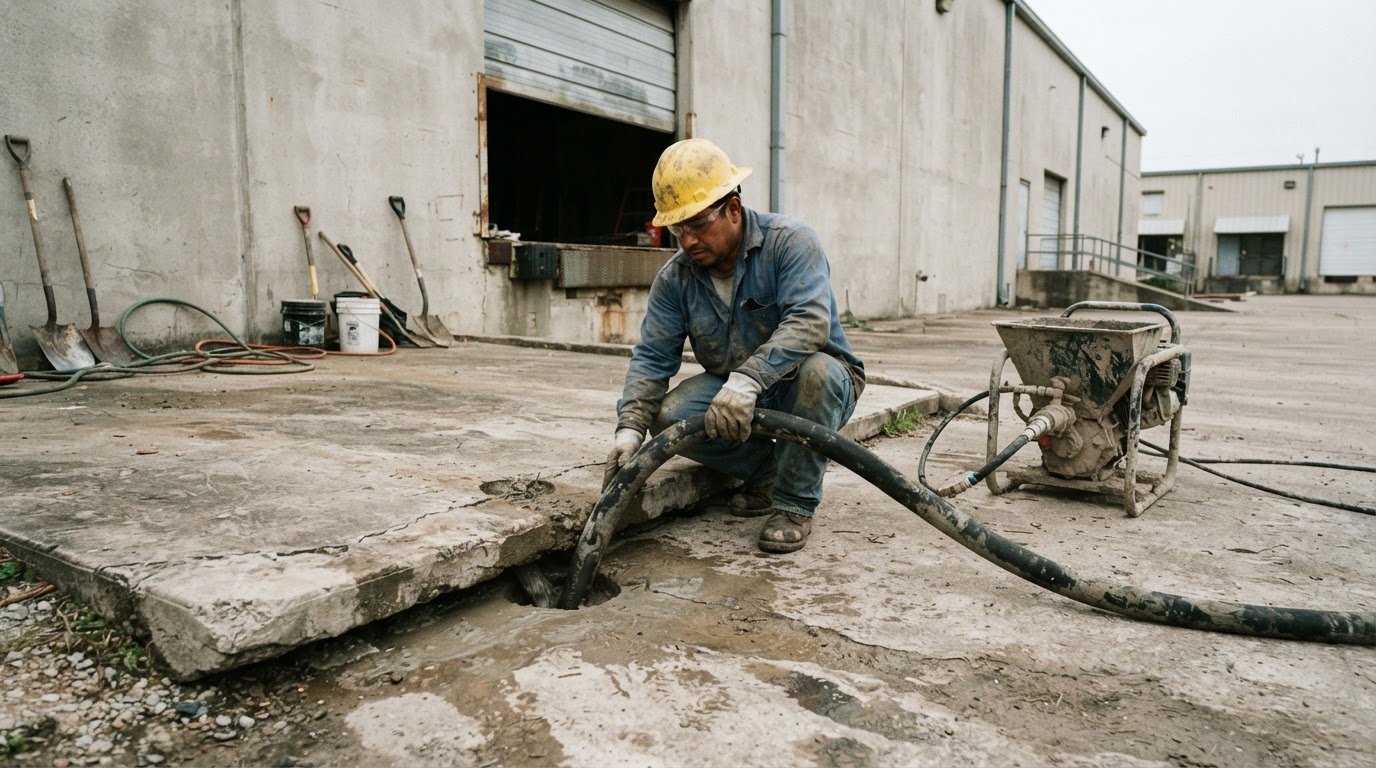
Most residential mudjacking jobs take a few hours. The work involves controlled injection beneath the slab, with the amount and placement guided by how the concrete responds as it is lifted. Unlike replacement, which removes and repours the surface, leveling raises the existing slab.
Mudjacking versus slabjacking and concrete replacement
Houston’s expansive clay swells after heavy rain and shrinks during summer drought, contributing to concrete settlement. The appropriate repair depends on whether the slab can be lifted and the soil beneath it stabilized.
Leveling, Raising, and Void Filling
Mudjacking injects cement-based slurry beneath concrete to fill voids and raise settled sections. For a sidewalk or driveway, it can restore elevation without removing the existing slab. Long-term performance depends partly on addressing soil instability or drainage problems contributing to settlement. When weighing concrete leveling against replacement, compare the affected area, the support beneath it, and the proposed repair scope.
Reviews, relevant project experience, and written warranty terms are useful comparison points, but no single review score guarantees a result. Ask about the proposed injection method, how voids will be filled, and what the warranty covers. Contractor licensing, insurance, and bonding are specific to each business; there is no single status for all Houston contractors.
Residential concrete leveling and repair usually don’t require permits, while a new concrete pour may require one depending on project scope and location. Houston-area contractors serve different project types, so match the work to the property, such as a sunken home slab or commercial pavement. Before hiring, ask what method is proposed, how the scope is defined, and what the written terms cover.
Risks, Limitations, and Replacement
Slabjacking can raise settled concrete, but lifting alone doesn’t stop soil movement. Houston’s changing clay conditions or unresolved water washout can affect support beneath a lifted slab. Concrete replacement may suit a project when the existing slab can’t be effectively lifted or repaired; the choice depends on its condition and the cause of settlement. A clear repair scope distinguishes lifting from any soil or drainage work.
Free inspections, estimates, and financing aren’t universal features of slabjacking. To verify references, insurance, and warranty terms, review project examples and request written documentation. Texas Slab Guys recommends getting the full scope and price in writing before committing to mudjacking work.
Polyurethane foam lifting compared with mudjacking
In Houston, polyurethane foam lifting and mudjacking both raise settled concrete by injecting material beneath the slab. They differ mainly in the fill material and the precision each method can provide.
Polyurethane foam injection can offer greater precision, which may be useful when targeted lifting matters. Mudjacking uses cement-based slurry and can suit some large-area applications. The slab’s condition, the size of the settled area, and the voids beneath it help determine which approach may fit. A cracked slab also needs assessment, since lifting addresses elevation, not every kind of concrete damage.
For parking lots and commercial exterior slabs, mudjacking can fill voids and restore elevation across broad flatwork areas. It may be practical when large sections have settled and the concrete remains suitable for lifting. Foam injection may suit a project requiring more precise adjustment. Start the comparison with the affected area and repair objective, not just the material used.
Timing differs, too. Mudjacking can take up to 24 hours to cure, while treated concrete can often be walked or driven on almost immediately after the work. Those timelines describe different aspects of the process, so the planned use of a driveway or parking area matters when scheduling.
Concrete replacement removes the existing slab and provides a new surface; lifting raises existing concrete instead. Houston concrete leveling typically costs 25% to 50% less than full replacement, though project scope influences the comparison. Pricing depends on the slab’s area, access, condition, and repair scope, and is provided after a quote request.
To assess the options, identify where settlement occurs, whether the slab is cracked, and how much area needs correction. Then compare the proposed injection method, intended elevation, and any related soil or drainage work. Mudjacking can suit some large commercial surfaces, while polyurethane may offer finer control for targeted concrete lifting.
Residential and commercial applications
Residential lifting often involves driveways, patios, walkways, and garage slabs. An uneven entrance can create a trip hazard, while settlement near a home’s foundation may indicate broader movement. First determine whether the affected concrete can be raised separately or whether the structure itself is moving. For residential concrete concerns, slabjacking contractors in Houston can assess the affected slab and its relationship to nearby areas.
Inside a home, a sinking slab foundation can affect more than floor level. Movement may crack drywall or pull at electrical and plumbing systems. A room that has dropped beside a settled slab, for example, deserves attention beyond its appearance. An estimate should identify affected areas and distinguish concrete leveling from foundation repair so the proposed work addresses the problem.
Commercial properties have different priorities. A settled customer entrance, loading area, or exterior slab can disrupt access and daily operations. Soil washout or compaction failure can contribute to commercial settlement, so the cause matters when defining the repair scope. Mudjacking may allow work with limited operational disruption. Slabjacking contractors in Houston can consider work zones and access needs when planning commercial slab repairs.
The property’s use also shapes the repair plan. A residential walkway may need correction where uneven panels affect foot traffic, while a commercial parking area may involve connected slabs. In either setting, the scope should identify where concrete has settled, which sections need lifting, and whether drainage or soil instability also needs attention. Raising the slab alone won’t resolve ongoing movement beneath it.
For homeowners, distinguish localized flatwork from movement affecting the foundation. Business owners can also identify critical access routes and operating areas before work begins. A useful estimate connects those property needs with the proposed scope and intended result. If a settled home slab or commercial surface needs evaluation, discuss concrete leveling for your property.
Hercules Foundation Repair: Slab Foundation Repair
Hercules Foundation Repair provides Slab Foundation Repair for property owners dealing with movement in a concrete slab foundation. When settlement affects the structure rather than only an isolated walkway or driveway, foundation repair can address the broader concern. Homes with pier-and-beam construction can also receive Pier and Beam Foundation Repair, and commercial properties can turn to Commercial Foundation Repair.
Describe what has changed, such as uneven floors or new cracks, and where it appears. This helps clarify whether the concern involves a slab foundation, a pier-and-beam structure, or a commercial building. The repair approach depends on the property and the foundation issue observed.
For help with a settling foundation, contact Hercules Foundation Repair to discuss your property.
Choose a Repair Path That Fits Your Property
Connect the visible change with the part of the property affected. A settled patio or driveway is different from movement across a home’s slab foundation. Note where the unevenness appears and whether nearby walls, floors, or doors have changed too. This context helps focus the repair discussion on the right structure and scope.
When comparing slabjacking contractors in Houston, keep the distinction clear: concrete leveling addresses settled flatwork, while foundation concerns may call for a broader repair approach. Hercules Foundation Repair offers Foundation Repair, Slab Foundation Repair, and Pier and Beam Foundation Repair for different structural needs. A suitable approach starts with identifying what has moved and how that movement affects the property.
If you’re ready to discuss the foundation or concrete concerns at your property, contact Hercules Foundation Repair. A clear next step can help you move from uncertainty toward a practical repair plan.
Frequently Asked Questions
How long does it take?
Most residential mudjacking jobs take a few hours. A larger work area or several separate sections can add steps, since each section must be addressed and adjusted. For planning, identify which surfaces need access during the work, such as a garage entrance or business drive lane. Ask for the expected work sequence so you can plan around the affected area.
Is mudjacking better than replacing?
Mudjacking may suit a project when the existing concrete remains suitable for lifting and the settlement can be addressed beneath the slab. Replacement may be more appropriate if the slab’s condition prevents effective lifting or repair. For example, a surface with extensive deterioration may need a different approach than a sound slab that has settled. The slab’s condition and the support beneath it are key considerations.
Is slabjacking the same as mudjacking?
The terms are closely related, but they don’t always describe the same level of detail. Slabjacking means raising a settled concrete slab; mudjacking refers to a method that injects cement-based slurry beneath it. People may use the terms interchangeably in conversation. For clarity, focus on the specified material, injection process, and surfaces included in the proposed repair scope.
What does mudjacking cost in Houston?
The cost depends on the project and is provided after an estimate request; factors include the area being lifted, slab condition, access, and repair scope. An estimate should make clear which concrete sections are included and whether related soil or drainage work is part of the plan. Compare the written scope, not just the total, when evaluating project options.
What is commercial mudjacking?
Commercial mudjacking raises settled concrete on business properties by injecting cement-based slurry beneath a slab. Applications can include parking lots, large flatwork areas, and exterior slabs. For example, settlement along a customer entrance may require a different work layout from settlement across a broad service yard. The project scope should identify affected sections and consider how access routes will be managed during the work.
When does concrete raising make sense?
Concrete raising may suit a slab that has settled but remains capable of being lifted, such as an uneven walkway panel or driveway section. It can restore elevation without removing the entire surface. If damage extends beyond settlement or the soil beneath continues moving, lifting alone may not address the broader problem. The slab’s condition and the cause of movement guide the decision.