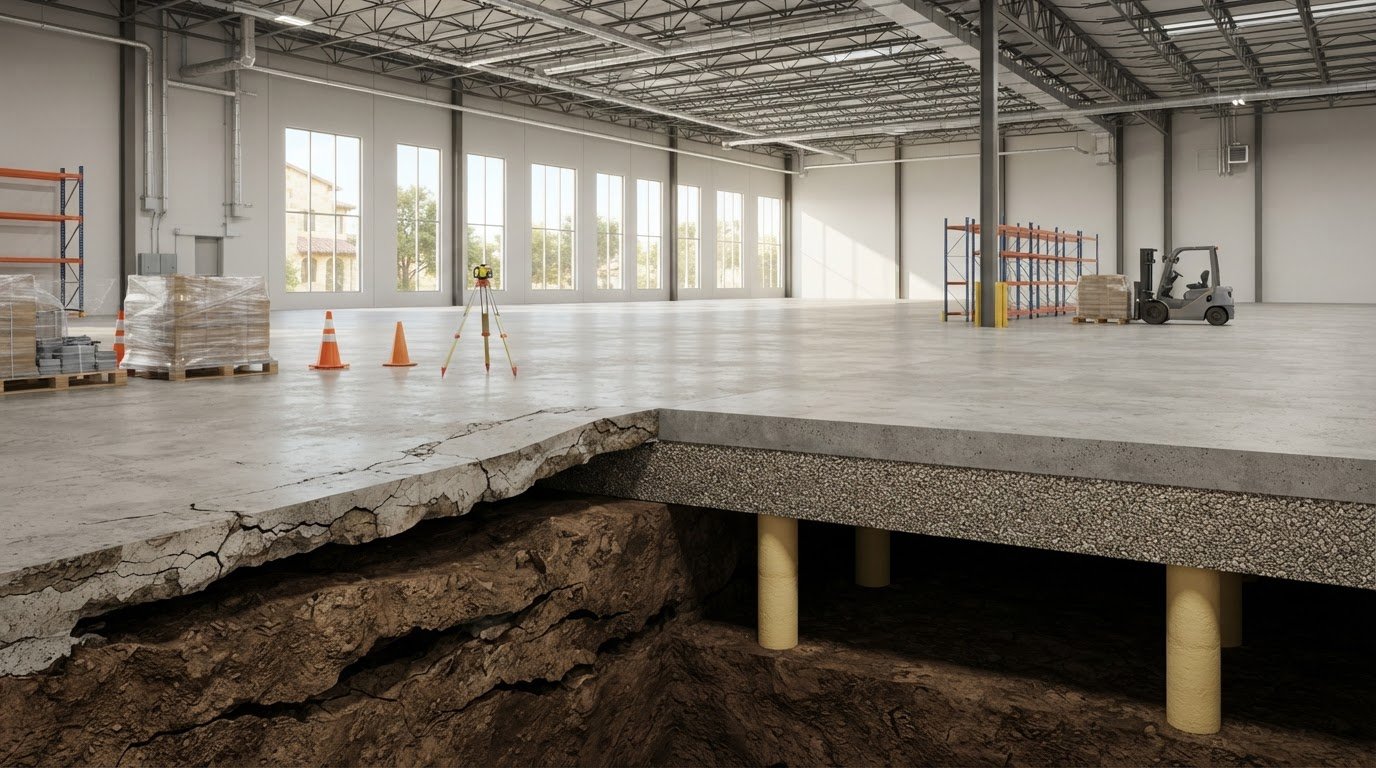
An uneven floor in your San Antonio facility may be more than a surface problem. The slab or the soil beneath it may have shifted. For businesses considering industrial floor stabilization San Antonio, identifying what has moved is the first step toward choosing a practical repair. Cracks, dips, and sinking areas can disrupt work and complicate movement through a facility, but the right solution depends on the cause.
It’s reasonable to ask whether the slab needs attention, its support has weakened, or underlying soil movement is involved. San Antonio’s expansive clay soils can swell and shrink as moisture conditions change, which may contribute to movement. Treating soil before construction is different from correcting an uneven existing slab, so it’s important to distinguish the project stage and problem before comparing repair options.
This guide explains how to recognize possible sources of instability, compare relevant repair paths, and plan a project around your facility’s needs. You’ll learn where commercial concrete leveling may fit when an existing slab is uneven or sinking, and why evaluating the slab and its support should come before choosing a repair. Hercules Foundation Repair provides commercial foundation repair and concrete leveling for properties in San Antonio, Austin, Houston, and Victoria.
Key Takeaways
- Distinguish surface wear from a possible loss of slab support before deciding what work the floor needs.
- Compare existing-slab leveling, structural foundation repair, and pre-construction soil stabilization by project stage and problem addressed.
- For industrial floor stabilization San Antonio, document affected areas and note traffic, equipment, and access constraints to support project planning.
- Evaluate the floor and its support to define the repair category and scope before scheduling work at your facility.
- Hercules provides commercial foundation repair and concrete leveling for facilities in San Antonio and across South Texas.
Industrial Floor Stabilization in San Antonio: Identify the Problem Before Choosing a Repair
Industrial floor stabilization addresses an existing concrete floor that has moved or lost support, with the goal of restoring usable levelness and stability. It concerns the slab or conditions beneath it, not simply surface wear, roughness, or damaged coatings. The appropriate response depends on the cause, so one repair approach won’t fit every floor.
Begin with what your facility team can observe. A noticeable height difference between adjacent areas, an uneven zone that returns after cosmetic work, or floor changes that interfere with carts, forklifts, stored materials, or routine work may warrant closer evaluation. These signs indicate a floor concern, but they don’t identify its source. A slab may be uneven while the soil beneath it is stable, or soil movement may contribute to a loss of slab support. These possibilities are related, but they are not the same diagnosis.
What does industrial floor stabilization address?
Movement or loss of support can leave sections of a concrete floor at different elevations, affecting how equipment and people move through the space. Structural movement is different from cosmetic wear. A worn coating, rough surface, or shallow finish damage may affect the top layer without indicating that the slab has shifted. Distinguishing these conditions helps facility teams describe the issue and avoid treating a support problem as a finishing concern.
Useful observations include where the elevation changes occur, whether the unevenness is isolated or spread across a larger area, and whether it appears to be recurring. Note any effects on routine operations. This information gives an evaluation of the floor a clearer starting point.
Why San Antonio site conditions belong in the assessment
San Antonio’s regional soils include expansive clays, and changing moisture conditions can influence how some soils behave. That context is relevant, but it isn’t a diagnosis. Soil and site conditions vary, even within the same part of the city, so don’t assume a floor moved because of clay or seasonal moisture alone.
The distinction matters because soil stabilization can refer to measures used to improve soil for construction, while an existing industrial floor may need its slab or support evaluated. An overview of soil stabilization methods explains the broader term, but it doesn’t determine which approach suits a particular facility. For an existing slab, concrete leveling may be relevant when the concern is an uneven or sinking surface.
For industrial floor stabilization San Antonio, document the symptoms and evaluate the slab and its support before choosing a repair. This keeps the decision tied to the observed condition rather than a guess based on appearance or location.
How San Antonio Soil and Slab Movement Can Affect an Industrial Floor
Changes in the ground can affect the support beneath a concrete slab. In San Antonio, expansive clay soils may swell as moisture increases and shrink as conditions dry, creating a potential source of ground movement. If support changes beneath part of a floor, the slab may settle unevenly. That is only one possible explanation. The slab’s condition, site history, and other support issues also matter.
The cause beneath a floor matters more than its appearance because similar dips or cracks can point to different repair needs. A low spot may be localized, while uneven elevations across several connected areas may call for a broader evaluation. A crack alone doesn’t prove soil failure, and a rough-looking floor may have surface damage without deeper movement.
Possible signs of movement beneath a commercial slab
Look for changes you can describe and track rather than trying to diagnose them from appearance. Uneven transitions between floor sections, noticeable elevation differences, and recurring changes in the same area are useful observations. Record where each condition occurs, when it was first noticed, and whether it appears to be changing. Note practical effects on traffic routes, equipment movement, and daily facility use.
A single crack or low area is a clue, not a conclusion. If a floor change seems to reappear or extend beyond its original location, record that pattern too. Photos taken from consistent viewpoints and a simple floor plan marked with affected zones can help communicate what facility staff have observed.
What a project assessment should establish
A useful evaluation brings observations together. It should establish which floor areas are affected, how unevenness is distributed, and whether signs of movement extend beyond one isolated zone. Consider the slab’s visible condition and relevant site context alongside potential support issues, rather than treating any one symptom as proof of a particular cause.
This matters operationally. A localized uneven area along one route may require a different scope of work than changing elevations across a broad section of the facility. The findings help determine whether concrete leveling may address an existing uneven slab or whether broader commercial foundation repair is more appropriate. They also help define which areas need attention, so the repair plan reflects the observed problem rather than assumptions.
For industrial floor stabilization San Antonio, documenting patterns gives the evaluation a clearer starting point, but it doesn’t replace examining the slab and its support. Note changes after wetter or drier conditions if you observe them, without assuming that timing alone proves a soil-related cause. A measured evaluation can help narrow the repair category and keep planning grounded in the facility’s actual conditions.
Hercules Foundation Repair provides commercial foundation repair and concrete leveling for facilities in San Antonio and across South Texas. Learn about Hercules’ commercial foundation repair and concrete leveling services.
Compare Industrial Floor Stabilization Options for Your San Antonio Facility
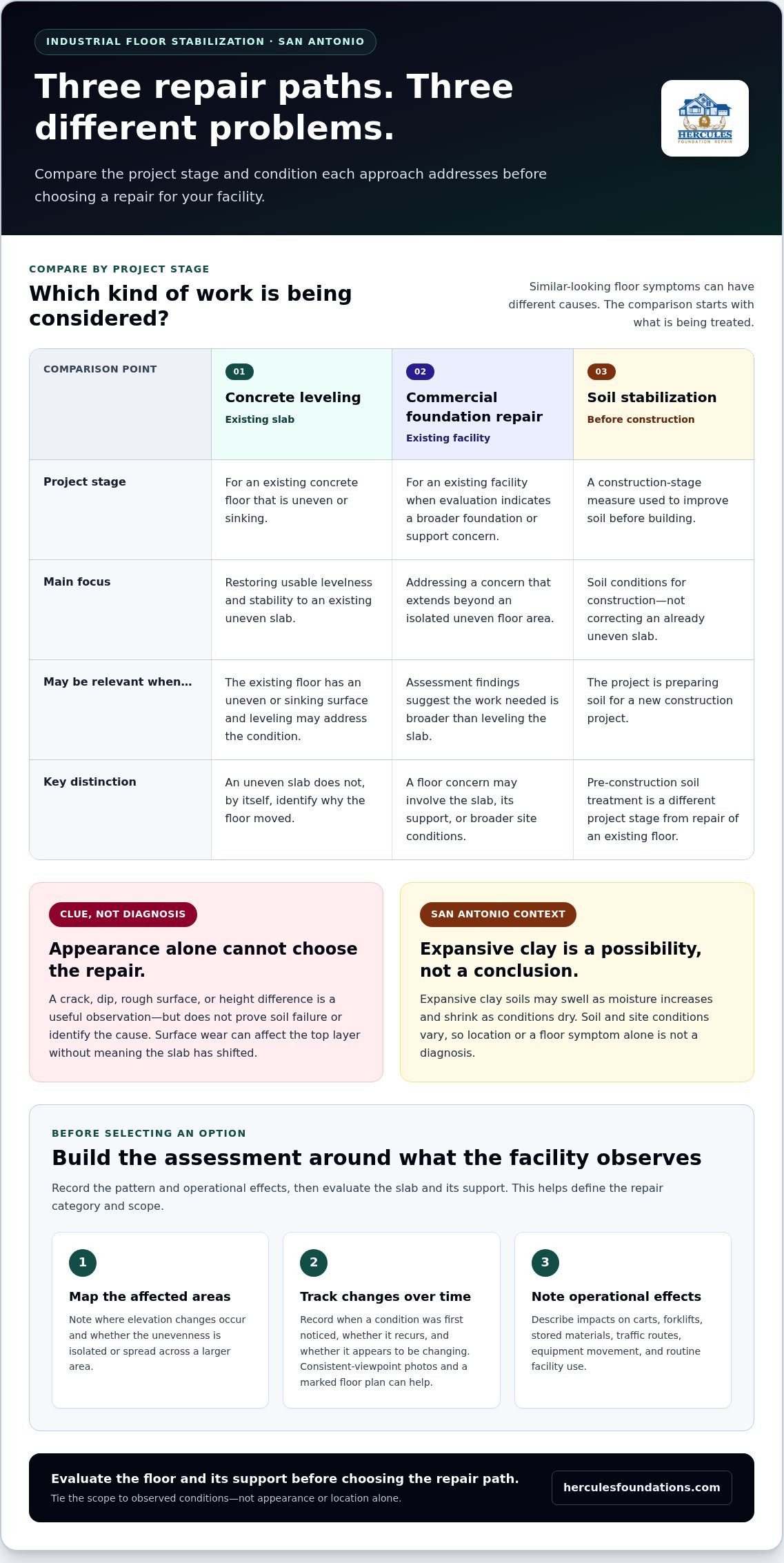
The phrase “industrial floor stabilization” can describe work at different stages and on different parts of a project. An existing slab that has settled calls for a different evaluation than an upcoming building site, and a structural foundation concern differs from an isolated uneven floor area. Compare options by the problem they address and what needs to be established, not by the label alone.
| Approach | Project stage | Problem addressed | Assessment needs and likely scope |
|---|---|---|---|
| Existing-slab concrete leveling | After the floor has been installed | An uneven or sinking slab area | Identify the affected sections and evaluate slab condition and support; scope centers on the existing uneven floor. |
| Structural foundation repair | Existing building | A concern involving the building’s foundation or structural support | Evaluate the broader structural condition and extent of movement; scope may reach beyond a single floor area. |
| Pre-construction soil stabilization | Before construction begins | Site soil conditions considered as part of preparing for construction | Evaluate site conditions and project requirements; scope relates to ground preparation before the slab is built. |
Concrete leveling or structural foundation repair?
Concrete leveling is relevant when an existing slab is uneven or sinking. Foundation repair applies when the evaluation identifies a concern with the structure’s foundation. These aren’t interchangeable solutions. For example, a localized floor elevation change may call for a different scope than movement involving broader structural support. Hercules provides commercial concrete leveling and foundation repair. The appropriate direction depends on the findings, not on one visible symptom.
Existing-floor repair or pre-construction soil stabilization?
Pre-construction soil work is part of preparing a site before a building and its floor exist. Existing-floor work starts with the installed slab: its condition, the affected areas, and the support beneath it. Confusing the two can lead to comparing work that addresses different project stages. For background on structural slab concerns, the slab foundation repair guide provides additional context.
For industrial floor stabilization San Antonio, the useful question is whether the evaluation points to an uneven existing slab, a wider foundation concern, or site preparation for a future build. That distinction helps facility teams define a relevant scope and plan around the work area, operations, and project stage.
Hercules Foundation Repair provides concrete leveling and foundation repair for commercial properties in San Antonio. Read about commercial concrete leveling and foundation repair.
Plan an Industrial Floor Stabilization Project in San Antonio
A clear plan starts with useful observations, not a guess about the repair. For industrial floor stabilization San Antonio, facility teams can help move the process forward by mapping affected areas, explaining how the floor is used, and organizing site information. Follow these steps:
- Document symptoms. Mark uneven areas on a floor plan or simple sketch. Note when each condition was first observed, whether it seems to be changing, and how it affects routine movement through the facility.
- Evaluate the site. Review the affected floor areas and their context, including slab condition and potential support concerns. Share relevant observations and records so the evaluation can focus on the actual site.
- Identify the repair category. Use the findings to distinguish between an existing-slab concern and a broader foundation issue. This helps clarify whether concrete leveling or commercial foundation repair is the appropriate category.
- Plan the work. Define the areas in scope and coordinate access, equipment movement, and the parts of the facility that need to remain usable. Project conditions shape the plan, so scheduling should follow the agreed scope rather than an assumed timeline.
Prepare the floor and facility information
Be specific. Mark where uneven transitions or elevation changes occur, and note whether they appear stable or have changed over time. Add routes used by forklifts, carts, and other equipment, along with areas that must stay accessible. Existing floor drawings and records of prior repairs can also provide helpful context when available.
Assessment checklist: Prepare a marked floor plan, symptom notes with dates, photos if useful, operational and access constraints, and any available drawings or repair records.
Coordinate assessment, scope, and facility operations
The findings establish which areas need attention and help define the relevant repair scope. A localized uneven section may call for a different plan than movement affecting multiple parts of a facility. Connect the work to the observed condition, then coordinate it with how people, materials, and equipment move through the site.
Before work is scheduled, identify access limits, high-traffic routes, equipment requirements, and zones that need to remain in use. Share these constraints early so the project plan can account for facility operations. Coordination depends on the scope and site conditions, so don’t assume one schedule or work arrangement will suit every building.
Hercules Foundation Repair provides commercial foundation repair and concrete leveling for San Antonio facilities. Learn about commercial floor repair.
Choose Hercules for Commercial Concrete Leveling and Stabilization in San Antonio
An uneven floor can raise practical questions for a facility team: Is the slab itself sinking, or does the concern extend to the building’s foundation? The answer matters because the appropriate repair depends on the condition. Hercules Foundation Repair provides commercial foundation repair and concrete leveling for existing-floor concerns in San Antonio and across South Texas. The first step is to match the service to the site’s findings.
What Hercules brings to a commercial floor project
Hercules is a family-owned and operated South Texas contractor founded in 1980, with more than 45 years serving the region. That local experience is relevant to commercial projects in San Antonio, where site conditions and floor concerns can vary from facility to facility. The focus is practical: understand the affected slab and its support, then define a repair scope that fits the findings.
For an existing slab that’s uneven or sinking, commercial concrete leveling may be appropriate. If the evaluation identifies a broader foundation concern, commercial foundation repair may be the right direction. These services address different conditions, so neither is the automatic answer to every dip, crack, or elevation change. Understanding the problem helps keep the repair discussion focused on what the facility needs.
This distinction is especially useful for industrial properties, where floor areas serve different purposes. A change along a main equipment route may have different operational implications from an uneven area in a less-traveled zone. Sharing those details helps frame the evaluation and clarify which areas should be considered in the project scope.
Take the next step on an uneven industrial floor
Before discussing a project, facility decision-makers can gather a simple description of the affected slab: where the unevenness occurs, how it affects routine use, and whether the condition appears to be changing. Include practical constraints such as equipment movement, access limits, and areas that need to remain usable. These details help connect the site evaluation to the facility’s day-to-day needs.
Project-specific findings help determine whether concrete leveling or broader foundation repair is relevant and which areas the work should address. They also give the facility team a clearer basis for coordinating around site access and operations. Hercules provides commercial foundation repair and concrete leveling for facilities in the San Antonio area, with the repair direction based on the floor’s observed condition.
If an uneven or sinking slab is affecting your facility, describe the floor concern and its operational constraints. Discuss your commercial concrete leveling project.
Move Your Facility Toward a Clear Repair Plan
Turn a floor concern into a practical project conversation by identifying the facility’s operational priorities. These might include keeping key routes usable, maintaining access to equipment, or coordinating work around active areas. Clear priorities help keep planning focused on your facility, not just the visible floor condition.
For industrial floor stabilization San Antonio, a well-defined scope begins with understanding the site and the facility’s needs together. Share what you’ve observed and explain how the affected area fits into daily operations. Hercules provides commercial concrete leveling and foundation repair, with the relevant service depending on the floor and support conditions.
You don’t need to choose a repair method before discussing the problem. Start with what your team sees and the constraints your facility needs to manage. Contact Hercules Foundation Repair to discuss your commercial floor project and take the next step toward a clear plan.
Frequently Asked Questions
Is industrial floor stabilization the same as soil stabilization?
Not exactly. For an installed industrial floor, stabilization may involve leveling the concrete slab or addressing a structural foundation concern. Soil stabilization usually refers to treating or improving ground as part of site preparation before construction. The terms sound similar, but they refer to different stages and issues. First identify whether the concern involves an existing floor or ground conditions at a planned building site, then compare approaches suited to that project.
What causes an industrial concrete floor to become uneven?
An industrial concrete floor can become uneven when the slab moves or its support changes. In San Antonio, expansive clay and moisture variation may be relevant factors, but they don’t prove the cause at a particular property. A crack, raised joint, or low area can have more than one explanation. A site-specific evaluation is central to industrial floor stabilization San Antonio projects because it helps determine whether concrete leveling or broader structural repair fits the observed condition.
Can a sunken industrial concrete slab be leveled instead of replaced?
In some cases, a sunken slab may be addressed with concrete leveling rather than replacement. Suitability depends on the concrete’s condition and whether its support can be addressed appropriately. A localized settled section differs from a slab with broader damage or structural concerns. An evaluation helps determine whether leveling matches the observed condition or whether another repair path is appropriate. Appearance alone can’t settle that decision.
How do I know whether my facility needs concrete leveling or foundation repair?
Concrete leveling is a relevant option for an uneven slab area, while foundation repair may be appropriate if findings indicate a structural foundation concern. Neither clue alone confirms the needed service. The evaluation considers whether the issue is limited to a floor area or appears to involve wider movement, along with the slab’s condition and site context. Those findings help define an appropriate repair scope for the facility.
Does San Antonio’s expansive clay affect industrial floors?
Expansive clay can be a relevant factor because moisture changes may affect soil behavior and, in some cases, slab support. It isn’t a universal explanation. Properties across San Antonio can have different site conditions, and a visible dip doesn’t establish clay-related movement. The same property-specific approach applies across San Antonio, Austin, Houston, and Victoria. Record where changes occur and evaluate the site before choosing a repair.
What information should I prepare before planning commercial floor stabilization?
Prepare a simple floor sketch with uneven zones marked, when each issue was first noticed, and whether changes seem to recur or spread. Add operational details such as equipment routes, access limits, and areas that need to remain usable. Existing drawings, prior repair records, and dated photos can provide helpful history. This information supports project planning, but the slab and its support still need to be evaluated to define the repair scope.