
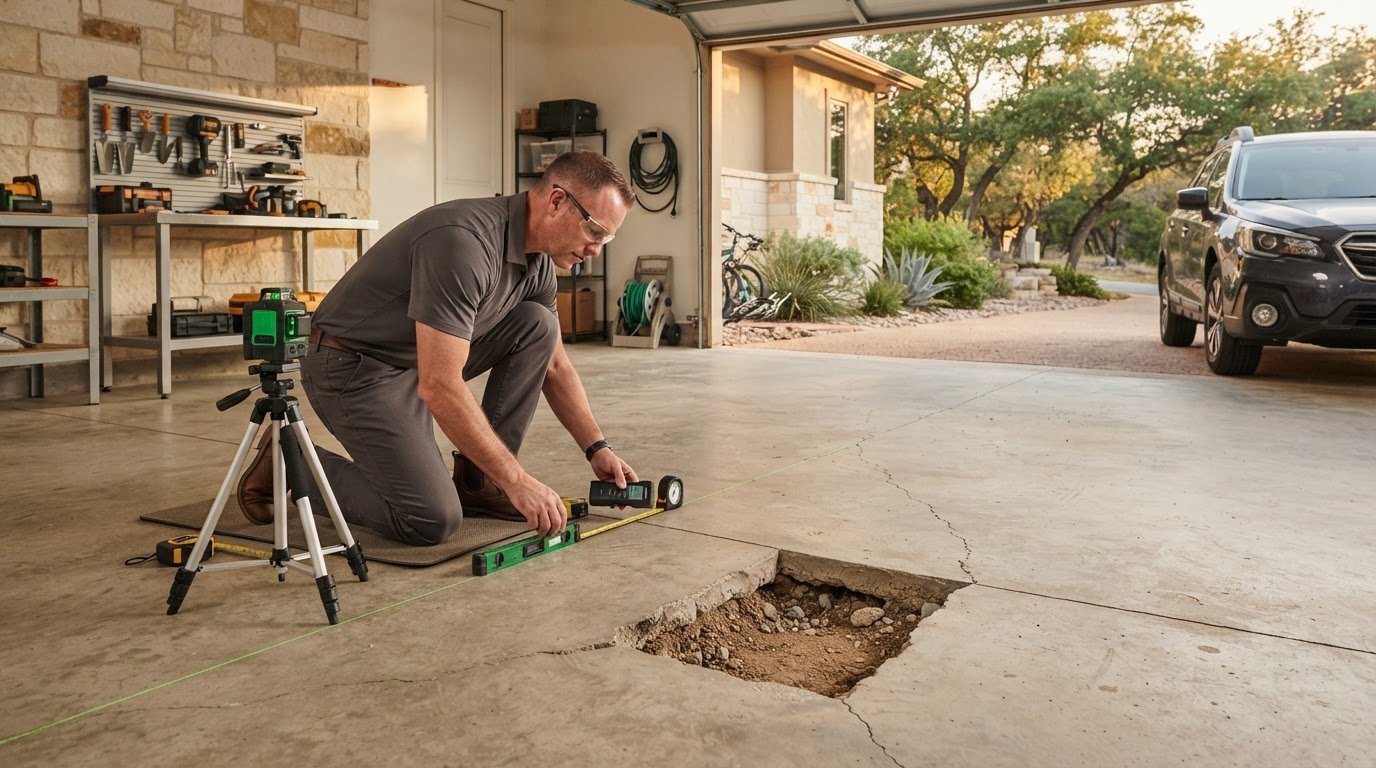
What if the uneven spot in your garage isn’t a sign that your whole home’s foundation is moving? A sloping or cracked floor can be concerning, especially when it affects parking or everyday use, but the right fix depends on what’s happening beneath the concrete. For garage floor leveling Austin homeowners should start by identifying the cause, not choosing a method by name.
A garage slab may settle on its own, while other signs can point to broader structural movement. These problems can be related, but they don’t automatically call for the same repair.
This guide explains how to distinguish an isolated slab issue from a possible foundation concern, compare leveling approaches, and prepare for a useful project discussion. Hercules Foundation Repair provides concrete leveling and foundation repair for Austin properties, helping homeowners understand which type of work fits the observed problem.
Key Takeaways
- Cracks, slope, and separation help describe an uneven garage floor, but don’t identify the cause on their own.
- Determine whether the concern is a settled garage slab or structural foundation movement before choosing a repair.
- Compare leveling approaches by the slab’s condition and support needs. Surface-level products aren’t designed to lift a settled slab.
- For a useful garage floor leveling Austin project assessment, document what you see, clear access, and explain how you use the space.
- Hercules Foundation Repair provides concrete leveling to lift and stabilize uneven slabs, with project scope tailored to the property.
Garage Floor Leveling in Austin: What an Uneven Slab Can Tell You
A dip beneath a parked car or a slope toward a storage area can make a garage frustrating to use. Cracks and gaps may also raise concerns about the slab. These visible changes are clues, not a diagnosis: they can help describe the problem but can’t show whether the garage slab settled or the home’s structural foundation moved.
In Austin, expansive clay soil and drainage conditions can influence how ground supports concrete. Clay can swell when wet and shrink during dry periods, but site conditions vary. Don’t assume soil movement caused an uneven floor. The location and pattern of changes, and whether they’re progressing, provide useful context for a closer assessment.
A garage slab can move independently of the home’s main foundation, so a low or cracked garage floor doesn’t automatically mean the house has a structural problem. For background on approaches used to correct settled concrete, see Concrete Leveling Methods. Start by documenting what you observe rather than deciding on a cause.
Which garage floor changes are worth documenting?
Note where the floor slopes or appears lower. Record cracks, separated edges, and gaps between the slab and a driveway, wall, or other nearby surface. Include practical effects, such as a car rocking in one spot or stored items shifting. Write down whether the condition seems stable or has visibly changed. Specific observations are more useful than a general description like “the floor feels off.”
Take photos from consistent positions, such as the garage entrance and the same interior corners. Keep the angle similar and note the date. A photo record can help show whether a crack or gap is changing, although it can’t establish what’s happening below the slab.
Could the garage slab issue involve the house foundation?
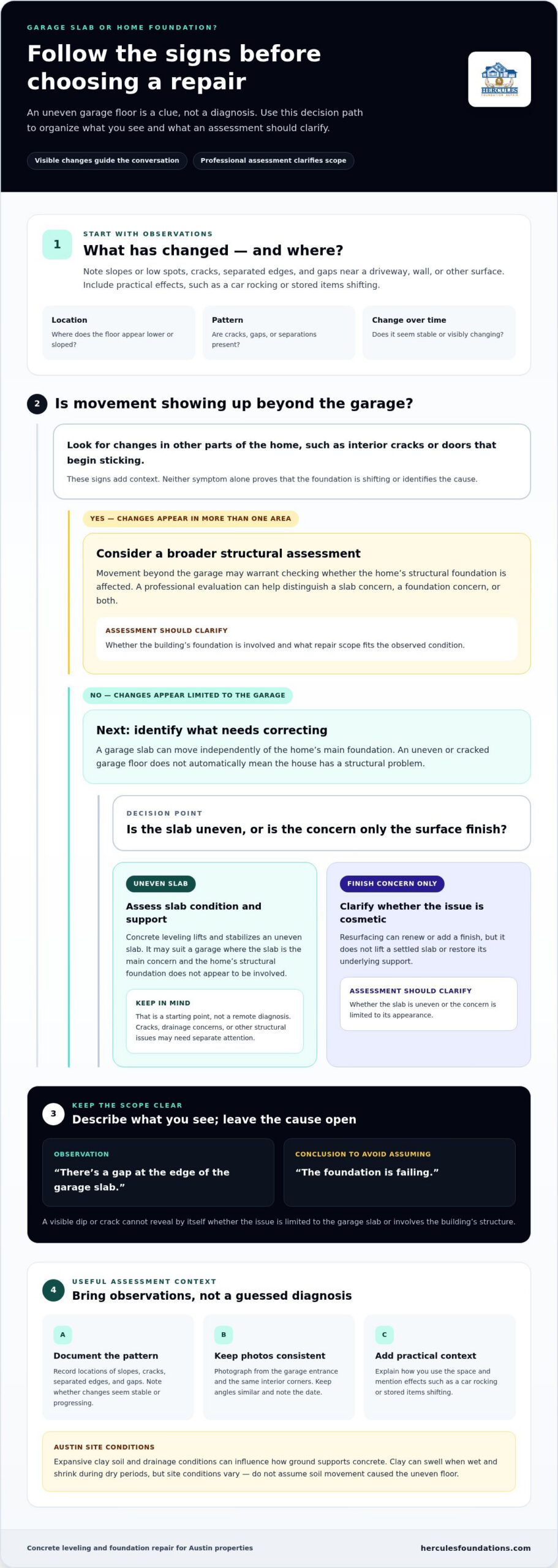
Yes, but the garage slab and the home’s structural foundation can behave differently. A garage floor may settle while the main foundation remains unaffected. Record interior cracks or doors that begin sticking as additional context, especially if you notice changes in more than one area. Neither symptom alone proves that the foundation is shifting or identifies the cause.
If the garage and other parts of the home show changes, a professional assessment can help distinguish an isolated slab concern from broader structural movement. Hercules Foundation Repair provides concrete leveling and structural foundation repair, so the discussion can focus on the type of movement before settling on a repair direction. That’s a practical starting point for garage floor leveling Austin homeowners can approach with better information and less guesswork.
Garage Slab Leveling or Foundation Repair: Identify the Problem First
An uneven garage floor can call for different work, depending on what has moved and what the repair needs to address. Concrete leveling corrects an uneven slab by lifting and stabilizing it. Cosmetic resurfacing, by contrast, renews or adds a finish but doesn’t lift a settled slab or restore its underlying support.
Foundation repair addresses structural movement affecting the home’s foundation. A visible dip or crack can’t reveal whether the issue is limited to the garage slab or involves the building’s structure. An assessment should consider the slab’s condition and support, along with whether movement appears elsewhere.
When may concrete leveling suit a garage slab?
Leveling may be appropriate when the garage slab is the main concern and the home’s structural foundation doesn’t appear to be involved. That’s a starting point, not a remote diagnosis. A contractor assesses the slab’s condition and support before recommending work. Cracks, drainage concerns, or other structural issues may need separate attention.
When should the assessment consider foundation movement?
If signs of movement extend beyond the garage, the assessment should consider a broader structural scope. Changes in multiple areas provide useful context, but don’t prove a cause on their own. A professional evaluation can help clarify whether the concern involves the garage slab, the home’s foundation, or both. For structural context, explore Hercules Foundation Repair.
Use this comparison to organize what’s known and what still needs assessment:
Keep observations separate from conclusions. “There’s a gap at the edge of the garage slab” describes what you see; “the foundation is failing” assumes a cause that needs professional evaluation. For garage floor leveling Austin homeowners can approach with clarity, describe the observed condition and ask how the proposed work addresses slab support and any wider structural concerns.
Compare Garage Floor Leveling Methods by Slab Condition
The right approach depends on what needs correcting. A surface that needs a smoother finish is different from a slab that has settled and needs lifting. Choosing a method before understanding that difference can improve the floor’s appearance without addressing the problem underneath.
How do slab-lifting approaches differ from surface leveling?
Self-leveling compounds are applied over concrete to create a more even surface plane, often in preparation for a floor finish. They don’t lift a sunken slab or restore its underlying support. Slab-lifting approaches place material beneath settled concrete to raise it. Polyjacking and mudjacking are injection methods, but their materials, equipment, access needs, and suitability differ by project.
Mudjacking injects a cement-based mixture through openings in the slab; polyjacking uses injected polyurethane foam. These are general descriptions, not a promise that either method suits every garage. The slab’s condition and site help determine the appropriate approach. For broader background, the Concrete Leveling Methods overview describes common slabjacking approaches.
What factors shape the right repair approach?
Method selection should reflect the slab and how the garage is used, rather than a one-size-fits-all preference. An assessment can consider visible settlement, cracking, slab condition, equipment access, and the support beneath the concrete. Possible voids are a factor to investigate, not something to assume from a dip alone. A useful comparison connects each proposed method to the site conditions.
- Slab condition: The extent and pattern of cracking or settlement can affect whether lifting is suitable.
- Access: The garage layout and available work area can influence equipment setup and practical options.
- Underlying support: The assessment should consider what may support the slab and whether gaps beneath it are present.
- Intended use: Parking, storage, and movement through the garage help define the floor’s practical needs.
Ask for a clear explanation of the goal: is the work intended to smooth a surface, lift settled concrete, or address a wider structural concern? A useful recommendation explains why the approach fits the slab, what it is intended to correct, and which separate issues it doesn’t address.
For garage floor leveling Austin homeowners comparing options, the key is matching the method to the condition, not choosing by name alone. Hercules Foundation Repair provides concrete leveling to lift and stabilize uneven concrete, with the project scope tailored to the slab and its needs.
Austin Garage Floor Leveling: Prepare for a Useful Project Assessment
A little preparation can make an assessment more productive. You don’t need to diagnose the cause yourself. Provide a clear record of what you’ve noticed, how you use the garage, and any relevant site conditions. Austin properties don’t all share the same soil or drainage patterns, so observations from your own site are more useful than assumptions about the neighborhood.
- Document the symptoms. Mark where the floor feels uneven, and note cracks, gaps, or areas that appear to have changed. Record when you first noticed them and whether they seem to be progressing.
- Clear access. Move vehicles, stored items, and other obstructions away from affected areas as much as practical. This makes the slab and its edges easier to evaluate.
- Describe how you use the garage. Explain where you park, store heavy items, or walk through the space. Note where unevenness interferes with regular use.
- Discuss relevant site conditions. Mention recurring water exposure, visible drainage patterns, or nearby downspouts if you’ve observed them. These details provide context, not proof of a cause.
What should homeowners note before an assessment?
Take photos from the same positions and keep the dates with the images. Describe what you see plainly, for example, “a crack near the side wall” rather than “the house is settling.” Separating observations from conclusions helps keep the assessment focused on the slab and site conditions.
- Locations of cracks, dips, gaps, or separation from nearby surfaces
- When each change first appeared and whether it seems to be changing
- Areas affected by water or runoff, if observed
- Garage use and practical problems caused by the unevenness
- Other areas of the property where you’ve noticed movement
What should a project-specific recommendation explain?
A useful recommendation identifies the observed concern, defines the proposed scope, and explains how the work is intended to address it. It should also cover preparation and access needs, along with project-specific limits or separate concerns. When comparing options, focus on the reasoning behind each proposed scope, not just the method name.
For garage floor leveling Austin homeowners should expect recommendations to reflect the actual slab and property conditions. A clear discussion distinguishes what’s visible from what still needs evaluation and helps you understand the next step without assuming every uneven floor has the same cause.
Ready to discuss what you’ve observed? Schedule a concrete leveling assessment with Hercules Foundation Repair to talk through your uneven garage slab and project needs.
Hercules Concrete Leveling for Austin Garage Floors: Your Next Step
Once you’ve documented the condition, the next step is matching the work to the slab. Hercules Foundation Repair provides professional concrete leveling for uneven surfaces, focusing on lifting and stabilizing slabs. The project scope is tailored to the concrete’s condition and the property’s needs, rather than selecting a method before understanding the problem.
How Hercules approaches uneven concrete
The discussion starts with the slab’s observed condition and the project details you share. Cracks, settled areas, separation from adjacent surfaces, garage use, and relevant site conditions help frame the project. Concrete leveling addresses uneven concrete, while signs that may involve the home’s structural foundation call for a broader foundation-repair perspective.
A garage slab and a home’s foundation don’t always move in the same way, and an uneven garage floor alone doesn’t establish a structural problem. Hercules also provides residential foundation repair, including slab and pier-and-beam repair, for properties where movement may extend beyond the garage.
Hercules is family-owned and operated, with over 45 years of service in South Texas. Its project-specific approach focuses on understanding the concrete’s condition, defining what the work is intended to address, and explaining the scope clearly. No single leveling approach should be assumed to fit every slab or site.
Move from an uneven floor to a clear plan
For a productive conversation about garage floor leveling Austin homeowners can bring a few helpful details:
- Where the floor dips, slopes, cracks, or separates
- When the condition appeared and whether it seems to have changed
- How the uneven area affects parking, storage, or everyday access
- Any relevant water exposure or drainage observations
- Whether other parts of the home show changes worth discussing
These details help separate observations from assumptions about the cause. The discussion can then focus on the slab’s condition, the proposed scope, and how the work is intended to address the issue. If signs extend beyond the garage, share those too so possible structural concerns can be considered. A clear plan should explain its purpose and fit the project, without promising to resolve unrelated issues.
Contact Hercules Foundation Repair to discuss your Austin garage floor and concrete-leveling needs. A clear account of what you’ve noticed is a practical place to begin.
Take the Next Step Toward a More Usable Garage
An uneven garage floor can feel like a problem with no clear starting point. You don’t have to settle on a cause or repair method before beginning the conversation. Think about how you want to use the space, whether that means parking without a noticeable dip, moving through the garage more easily, or storing items securely.
That practical goal can help shape the project discussion. For garage floor leveling Austin homeowners can connect the visible condition with how the space is used, then consider a repair plan that fits both. There’s no need to choose based on a crack or method name alone.
Hercules Foundation Repair serves Austin with concrete leveling focused on lifting and stabilizing uneven concrete. Talk with Hercules about your garage floor and share what you’ve noticed. A clear conversation can help you move from concern toward a practical plan.
Frequently Asked Questions
Is garage floor leveling different from resurfacing?
Yes. Resurfacing refreshes or prepares the upper surface, while leveling addresses the slab’s position. If you’re planning a coating or another finish, such as resinous systems installed by Masterclass Epoxy Floors & Training, ask whether the concrete needs surface preparation, slab correction, or both. A new surface can improve appearance, but it doesn’t show that a low area has been lifted. Clarifying the goal helps align the proposed work with how you want to use the garage.
Can garage floor leveling fix cracks in the concrete?
Not necessarily. Leveling focuses on correcting unevenness, but it doesn’t automatically repair every crack or identify why one formed. Note whether a crack is near a joint, runs toward a wall, or appears to be changing, and share those details during the assessment. Filling a crack may improve its appearance, but by itself it doesn’t show that slab movement or an underlying support issue has been addressed.
Is garage floor leveling permanent?
No repair should be treated as a promise that concrete will never move again. How a leveling project holds up depends on the slab, its support, site conditions, and the work performed. Before proceeding, ask what the proposed scope is intended to correct and what conditions fall outside it. If you later notice a new dip, widening gap, or change in water flow, record it and arrange an appropriate follow-up assessment.
How long does garage floor leveling take?
Project duration varies with slab size and condition, access, repair scope, and site requirements. A photo may show a visible dip, but it can’t establish every detail that affects the work plan. For a useful estimate, describe the affected area and ask what preparation is needed, whether vehicles or stored items must be moved, and how garage access will be affected during the project.
Can a garage slab settle while the house foundation remains stable?
Yes. A garage slab and the home’s structural foundation can behave independently, so a low garage area alone doesn’t establish that the house is moving. If you’ve also noticed a new interior crack or a door that sticks, record where and when it appeared and share that context. Homeowners in Austin, San Antonio, Houston, and Victoria should base the discussion on their property’s observed conditions, not assumptions about the city.
Should I replace a garage floor instead of leveling it?
Not automatically. The choice depends on the slab’s condition, the extent of settlement, and whether the concrete can be stabilized and corrected. Ask for the reasoning behind each proposed scope: what problem does it address, and what limitations remain? For garage floor leveling Austin homeowners should compare recommendations by how well they fit the slab’s observed condition and intended use, rather than choosing based on a method’s name alone.