

Austin foundation problems often begin in the soil, not the structure. Expansive clay swells when it absorbs moisture and shrinks during dry spells, putting seasonal stress on foundations. Experienced foundation contractors in Austin assess signs of movement alongside the foundation type and soil conditions to understand what may be happening.
If you’ve noticed cracks, sticking doors, or uneven floors, it’s natural to wonder whether the changes are cosmetic or point to a deeper issue. This guide explains how Austin’s clay soil and seasonal shifts affect homes and businesses, which warning signs to watch for, what a free foundation evaluation can help you understand, and how to choose a contractor carefully. You’ll also learn how slab and pier-and-beam foundations differ and what typically happens from evaluation through repair.
Key Takeaways
- Learn how Austin’s expansive clay and seasonal moisture shifts can affect foundations, and why foundation type matters when assessing movement.
- Recognize common warning signs early so you can understand when cracks, sticking doors, or uneven floors may call for closer attention.
- Find out what a free foundation evaluation can help clarify about observed damage and possible next steps.
- Understand what to review in a repair warranty, including its coverage, exclusions, and maintenance requirements.
- Use practical criteria to compare contractors and choose an approach suited to your home or business.
What Causes the Need for Foundation Repair in Austin Homes and Businesses?
Austin’s expansive clay soil changes volume as moisture levels rise and fall. That movement can shift a home or business foundation, causing cracks, uneven floors, or sticking doors. Many Austin homes have post-tension or conventionally reinforced concrete slab foundations, while older homes in Hyde Park, Clarksville, Travis Heights, and East Austin were often built on pier-and-beam foundations. The Balcones Fault Zone also crosses Austin and spans several miles, contributing to geological variation across the area.
Water management matters, too. A large tree can consume as much as 150 gallons of water per day, drawing moisture from soil near its roots. If that soil dries unevenly beside a slab, sections of the foundation may settle at different rates. For properties in Austin and surrounding communities, note where cracks appear, whether they change, and whether nearby drainage or landscaping could be affecting soil moisture.
Review warranty terms before repair begins. Ask for the written document and read what it covers, how long coverage lasts, and whether it applies to materials, labor, or both. Check whether it covers only the repaired area or also addresses movement elsewhere. Look for exclusions, maintenance requirements, transfer rules, and claim procedures. The document should clearly explain the protection being offered.
Permit requirements depend on the project’s scope, including whether the work involves localized repair or foundation replacement. Define the proposed work, then follow the City of Austin Development Services permitting process that applies to that scope. Keep permit information and approved project documents with your repair records.
Austin foundation specialists handle repair and leveling, support systems such as piers or piles, and, when needed, new foundations. The right method depends on the foundation type, observed movement, and supporting soil. For a slab, repair may involve installing support beneath settled areas, then carefully lifting or stabilizing the concrete. Piling systems transfer structural loads to deeper, more stable soil.
Pier-and-beam problems may involve shifting supports, damaged beams, or uneven interior floors. Repairs can include correcting or replacing compromised supports and restoring the structure’s bearing points. Wall cracks, binding doors, and sloping floors can indicate movement, but each sign should be considered in the context of the building’s overall condition.
Repair duration depends on the work area, access, foundation type, and number of supports involved. Excavation, equipment, noise, and temporary restrictions around active work zones may disrupt daily routines. Before work starts, plan access routes and protect items near repair areas. Ask about the sequence of work and how the crew will manage interior access.
Expansive clay soil and seasonal foundation movement
Austin’s clay-rich soils respond to changing moisture, creating movement beneath homes and businesses. Understanding how seasonal drying and rainfall affect the ground can help you interpret changes around a structure.
Austin Soil Conditions
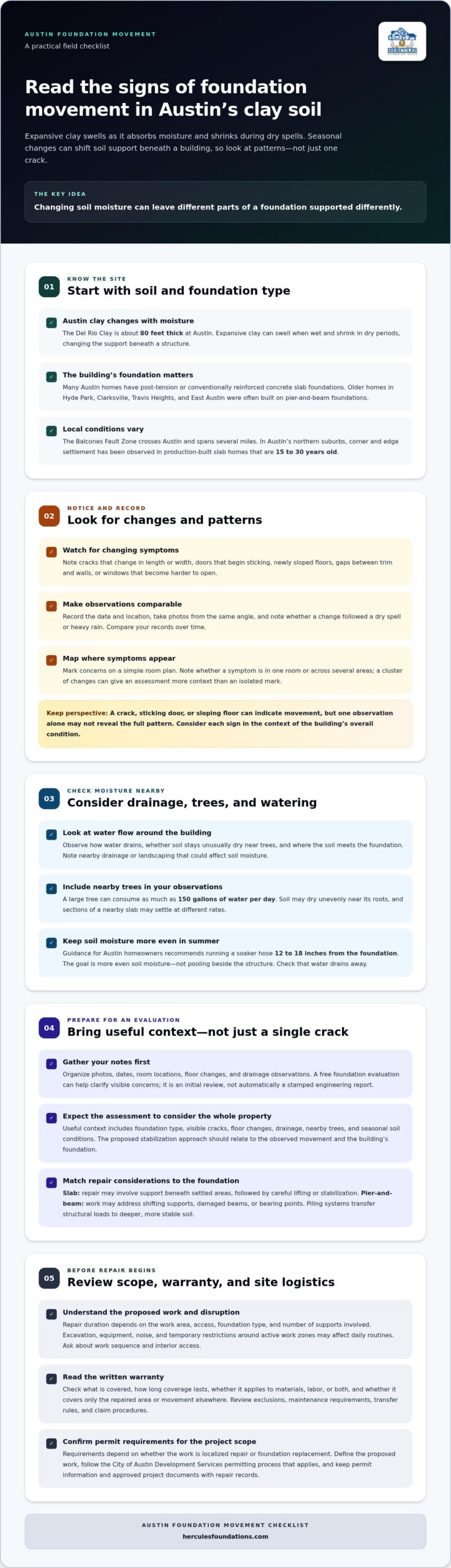
At Austin, the Del Rio Clay is about 80 feet thick, and expansive clay can swell as it absorbs water, then shrink during dry periods. That repeated change can leave one part of a foundation supported differently from another. Look at how water drains around the building, whether the ground stays unusually dry near trees, and where the soil meets the foundation.
Austin’s northern suburbs include production-built slab homes that are 15 to 30 years old, where corner and edge settlement has been observed. That pattern makes the location of movement useful: a change at one corner may call for a closer look at nearby drainage, grading, and soil moisture, rather than treating every crack as the same problem.
Signs of Possible Movement
Watch for cracks that change in length or width, doors that start sticking, and floors that feel newly sloped. One observation alone may not reveal the full pattern. Record the date and location, take photos from the same angle, and note whether the change followed a dry spell or heavy rain. Compare your records over time.
Movement may also appear as gaps between trim and walls or windows that become harder to open. Note whether a symptom occurs in one room or across several areas. A cluster of changes in one part of a building gives an assessment more context than an isolated mark.
A useful assessment connects your observations to the property. The reviewer can consider foundation type, visible cracks, floor changes, drainage, nearby trees, and seasonal soil conditions. For a clear record, mark each concern on a simple room plan and note when it began. This helps distinguish a developing pattern from an old defect that has remained unchanged.
Moisture management is one practical step for properties on clay soil. During summer, guidance for Austin homeowners recommends running a soaker hose on a schedule, 12 to 18 inches from the foundation. The goal is to maintain more even soil moisture, not to create pooling beside the structure. Check that water drains away rather than collecting against the foundation.
When you seek an estimate, organize your photos, notes, and drainage observations first. The proposed stabilization approach should relate to the observed movement and the building’s foundation, not just one visible crack. If documented changes continue, explore foundation movement support as a next step.
Free foundation evaluations
A free foundation evaluation can help property owners understand visible concerns before deciding on next steps. Treat it as an initial review, not automatically as a stamped engineering report. For an Austin home with cracks, sloping floors, or sticking doors, prepare a short list of symptoms and when each appeared. This gives the evaluator useful context beyond a quick walk-through.
What an Evaluation Covers
A focused evaluation examines accessible areas inside and outside the building. The reviewer may note crack locations, floor changes, drainage patterns, and foundation type. In a slab home, the inspection can include visible edges and interior symptoms. In a pier-and-beam home, accessible supports and framing may also be relevant. Ask for the findings and recommended next steps in writing.
Before the visit, photograph each concern and mark its location on a simple room plan. Include changes noticed after heavy rain or a dry spell, especially where clay soil surrounds the property. Mention recent plumbing work or installations that changed drainage or soil moisture. These details can help connect visible symptoms with possible causes, rather than treating every crack as proof of structural movement.
Engineering Evaluations and Insurance
A contractor’s evaluation and an engineering evaluation serve different purposes. According to Dura Pier, a licensed professional engineer in Texas is authorized to issue an engineering evaluation of a structure. That formal assessment can help when you need a structural opinion or written engineering documentation. It is distinct from a repair proposal, which describes recommended work and its scope.
Most standard Texas homeowners insurance policies don’t cover foundation repair caused by soil movement, settling, or drought. According to G.L. Hunt, coverage may apply when a sudden covered event, such as a plumbing leak, causes foundation damage. Report the event to your insurer and keep dated photos, repair records, and evaluation documents together. The cause of damage affects how a claim is considered.
Use the written findings to compare the observed condition with the proposed response. A useful report identifies affected areas, explains the basis for recommended stabilization, and distinguishes urgent structural concerns from maintenance observations. If repair is proposed, review the scope, installation details, and warranty language before approving the work. A “lifetime” warranty label alone doesn’t explain what is covered, which areas qualify, or how future claims are handled.
For Austin properties, drainage and changing clay-soil moisture deserve attention during an evaluation. Ask how those site conditions relate to the observed movement and what documentation supports the recommendation. Keep the evaluation, repair records, and warranty in one file. This makes later comparisons easier if symptoms change or a new assessment is needed.
Common signs and causes of foundation damage
Foundation damage often shows up as changes inside or outside a building. Look for widening wall cracks, tile cracks that cross several flooring sections, doors that suddenly bind, and windows that no longer close smoothly. A single hairline crack doesn’t establish the cause. A cluster of changes, especially across adjoining rooms, gives an evaluation more useful context than one isolated mark.
Soil movement is a common source of stress around Austin foundations. During dry weather, clay can shrink; when moisture returns, it expands. Uneven drainage, downspouts that release water beside a structure, and ground that slopes toward a building can create localized moisture changes. For example, a crack near a corner with pooling soil nearby calls for attention to both the structure and the drainage pattern.
Plumbing leaks can also affect soil beneath a slab. A persistent leak may soften or wash away supporting soil, while a sudden leak can cause damage unlike gradual seasonal movement. Note damp flooring, unexplained water use, or a recurring wet area, and record where it occurs. This information can help distinguish a possible water-related cause from cracks associated with soil drying and shrinkage.
New construction can settle as its materials and supporting ground adjust. According to Dura Pier, the first year or two after construction is a period when new construction may settle. Watch for changes during that time, such as doors that start sticking or cracks that appear around openings. Record when each symptom starts and whether it changes, rather than judging the condition from a single visit.
Use a simple tracking routine before an evaluation. Photograph each crack beside a ruler, write down the date, and identify its location, such as “living room, above the east window.” Repeat the photo later from the same position. Also note rainfall, visible drainage problems, and recent plumbing work. These observations can show whether several symptoms are changing together or staying stable.
Early attention matters because catching signs of foundation damage can help prevent more costly damage in Austin-area properties. Focus on changes that affect function, including a door that no longer latches or a floor that feels newly uneven. A clear evaluation should connect the observed symptoms with possible causes and explain whether stabilization or monitoring fits the findings. Honest documentation supports a practical repair decision in Austin without treating every crack as a structural failure.
Choosing an Austin foundation contractor
A sound choice starts with a clear explanation of the problem, proposed work, and scope. Compare contractors by how well their assessment connects visible settlement to a practical repair plan.
Licensing and Insurance
In Texas, a licensed professional engineer is authorized to issue an engineering evaluation of a structure. That authorization is distinct from a foundation contractor’s credentials. Licensing and insurance requirements depend on applicable rules and project scope, so review the contractor’s documentation for the proposed work. Ask what coverage applies to the job and how the written agreement addresses responsibility for the work area.
Inspections and Estimates
An inspection should address the foundation, affected rooms, drainage, and visible changes such as cracks or sloping floors. A free estimate is an offer-specific term; financing and transferable warranty rights depend on the written agreement. Read the estimate for the repair method, work areas, materials, exclusions, and payment terms. A useful proposal explains why the method fits the observed settlement.
Experience in Austin matters because expansive clay, seasonal moisture shifts, and local construction types shape repair decisions. A research-backed recommendation for choosing a contractor is to look for at least 10 years of industry experience in Austin. Experience alone isn’t enough, though. The contractor should explain how site conditions and foundation type relate to the proposed stabilization plan.
Compare proposals by scope, not just by the repair method’s name. For example, one proposal might address supports beneath a settled slab, while another includes broader structural work. Ask how the plan identifies affected areas, what access the crew needs, and how completed work will be documented. A clear written scope makes differences between estimates easier to understand.
Match the work to the problem. Concrete leveling can correct an uneven concrete surface, such as a driveway, but it isn’t the same as stabilizing a building foundation. If floors slope or cracks continue through interior walls, the assessment should consider the structure, not just the visible concrete. The proposed work should address the symptoms and their likely cause.
Review warranty language before approving a project. Check which work and areas are covered, the term, exclusions, maintenance requirements, and whether coverage transfers to a future owner. Don’t rely on a verbal description. Keep the signed agreement, evaluation, estimate, and completion records together so you can refer to the exact scope later.
Choose the proposal that explains the cause, scope, and method in plain language, not simply the shortest estimate. To discuss a property’s structural concerns and repair options, request foundation repair guidance.
Hercules Foundation Repair: Foundation Repair
Hercules Foundation Repair helps Austin property owners address foundation settling and structural instability. If an evaluation points to movement beneath a home or business, its Foundation Repair service can address the underlying concern. Slab Foundation Repair and Pier and Beam Foundation Repair serve those respective foundation types, while Commercial Foundation Repair is available for business properties.
Describe the symptoms you’ve observed, such as changing cracks, uneven floors, or sticking doors, and explain what the evaluation found. This gives the repair discussion a practical starting point based on the property and its foundation.
For help with a foundation concern, contact Hercules Foundation Repair or visit herculesfoundations.com.
Choose a Clear Path to a Stable Foundation
The next step is to turn what you’ve observed into a focused repair decision. Before choosing among foundation contractors in Austin, identify the outcome that matters most: addressing structural movement, restoring a level surface, or understanding what work the property needs. A sound plan should connect the recommended work to the building’s condition, not simply treat the most visible symptom.
Keep the decision grounded in the details that matter to you. Note which areas affect daily use, what concerns you about the structure, and what you need explained before moving forward. Clear communication helps you understand the proposed scope and make an informed choice.
Hercules Foundation Repair provides foundation services for residential and commercial properties. If you’re ready to discuss your property’s needs, contact Hercules Foundation Repair today. Taking a thoughtful next step can help you move from concern toward a practical plan.
Frequently Asked Questions
Does homeowners insurance cover foundation repair in Texas?
Standard Texas homeowners policies generally exclude foundation damage caused by soil movement, settling, or drought. According to G.L. Hunt, coverage may apply when a sudden covered event, such as a plumbing leak, causes the damage. Keep plumbing invoices, dated photos, and evaluation documents together to help document the cause. Review your policy’s covered-event language, since the cause of damage affects whether a claim may qualify.
How do I know if this is real movement or normal settling?
Changes that continue, spread, or affect how doors and windows work deserve closer attention than an unchanged hairline crack. Compare dated photos and note whether symptoms appear in connected areas, such as a binding door near a wall crack. New construction may settle during its first year or two, according to Dura Pier. A structural evaluation can distinguish ordinary adjustment from movement that needs a repair plan.
What is the average cost of Foundation Repair in 2026?
Foundation repair pricing in 2026 depends on the specific project and is provided after a quote request. Cost factors include foundation type, affected areas, site access, repair method, and the stabilization needed. A localized issue differs from work involving several supports or difficult access. Compare written scopes carefully, since estimates may cover different work even when they address similar symptoms.
Which foundation contractors serve Austin, Texas?
Hercules Foundation Repair serves Austin, San Antonio, Houston, and Victoria. Homeowners comparing foundation contractors in Austin can consider whether the proposed work matches their property type and observed issue. Residential slab, pier-and-beam, and commercial foundations call for distinct repair approaches. Describe the structure and symptoms clearly so the repair discussion can focus on the property’s needs.
What is the average cost of foundation repair in Austin, TX?
For an Austin foundation repair project, pricing depends on the case and is provided after a quote request. Factors include whether the structure has a slab or pier-and-beam foundation, how widely movement affects the building, site access, and the stabilization method. Hercules Foundation Repair offers free estimates and a Quick Estimate Calculator. A written estimate should define affected areas and explain the proposed work. Compare those details, not just the total, to see whether estimates cover equivalent repairs.
How do Austin foundation repair contractors compare by reviews, experience, and warranties?
Compare documented experience, review patterns, and written warranty information rather than relying on a single rating. As you assess foundation contractors in Austin, look for clear explanations of the repair scope and follow-up process. Hercules Foundation Repair states 45 years of professional experience and 437 reviews. Its website has a Warranty Request page; review the applicable written documents for the actual warranty terms.
How do Austin’s expansive clay soils and drought affect foundations?
During drought, expansive clay loses moisture and shrinks; when wet conditions return, it can swell. These changes can create uneven support beneath a structure, especially where drainage or landscaping causes moisture to vary across the site. For example, soil beside a large tree may behave differently from ground receiving roof runoff. Observe moisture and drainage patterns around the whole building, not only beside the most visible crack.
What signs indicate a home in Austin needs foundation repair?
Hercules Foundation Repair describes warning signs as “cracks between bricks, horizontal or zig-zag cracks, doors and windows that don’t close correctly.” Note whether symptoms appear together or change over time. A sticking window alongside a widening masonry crack provides more context than either observation alone. Photograph affected areas and record changes to give a structural evaluation a clear starting point.