
The first repair plan you hear isn’t automatically the right one. When comparing foundation contractors Houston property owners need a recommendation based on the actual structure and observed conditions, not a one-size-fits-all fix. It’s understandable to feel unsure when assessments differ or project scopes are hard to compare. A sound plan should explain the concern, account for the property and site conditions, and make clear what work is proposed.
This guide offers a practical way to compare local experience, repair plans, project fit, and communication. It also explains how needs can differ between slab and pier-and-beam homes, commercial properties, and concrete leveling projects. Hercules Foundation Repair is family-owned and operated and has served South Texas since its founding in 1980. Use the questions and checklists below to prepare for a focused discussion about your property.
Key Takeaways
- Compare foundation contractors Houston by their experience with your property type and structural concern, not by broad claims alone.
- Consider soil and moisture as factors in an assessment, not proof by themselves that your foundation needs repair.
- Match the project to the need: slab, pier-and-beam, and commercial foundation repair address structural concerns, while concrete leveling addresses uneven concrete surfaces.
- Review each proposal for the problem it addresses, the planned scope, communication, and next steps.
- Hercules Foundation Repair serves Houston with residential and commercial foundation repair, slab and pier-and-beam repair, and concrete leveling.
How to Choose a Foundation Contractor in Houston with Confidence
Comparing structural repair contractors can feel stressful, especially when assessments or proposed work differ. Choosing among foundation contractors Houston homeowners are considering gets easier when you focus on project fit, evidence, and clear explanations instead of confident-sounding promises. A useful assessment should connect the conditions observed at your property to the concern being addressed and the work proposed.
A project-specific foundation repair plan connects a property’s observed conditions to the work intended to address its structural concern. Keep that standard in mind as you review experience and proposals. If the reasoning is hard to follow, ask for a clearer explanation before making a decision.
What Houston property owners should look for in a contractor
Start with experience that matches your project. Commercial foundation repair calls for an understanding of commercial properties, while a residential project requires familiarity with the home’s foundation type and the structural issue under discussion. Broad claims about experience matter less than a clear explanation of how that experience relates to your property.
Look for a logical connection between what you’ve noticed, what was observed, and what the proposed work is designed to do. A crack, uneven floor, or sticking door may be worth discussing, but a symptom alone doesn’t establish its cause or the right repair. The assessment should explain the concern and why the proposed scope fits.
Hercules Foundation Repair handles residential and commercial foundation repair, including slab and pier-and-beam projects, as well as concrete leveling. These services address different needs: structural foundation repair focuses on foundation concerns, while concrete leveling addresses uneven concrete surfaces. The proposed work should fit the problem at hand, not simply share a familiar label.
Questions that reveal whether the proposed scope fits
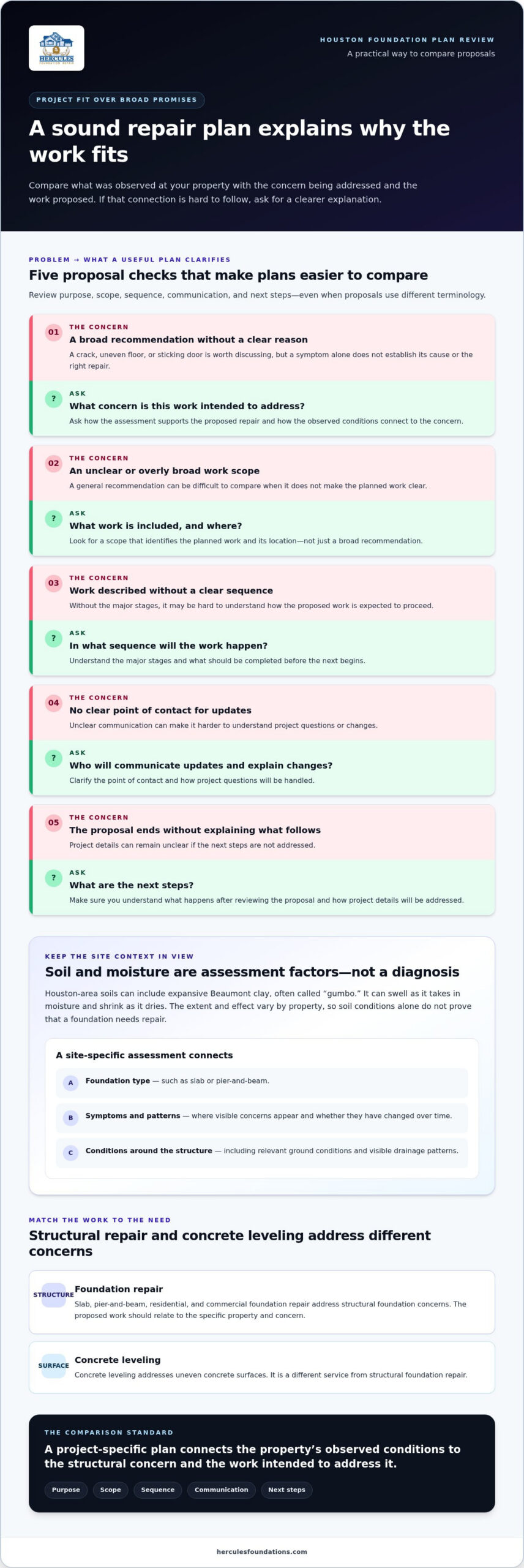
Use these questions to understand what each proposal is meant to address. Clear answers make it easier to compare plans, even when their scopes use different terminology.
- What concern is this work intended to address? Ask how the assessment supports the proposed repair.
- What work is included? Look for a scope that identifies the planned work and its location, rather than relying on a broad recommendation.
- In what sequence will the work happen? Understand the major stages and what should be completed before the next begins.
- Who will communicate updates and explain changes? Clarify the point of contact and how project questions will be handled.
- What are the next steps? Make sure you understand what happens after you review the proposal and how project details will be addressed.
Compare the purpose, scope, sequence, and communication details side by side. Hercules matches foundation repair or concrete leveling to the property’s needs and explains the work in practical terms. That gives you a clearer basis for deciding whether a proposal addresses the concern you want resolved.
How Houston Soil and Moisture Conditions Shape Foundation Assessments
Soil and moisture help explain conditions around a building, but neither proves that a foundation needs repair. Local context matters in Houston: soils can include expansive Beaumont clay, often called “gumbo,” which can swell as it takes in moisture and shrink as it dries. The extent and effect of those changes vary by property, so soil conditions are factors in an assessment, not a diagnosis by themselves.
In Houston, changing moisture can make expansive clay swell or shrink. Soil conditions help inform a foundation assessment, but cannot establish the cause of a building symptom on their own. The goal isn’t to assume every home is affected in the same way. It’s to consider how the site and the building’s observed condition fit together.
Why Houston-area soil and changing moisture deserve attention
Clay behavior provides useful context for a local assessment. During wetter periods, clay may absorb water and expand; during drier conditions, it may lose moisture and contract. Those shifts can influence the ground supporting a structure. A region’s general soil profile, however, can’t show whether a particular foundation has moved or identify the right response.
Site conditions matter, too. Moisture may not be distributed evenly around a building. An assessment can consider visible drainage patterns, ground conditions, and reported changes alongside the soil context. Don’t draw conclusions based only on a Houston address or a general statement about “gumbo” clay.
What a site-specific assessment should connect
A useful assessment brings together the foundation type, the location and pattern of visible symptoms, and relevant conditions around the structure. A crack, sloping floor, or sticking door is worth documenting, but one symptom alone doesn’t establish whether soil movement caused it or define a repair scope. The pattern and context matter.
For a slab foundation, the assessment should relate observed concerns to the slab and the structure it supports. A pier-and-beam property has a different foundation system and context. That’s why foundation contractors Houston property owners consider should explain how proposed work connects to the specific building and concern, rather than treating every symptom as the same problem.
- Note where symptoms appear. Record the room or area and whether you’ve noticed changes over time.
- Describe site conditions. Share what you’ve observed about wet or dry areas near the building without assuming the cause.
- Ask how the factors connect. Look for an explanation linking the foundation type, observed conditions, and proposed scope.
Hercules Foundation Repair provides structural foundation repair and stabilization for residential and commercial properties. To learn more about foundation repair services from Hercules, start with the concern you’ve observed and the type of property involved.
Compare Foundation Repair Plans by Property Type and Problem
A repair category is a starting point, not a diagnosis. The right scope depends on what an assessment identifies, the property’s foundation type, and whether the concern is structural or limited to an uneven concrete surface. Use this comparison to clarify the project context before weighing proposals. No repair method should be selected based on a property label alone.
Residential slab: A home built on a concrete slab may need structural repair if an assessment identifies a foundation concern. The discussion should connect the observed issue to the home and explain the proposed work.
Residential pier-and-beam: This foundation system differs from a slab, so the relevant observations and repair scope may differ too. The plan should address the specific concern identified for the home.
Commercial property: The assessment and scope should reflect the building’s needs and the structural issue under consideration.
Uneven concrete: Concrete leveling addresses an uneven concrete surface. It is distinct from structural foundation repair, which addresses concerns with the foundation itself.
Slab and pier-and-beam projects need different context
Slab and pier-and-beam homes have different foundation systems, so a similar visible symptom doesn’t automatically point to the same scope. The contractor should explain how the property type and observed conditions shape the repair discussion, what the proposed work is intended to address, and why the scope fits. When comparing slab proposals, focus on the stated concern, the work included, and how the plan relates to the assessment.
Residential and commercial projects also call for project-specific thinking. A recommendation should reflect the structure being assessed rather than assume that a familiar repair category applies everywhere. If a proposal names a repair method but doesn’t explain why it fits the property, compare the stated concern, scope, and connection to the assessment. This makes differences between proposals easier to understand.
When concrete leveling is a separate project consideration
An uneven walkway or other concrete surface may call for a different discussion than a concern involving the building’s foundation. Concrete leveling focuses on the surface; structural foundation repair focuses on the foundation. Before comparing scopes, identify which issue the proposed work addresses. For concrete leveling options, compare the surface included in the scope and the work proposed to correct the unevenness.
As you compare foundation contractors Houston property owners may consider, look for a clear distinction between surface leveling and structural repair. Hercules Foundation Repair provides both foundation repair and concrete leveling, with the project scope shaped around the identified need. Ask what the proposed work is meant to address, which parts of the property are included, and how the plan fits the assessment. A clear answer helps you compare proposals without treating different services as interchangeable.
Use This Houston Contractor Checklist to Compare Project Proposals
A proposal is easier to evaluate when you can trace each part of the planned work back to the assessment. Instead of comparing only the total scope or a contractor’s summary, consider what the work is meant to address, how it will proceed, and how project questions will be handled. Use this checklist to organize the details and identify unanswered questions.
Review the diagnosis and proposed scope side by side
Put the assessment and proposal next to each other. For every task listed, note the structural concern it relates to. If a project includes both foundation work and concrete leveling, record them as separate parts of the scope so it’s clear which addresses the foundation and which addresses an uneven surface.
- Assessment: Summarize the conditions described and the areas of the property involved. Note whether the proposal explains how those observations informed its recommendations.
- Problem addressed: Write down the specific concern each proposal says its work is intended to address. If the language is broad, mark it for clarification rather than guessing what it means.
- Work scope: Compare the tasks, locations, and stated limits. A plain-language summary can help: “This task addresses the foundation concern in this area” or “This task levels the uneven concrete surface.” Keep structural repair and surface leveling distinct.
- Sequence: Note the order of major tasks and what the proposal says happens before, during, and after the work. Record questions if the sequence isn’t clear.
- Communication and next steps: Identify how project updates and questions will be handled, along with any stated decisions or information needed to move forward. Write down anything the proposal leaves unanswered.
This side-by-side review can show whether proposals differ because they address different concerns, include different tasks, or describe the work differently. Don’t fill in gaps yourself. Keep a short list of questions about the scope or sequence and ask for straightforward explanations. You can also write a one-sentence summary of each proposal’s purpose to make its intended outcome easier to compare.
Prepare for a clear project conversation
Before discussing a project, gather the proposal, assessment notes, relevant project documents, and your own observations. List the affected rooms or exterior areas, what you’ve noticed, and when you first became aware of it. Bring questions about the work sequence and how updates will be communicated. A concise record helps keep the conversation focused on the property and proposed scope.
For Houston property owners comparing foundation contractors Houston proposals, clarity is a practical measure of project fit. Review the conditions and proposed work with Hercules Foundation Repair. Discuss your Houston foundation repair project with Hercules.
Choose Hercules Foundation Repair for Houston Structural Work
Choosing a contractor for structural work is easier when the company understands the property type and concern being discussed. Hercules Foundation Repair is a family-owned and operated foundation contractor serving Houston and other South Texas cities. Its services include residential and commercial foundation repair, slab and pier-and-beam foundation repair, and concrete leveling. The project conversation can then focus on matching the service to the need.
A South Texas foundation contractor for residential and commercial projects
Different buildings call for different repair discussions. A home with a slab foundation differs from a pier-and-beam home, while a commercial property brings its own project context. Hercules handles residential and commercial foundation repair, with the proposed work shaped around the property and structural concern identified. A service category isn’t a diagnosis, so a repair plan should explain how its scope fits the building.
Concrete leveling is intended for uneven concrete surfaces rather than structural concerns with a building’s foundation. If a property has both an uneven surface and a foundation concern, keeping those needs distinct helps clarify what each part of the proposed scope is meant to address. Hercules provides both foundation repair and concrete leveling to address these different project needs.
As you consider foundation contractors Houston property owners can turn to, prioritize a clear explanation of the property-specific concern, the work proposed, and how the project will be discussed. Hercules’ family-owned background and South Texas experience provide local context for that conversation without reducing every property to the same repair plan.
Take the next step toward a project-specific plan
You don’t need every technical detail figured out before beginning a conversation. Share the property type, its location, and what you’ve observed. For example, note whether the building is a home or commercial property, whether you know its foundation type, and where you’ve noticed changes. Photos, proposal documents, and notes can help explain what you’re seeing.
A focused discussion about the concern and a suitable scope can help clarify the project. Bring questions about what the proposed work is intended to address and what happens next, so you can better understand the path forward.
Talk with Hercules about foundation repair in Houston and share your property type, location, and observed concern.
Move Forward With a Clearer Project Decision
You don’t have to resolve every technical detail before taking a next step. Focus on understanding what concern needs attention, what information could clarify it, and what you want explained before approving work. That keeps the decision grounded in your property and makes the conversation more useful than choosing a proposal simply because it sounds familiar or straightforward.
As you compare foundation contractors Houston property owners are considering, take time to ask questions and understand the reasoning behind a proposed scope. A calm, focused discussion can turn uncertainty into a practical plan for your home or commercial property.
Hercules Foundation Repair serves Houston, San Antonio, Austin, and Victoria with foundation repair and concrete leveling. Use the checklist in this guide to organize your observations and questions before discussing your project.
Frequently Asked Questions
How long does foundation repair take?
There isn’t one standard timeline for every foundation repair project. Duration depends on the property, structural issue, agreed scope, and site conditions. Before work begins, ask for the expected sequence and schedule for your project. Find out which areas will be accessed and how updates will be shared. Those details can help you plan household or business routines without relying on a generic estimate.
Can foundation repair be completed while a home is occupied?
Whether you can remain in your home depends on the work area, repair scope, access needs, and site-specific considerations. Work near an entry or frequently used area, for example, may affect daily routines differently from work elsewhere. Discuss access to the affected spaces and household scheduling needs during planning. A project-specific explanation can help you understand practical arrangements before work starts.
Will foundation repair prevent all future foundation movement?
No repair can promise that soil and moisture conditions will never change or that no new symptoms will appear. Foundation repair is intended to address the structural concern identified for a particular property. Ask what the proposed work is designed to address and what conditions remain relevant afterward. Keep notes if you notice a new or changing issue, including where and when it appeared.
Can tree roots affect a Houston home’s foundation?
Tree roots and nearby vegetation can influence soil moisture, but their effect depends on the property and surrounding conditions. A tree near a home doesn’t, by itself, prove that the foundation has a problem. If you’re concerned, note the tree’s location, nearby changes in the yard, and any building symptoms you’ve observed. Share those details during a site-specific discussion rather than assuming roots are the cause.
Is concrete leveling the same as foundation repair?
No. Concrete leveling addresses uneven concrete surfaces, such as a sunken section of a walkway or driveway. Foundation repair addresses structural concerns involving the building’s foundation. A property can have one issue or both, so identify which areas and structures are affected before comparing proposed work. This distinction helps you understand whether a scope addresses a surface problem, a foundation concern, or separate needs.
What should I do if foundation cracks keep changing?
Record where the cracks are and when you notice changes. Photos taken from a consistent position, along with brief notes about the date and affected area, can make it easier to describe what’s happening. Also note other changes nearby, such as doors becoming harder to open. These details don’t determine the cause, but they give a contractor useful context to assess the property and explain possible next steps.
Do foundation contractors in Houston repair commercial buildings as well as homes?
Some foundation contractors work on both residential and commercial buildings, though the property’s use and structural context shape the project discussion. Hercules Foundation Repair provides residential and commercial foundation repair. The company also serves San Antonio, Austin, and Victoria. For a commercial project, share the building type, areas of concern, and any access or operational needs relevant to planning.