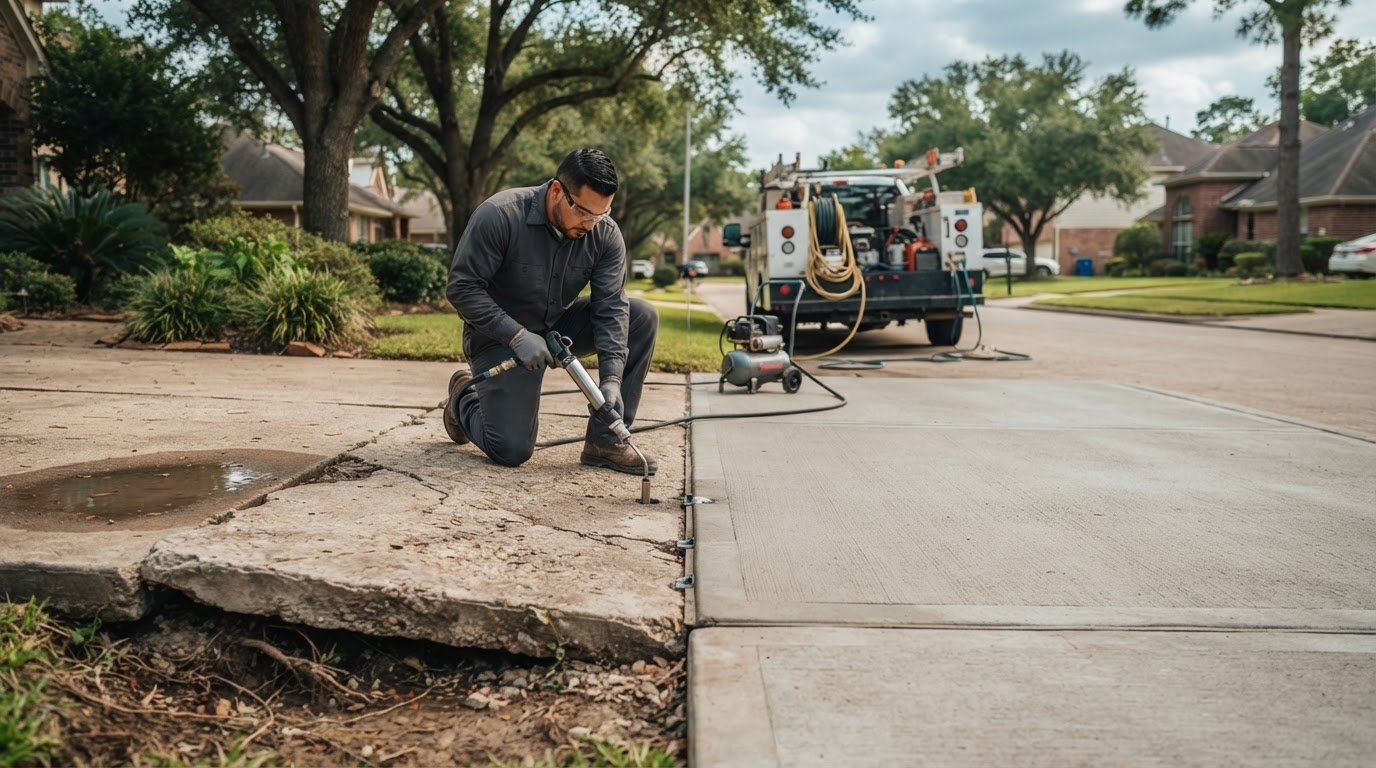
What if your uneven driveway doesn’t need to be torn out and replaced? A raised edge, low spot, or slab that has become a tripping hazard can make it hard to know what to do next. With driveway leveling Houston homeowners can have settled concrete lifted and stabilized when the slab is suitable for the work.
Houston’s expansive clay soil can swell when wet and shrink during dry periods, contributing to movement beneath concrete. That doesn’t automatically mean a driveway needs replacement, or that leveling is right for every slab. An assessment of the concrete and site conditions helps determine whether it can be lifted and stabilized or whether another repair is more appropriate.
In this guide, you’ll learn what may cause driveway movement, how concrete leveling differs from replacement and foundation repair, and what to consider before choosing a next step. Hercules Foundation Repair provides concrete leveling for residential and commercial properties in Houston, as well as foundation repair and concrete leveling in San Antonio, Austin, and Victoria. The practical starting point is to understand the driveway’s condition, then plan work that fits the slab.
Key Takeaways
- Sloping sections, uneven joints, pooling water, and raised edges can help you identify driveway areas that need attention.
- With driveway leveling Houston homeowners can have existing concrete lifted and stabilized when the slab’s condition makes leveling a suitable option.
- Leveling works with the existing slab, while replacement installs new concrete. The slab’s condition and project goals help guide the choice.
- Before discussing the project, note where water collects and where slabs meet. These observations describe what you see, but don’t diagnose the cause.
- Hercules Foundation Repair provides concrete leveling for sinking driveway slabs in Houston. An assessment is a practical next step.
Why Houston Driveways Sink and When Uneven Concrete Needs Attention
A sloping slab, a joint that no longer lines up, water pooling after rain, or a raised concrete edge can make a driveway awkward to walk and drive across. These changes are worth noting, especially if they create a trip hazard or make it difficult to move a vehicle smoothly from one section to another. They show that the surface has changed, but they don’t reveal the cause on their own.
Driveway leveling is the process of raising and stabilizing a settled concrete slab to make its surface more even. Whether leveling is appropriate depends on the slab’s condition and the support beneath it.
Which driveway changes should homeowners notice?
Look for a height difference where neighboring sections meet. One edge may sit higher than the next, or a slab may slope toward the house, garage, or another part of the driveway. Gaps at joints, new or widening cracks, and a transition that catches a shoe or tire can also indicate that the surface has shifted.
Notice how you use the driveway, too. A change in slope may direct water toward a spot where it collects, while an uneven joint can make walking or rolling bins across the surface less comfortable. These observations help describe the problem and its location. They aren’t a diagnosis, and one visible symptom can have more than one explanation.
Consider how much of the property appears affected. Movement limited to one driveway section is different from changes that also show up around a nearby porch, garage, or other structure. If several areas seem affected, note each location instead of assuming they share a cause. An on-site assessment can consider the driveway in context.
How Houston conditions may affect driveway concrete
Soil support matters because concrete depends on the ground beneath it for an even base. In the Houston area, expansive clay soils can change volume as moisture levels change. As expansive clay soils absorb water, they can swell; as they dry, they can shrink. That movement may affect the support under a slab and contribute to unevenness.
Rain and runoff can also affect the ground around a driveway. Where water drains, whether it collects beside a slab, and how the underlying soil responds can all be relevant when considering movement. Drainage is one possible factor, not a conclusion about any individual property. Houston’s soil and weather conditions don’t cause every driveway to settle in the same way.
A symptom alone can’t establish whether soil movement, drainage, slab support, or another site condition is involved. The pattern and location of the changes matter. For homeowners considering driveway leveling Houston, an assessment of the specific slab and site is the practical way to choose an appropriate repair.
How Professional Driveway Leveling in Houston Lifts and Stabilizes Concrete
Professional driveway leveling is a measured repair, not simply an attempt to make a low spot look better. The slab’s condition, the amount of movement, and the surrounding concrete help determine what work is appropriate. Hercules Foundation Repair provides concrete leveling to lift and stabilize sinking slabs, with the project scope shaped by conditions at the property.
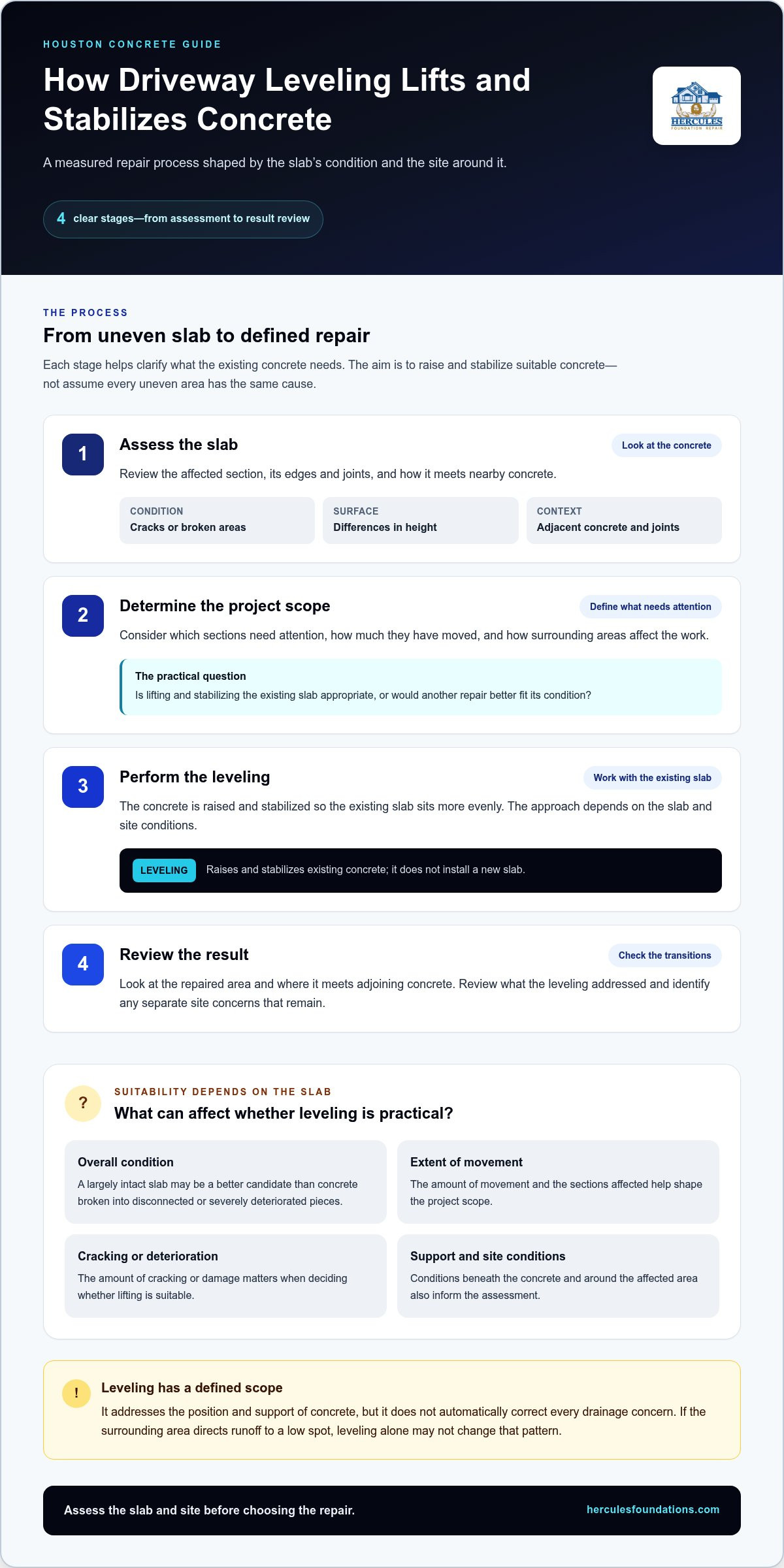
The process follows a straightforward sequence:
- Assess the slab. Review the affected section, its edges and joints, and how it relates to nearby concrete. Cracks, broken areas, and differences in height help describe the slab’s condition.
- Determine the project scope. Consider which sections need attention and how the surrounding area affects the work. The aim is to define a practical repair, not assume that every uneven area has the same cause.
- Perform the leveling. The concrete is raised and stabilized so the existing slab sits more evenly. The approach depends on the slab and site conditions.
- Review the result. Look at the repaired area and its transitions to adjoining concrete. This helps establish what the leveling addressed and whether other site concerns remain separate.
What happens during a driveway leveling project?
The affected concrete and the area around it guide the scope. For example, a low section next to a garage needs to be considered alongside the neighboring slab and the driveway’s slope. The work aims to raise the existing concrete and improve its support, rather than replace it with a new slab.
That distinction matters. Leveling addresses the position and support of the concrete, but it doesn’t automatically correct every drainage concern. If water continues to collect because of how the surrounding area directs runoff, leveling alone may not change that pattern. The assessment and review should keep those issues distinct rather than treating one repair as a fix for everything.
What determines whether a slab can be leveled?
Not every slab is a good candidate. Its overall condition, the extent of movement, and the amount of cracking or deterioration all affect whether lifting is practical. A slab that remains largely intact may be a better candidate than concrete that has broken into disconnected or severely deteriorated pieces. In the latter case, another repair may be more suitable.
Conditions beneath concrete matter, too. The USDA-NRCS educational resource on Houston Black soils describes local soil characteristics relevant to understanding ground movement, but soil type alone can’t establish what has happened beneath a particular driveway. Site conditions shape both the suitable approach and the result that can reasonably be achieved.
Leveling doesn’t guarantee that a driveway will never move again, and it isn’t a substitute for addressing unrelated structural concerns. For a project-specific next step, learn about Hercules concrete leveling for Houston driveways.
Driveway Leveling or Replacement: Which Houston Concrete Fix Fits?
An uneven driveway doesn’t automatically need to be demolished. The choice between leveling and replacement depends on the existing concrete’s condition and what the repair needs to accomplish. Leveling aims to raise and stabilize usable concrete; replacement removes damaged concrete and installs a new slab. An assessment of the specific driveway helps distinguish these options.
| Consideration | Leveling | Replacement |
|---|---|---|
| Slab condition | May suit a settled slab that remains sufficiently intact to be lifted and stabilized. | May be relevant when concrete is extensively deteriorated, fragmented, or otherwise unsuitable to retain. |
| Project purpose | Adjusts the position of existing concrete and its support. | Removes and replaces concrete, providing a new slab. |
| When to assess further | When the cause or extent of movement isn’t clear, or nearby areas appear affected. | When damage is widespread or the existing slab’s condition raises questions about retaining it. |
When may driveway leveling be a practical option?
Leveling may be worth considering when a driveway section has settled but the concrete remains largely intact. For example, a slab that sits lower than its neighbor but hasn’t broken apart may be a candidate for lifting and stabilization. The purpose is to improve the position of the existing surface, not install new concrete.
This makes leveling a practical alternative to assuming replacement is necessary as soon as a height difference appears. Still, appearance alone can’t determine suitability. Cracks, the slab’s overall condition, and the extent of movement all matter. An on-site assessment of the driveway helps establish whether leveling fits the repair goal. Homeowners comparing approaches can read this guide to compare concrete leveling options.
When might replacement or foundation assessment be relevant?
Concrete that has broken into multiple pieces or deteriorated across a broad area may not be suitable for lifting as a single slab. In that situation, replacement may be more appropriate because it provides new concrete rather than trying to retain damaged sections. The decision depends on the condition and extent of the damage, not just one crack or uneven edge.
A driveway concern is also different from a structural foundation concern. A driveway slab can move independently of a home’s foundation. If changes also appear to affect the home, such as movement or cracking in the structure, the issue may call for broader assessment rather than treating driveway leveling as the answer. For concerns involving a slab foundation, see this slab foundation repair guide.
For driveway leveling Houston homeowners, the practical next step is to assess the slab before choosing a repair. That keeps the decision focused on the concrete’s actual condition and the purpose of the work.
Prepare for Houston Driveway Leveling with a Clear Project Assessment
A clear description of the problem makes the first project discussion more useful. Before discussing driveway leveling Houston, take a little time to record what you’ve noticed. You don’t need to identify the cause. The purpose is to show which areas have changed and what happens around them, so the driveway and its setting can be considered together.
What information helps describe the driveway problem?
Start with the location. Note which driveway sections appear uneven, where adjoining slabs meet, and whether the change is close to the garage, walkway, or street. If you remember when you first noticed the difference, or whether it seems to have changed since then, include that too. A simple description such as “the left section sits lower beside the garage” is more useful than a general note that the driveway looks uneven.
Next, record the visible details. You may find it helpful to note:
- Where cracks appear and whether they cross a joint or run through a slab.
- Which way the surface seems to slope, especially near a doorway or adjoining concrete.
- Where water collects after rain and whether that spot recurs.
- Which edges or joints show a noticeable height difference.
Photos can help document what you see. Take them from a few angles, including a wider view that shows where the affected section sits in relation to the rest of the driveway. If water accumulation is part of the concern, capture the area when it’s visible. Photos are useful records, but they can’t show the condition beneath the slab or replace an in-person assessment.
How to set practical expectations for the work
A driveway assessment should consider slab condition, movement, and surrounding drainage. These factors help determine the project scope and whether the work should focus on one section or a broader area of concrete. What you observe is useful context, not a diagnosis: a low spot or recurring puddle alone can’t establish why the driveway has changed.
Keep your notes available for the project discussion, and point out the areas that affect everyday use most. The assessment can then focus on the actual driveway conditions rather than assumptions based on a single photo or symptom. Hercules Foundation Repair provides concrete leveling to lift and stabilize sinking slabs, with the project scope guided by the affected concrete and site conditions.
The recommended work should reflect those observations and the on-site assessment. The exact scope, timing, and suitable result depend on the driveway, so discuss them in relation to the specific project rather than assuming them in advance.
When you’re ready to discuss your observations and project scope, discuss a Houston driveway project with Hercules Foundation Repair.
Choose Hercules for Houston Driveway Leveling and Take the Next Step
An uneven driveway can leave you unsure whether to monitor the change, level the concrete, or consider another repair. A useful next step is to discuss what you’re seeing with a team that provides concrete leveling in Houston. Hercules Foundation Repair is a family-owned and operated South Texas business founded in 1980, providing concrete leveling for residential and commercial properties.
That history reflects a local presence, not a promise that every driveway will need the same repair or have the same result. Each slab has its own condition and site factors. A useful discussion starts with your driveway’s actual symptoms and focuses on a project-specific path.
What Hercules brings to a driveway leveling project
Hercules provides concrete leveling to lift and stabilize sinking slabs. The work focuses on the existing driveway concrete and the support needed to address its settled position. The appropriate scope depends on the affected slab and conditions at the property, rather than a one-size-fits-all method.
Hercules also provides structural foundation repair. That service is relevant context if you’ve noticed movement beyond the driveway, but an uneven driveway doesn’t automatically require foundation work. A driveway concern and a structural concern are distinct, and the project discussion should focus on the conditions you’re observing.
How to move from uneven concrete to a clear plan
Before getting in touch, gather a few simple details. Identify which driveway sections look uneven, where adjoining slabs meet, and whether you’ve noticed changes in cracks, slope, or water accumulation. If you’ve taken photos, keep them handy as a record. These details help describe the concern, but an image or observation alone can’t establish the cause or determine the repair.
Share what matters most in everyday use, too. For example, mention if a particular transition feels difficult to cross on foot or if a section affects access to the garage. You don’t need technical terms. A straightforward account of what has changed and where it’s happening gives the discussion a useful starting point.
From there, Hercules can discuss a project-specific path based on the driveway’s condition. The goal is to determine what work fits the concrete, without assuming a particular technique, price, timeline, or outcome before the project is assessed. If replacement or a broader structural concern seems relevant, keep those considerations separate from the question of leveling the driveway slab.
If you’re considering driveway leveling Houston homeowners can discuss with a local concrete leveling team, contact Hercules Foundation Repair to talk about the driveway areas and changes you’ve noticed.
Take the Next Step Toward a More Usable Driveway
You don’t have to settle on leveling or replacement before discussing the driveway. Start with the areas that concern you and the change you’d most like to address. A project-specific conversation can help turn those observations into a practical direction, without assuming the repair or result before the concrete has been assessed.
That’s a sensible way to approach driveway leveling Houston: focus first on the condition of your own driveway, then consider the work that fits. If the surface affects how you walk, park, or access your home, explore the options and decide on a next step based on the slab’s condition.
Share your driveway concerns with Hercules and start a conversation about your project. A clearer plan begins with a straightforward look at what’s happening on your property.
Frequently Asked Questions
Can I level a sunken concrete driveway myself?
For a sunken slab, professional assessment is usually the safer first step. Concrete is heavy, and attempting to lift it without suitable equipment or a clear understanding of the cause can worsen the unevenness or create a hazard. DIY patching may improve a small surface blemish, but it won’t necessarily correct a slab that has moved. If the driveway is tilted, cracked, or difficult to cross, document the area before deciding how to address it.
How long does driveway leveling take in Houston?
There isn’t one reliable timeframe for every driveway leveling Houston project. The work duration depends on factors such as how many sections are affected, the slab’s condition, and the project scope. One area and several connected sections aren’t the same job. A project-specific time estimate should follow an assessment of the affected concrete, so plan around the details for your driveway rather than a general online estimate.
Can I park on my driveway immediately after leveling?
Don’t assume the driveway is ready for vehicle traffic as soon as the work looks finished. The appropriate wait, if any, depends on the project and the work performed. Before using the driveway, follow the project-specific instructions about when vehicles can return and whether access restrictions apply to one section or the full surface. Don’t judge readiness by appearance alone.
Does homeowners insurance cover driveway leveling?
Coverage depends on the terms of your policy and the circumstances behind the damage, so there’s no universal answer. Review your policy language and ask your insurer how it treats the specific driveway issue before making assumptions about reimbursement. Photos, the date you noticed the change, and a description of what happened can help you explain the situation. Don’t treat an estimate or repair recommendation as confirmation of coverage.
Will heavy rain affect a driveway leveling project?
Heavy rain may affect the ground and work conditions around a driveway, so its impact depends on the property and project. Water collecting near the slab, saturated ground, or restricted access may be relevant to planning. Note where runoff gathers and whether the area stays wet after rainfall. Share those observations during the project discussion; they can inform the assessment, but they don’t establish the cause of the slab movement.
Can tree roots cause an uneven concrete driveway?
Yes, tree roots can contribute to uneven concrete if growing roots push against or beneath a slab. But a nearby tree doesn’t prove that roots caused the movement. Look for changes concentrated near a tree, visible roots, or a shifted slab edge, then share those details during an assessment. Avoid cutting large roots based only on the driveway’s appearance, since that may affect the tree or leave the underlying concrete issue unresolved.