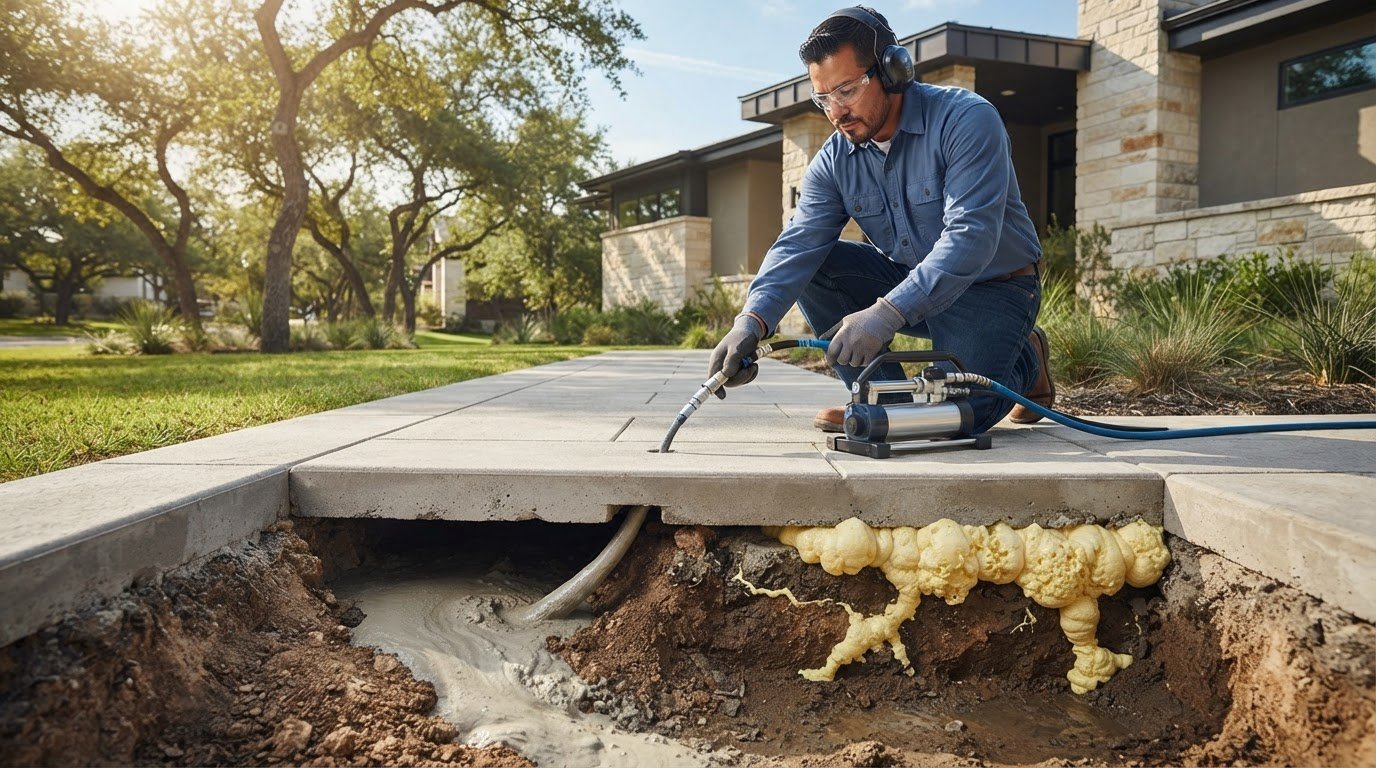
A settled concrete slab doesn’t always need to be demolished. For concrete lifting in Austin, mudjacking and hydrophobic polyurethane foam can raise sunken concrete by injecting material beneath it. Mudjacking uses a cement-based slurry, while foam is injected into voids under the slab to lift it. When the concrete is suitable for raising, lifting may offer an alternative to removing and replacing it.
Uneven sidewalks, patios, driveways, and other slabs can create trip hazards and make everyday access harder. A sunken section doesn’t always mean a full tear-out is the only answer. The right method depends on the slab’s condition and what is happening beneath it.
This guide explains how mudjacking and foam lifting work, how their differences can affect a repair, and what to consider when deciding whether lifting can avoid demolition. You’ll also learn what the process involves and when concrete leveling may be a practical next step for a settled slab in Austin.
Key Takeaways
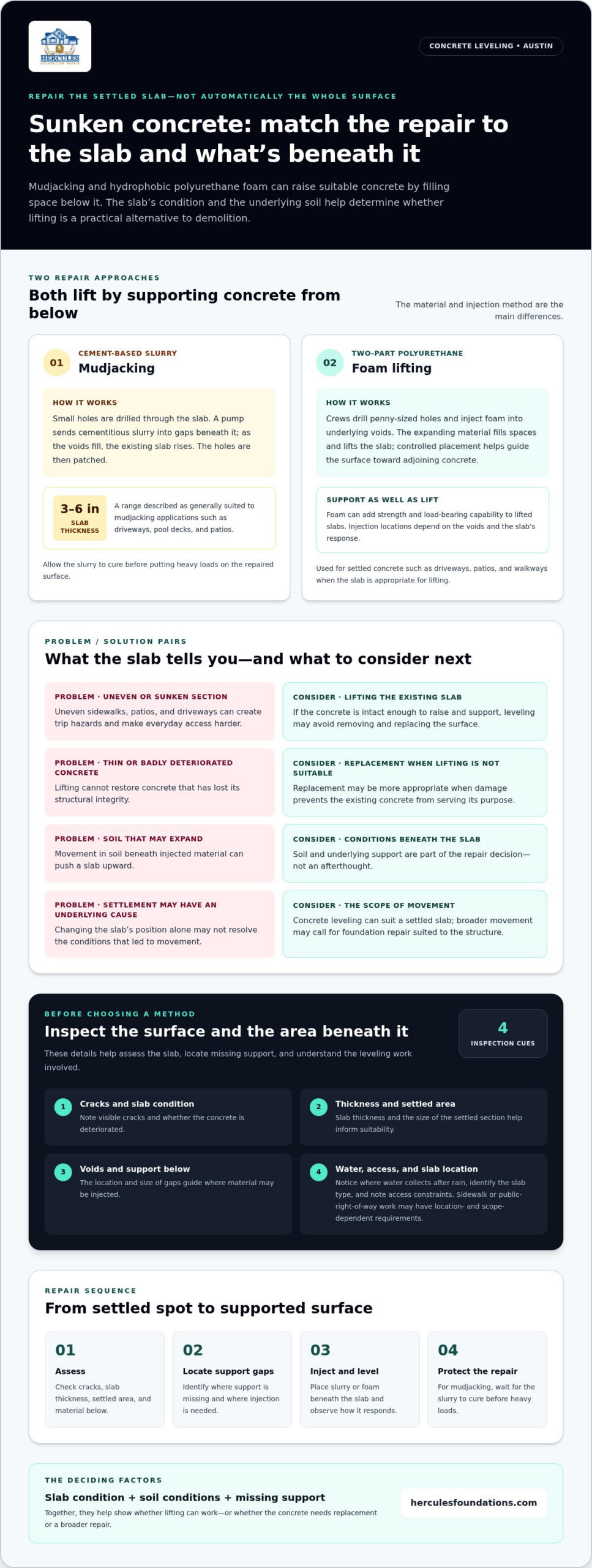
- Mudjacking raises settled slabs by pumping cement-based slurry beneath them, and it’s generally suited to concrete that’s 3 to 6 inches thick.
- Hydrophobic polyurethane foam is injected into voids beneath a slab through small drilled holes; the material expands to help lift and support the concrete.
- Before choosing a repair method, consider the slab’s condition and what’s happening in the soil beneath it. Those factors help determine whether lifting can avoid demolition.
- Settlement can have underlying causes, so addressing the slab’s position alone may not resolve the conditions that led to movement.
- Concrete leveling can be a practical next step for sunken slabs, while broader movement may call for foundation repair suited to the structure.
Concrete Leveling Austin: What Is Mudjacking?
Mudjacking lifts a settled slab by pumping cementitious slurry beneath its surface. It can be an alternative to demolition when the concrete is suitable for lifting and conditions below it support the repair.
The process starts with small holes drilled through the slab. A crew pumps a cement mixture through the openings into gaps beneath the concrete. As the mixture fills the voids, it raises the slab toward a more even position. The holes are then patched. CRC Geotech describes concrete raising as also known as poly jacking, mud jacking, concrete lifting, or slab raising.
In most applications, the injected material is low-strength concrete mixed into a pumpable slurry. Unlike placing a new concrete surface, the goal is to support and raise the existing slab, not replace it. The injection points and amount of material depend on where support is missing and how the slab responds during leveling.
Driveways, pool decks, patios, and similar structures may suit mudjacking when their concrete is 3 to 6 inches thick. A thin or badly deteriorated slab may not be a good candidate because lifting cannot restore concrete that has lost its structural integrity. A professional assessment considers cracking, slab thickness, the size of the settled area, and the material below it.
Mudjacking can be completed quickly. Allow the slurry to cure before putting heavy loads on the slab. This can be faster than pouring new concrete, which takes several days to complete. Keep vehicles and other heavy loads off the repaired surface until it is ready for use.
Soil conditions matter. Avoid mudjacking where soil beneath the injected material may expand, because that movement can push the slab upward. Conditions below the slab are part of the repair decision, not an afterthought.
When should concrete be lifted instead of replaced? Lifting is practical when the slab is intact enough to raise and support. Replacement is more appropriate when damage prevents the existing concrete from serving its purpose. The slab’s condition and the soil beneath it guide the decision.
Mudjacking may reduce the need for demolition and replacement when the existing slab can be reused. The price depends on the project and is provided after a quote request; material use and site access affect the estimate. The method may avoid replacement work, but it won’t repair severely damaged concrete.
Do Austin permits or local rules apply to concrete lifting? Requirements depend on the project’s location and scope, especially when work involves a sidewalk or public right-of-way. Before planning, identify whether the slab is a private driveway, patio, or public-facing walkway.
How can homeowners prepare for concrete lifting and get an accurate estimate? Clear the slab, mark the settled area, and note whether it is a driveway, patio, or walkway. Share the slab’s dimensions, visible cracks, access constraints, and any known soil movement so the estimate reflects the work involved.
Hydrophobic polyurethane foam lifting
Polyurethane foam lifting raises settled concrete by injecting material into voids beneath the slab. Small access holes and controlled placement allow the method to support concrete without removing the entire surface.
Polyurethane Foam Injection
The process begins by locating the settled area and identifying where support is missing beneath it. Crews drill penny-sized holes through the concrete, then inject two-part polyurethane foam into the underlying voids. As the material fills those spaces, it lifts the slab. The injection points let the crew direct material beneath the affected surface instead of excavating around it.
Hydrophobic polyurethane foam is used for concrete leveling because it can enter gaps below a slab and provide support as the concrete rises. The goal is to restore a more even surface while retaining the existing concrete. The size and location of the voids guide where injection is needed, focusing the repair on the settled area rather than applying material indiscriminately.
Placement matters. A crew can observe how the slab responds as foam is injected and adjust the work to bring the surface toward the adjoining concrete. For example, a sunken walkway beside a level section needs a controlled transition, not simply upward movement at one point. The slab’s condition and the voids beneath it shape the injection pattern.
Polyurethane foam can also add strength and load-bearing capability to lifted slabs. That makes support beneath the concrete part of the repair, not just a way to change its height. A driveway, patio, or walkway still needs an assessment of its cracks and overall condition before choosing a lifting method.
Foam Lifting Compared With Mudjacking
Polyurethane foam lifting injects two-part foam through penny-sized holes, while mudjacking pumps cement-based slurry beneath the concrete. Both methods aim to raise a settled slab by filling space below it. Foam lifting uses polyurethane; mudjacking uses a cement mixture. The material and injection approach are the main differences homeowners should consider.
What is the difference between polyurethane foam lifting and mudjacking? Foam lifting injects two-part polyurethane into voids, while mudjacking pumps cementitious slurry beneath the slab. The choice depends on the slab, the space beneath it, and the support the repair needs to provide.
Before either method, inspect the surface. Note uneven joints, visible cracks, and where water collects after rain. These details help show how the slab has settled and where it needs support. They can also distinguish a localized low area from broader movement affecting several concrete sections.
Concrete lifting in Austin can involve different materials and repair approaches, so match the method to the slab and its underlying support needs. A professional concrete leveling assessment can connect the surface condition with the location of voids beneath it. For a settled slab, concrete leveling is a practical next step to discuss.
Company experience and reputation
Concrete leveling involves more than raising a low spot. The work begins by understanding what moved, where support is missing, and whether the slab can be lifted. Experience matters because the same symptom can have different causes. A sunken walkway, a cracked shed slab, and a settling foundation each need a clear diagnosis before a repair is selected.
In Austin, one reported job request involved a church sidewalk section sitting 1-3 inches above the adjoining section. That example shows why the transition between slabs matters: a repair must address the uneven joint, not just the lowest point. Another Austin request concerned a 167-square-foot shed slab that had sunk and cracked. The slab’s size, visible damage, and purpose all help define the work.
A clear explanation of the proposed work connects the observed condition to the repair method. Concrete leveling addresses a settled slab, while foundation repair concerns movement affecting the structure’s support. A crack inside a home alone doesn’t prove there is a foundation problem. The diagnosis should distinguish surface damage from movement that affects the foundation.
Clear project communication helps homeowners understand the work involved. A useful estimate describes the affected area, the planned repair, and factors that may change the scope, such as access or the slab’s condition. It should also explain how the repaired surface will be used and when heavy loads can return. These details clarify the plan without relying on broad claims.
Reputation is best considered alongside the actual explanation of a job. Look for a specific account of the slab, the cause of settlement, and the reasoning behind the repair. A general promise of a level surface doesn’t explain whether the method suits the concrete or its underlying support. In a 30-year-old walkway problem, for instance, the long history of settlement would be relevant to understanding the site.
Before work begins, homeowners can prepare a concise record: photograph the slab, mark uneven joints, and note where water collects. Include whether the area is a driveway, patio, sidewalk, or shed slab. These details help inform the assessment and keep the proposed scope focused on the actual problem.
For Austin properties, a careful conversation about the slab and surrounding foundation can clarify whether concrete leveling or foundation repair addresses the issue. The strongest next step is a repair plan that explains the observed condition, the chosen approach, and the work’s limits in plain language.
Avoiding concrete demolition
Concrete lifting can preserve an existing slab when it is suitable for raising and support can be restored underneath. Instead of breaking out the entire surface, the repair addresses the settled area. This can matter for a driveway, walkway, patio, or shed slab where the concrete is uneven but still usable.
An Austin job request described a 167-square-foot shed slab that had sunk and cracked. That example shows why area and condition both matter. A professional assessment considers whether the slab can be lifted as a whole, whether cracks affect its integrity, and whether the space beneath it can receive support. Raising a damaged slab without addressing those factors won’t resolve the underlying problem.
Start by mapping the affected surface. Note where the concrete dips, where adjoining sections meet unevenly, and whether the problem affects one section or several. For a driveway, record the low area and how it meets the garage or sidewalk. These observations help distinguish localized settlement from movement across a larger area.
Next, consider the slab’s condition. Concrete lifting raises existing concrete; it doesn’t rebuild material that has broken apart or lost its ability to function. A cracked section may still be a candidate if it is stable enough to lift, while widespread deterioration points toward replacement. The decision should account for both visible damage and support underneath.
The goal is a practical surface, not simply a higher slab. A walkway that has settled beside another section, for example, needs a usable transition between them. A driveway should meet adjacent concrete without creating a new abrupt edge. The planned lift should address the affected area and its connection to nearby slabs.
Before choosing demolition, gather useful details for an assessment. Photograph the surface from several angles, mark the settled section, and note where water collects. Include the slab’s use, such as a shed foundation, driveway, or patio, and describe any changes you’ve observed. These steps help clarify whether lifting can preserve the concrete or replacement better suits its condition.
Concrete lifting in Austin can avoid a full tear-out when the existing slab can be raised and supported. It isn’t suitable for every damaged surface. The key is matching the repair to the slab’s condition, the settlement pattern, and the support available underneath. That assessment helps homeowners decide whether to preserve the concrete or replace it.
Causes of concrete settlement
A concrete slab settles when the ground or material supporting it changes. The surface may dip, tilt, or separate from adjoining concrete. In Austin, a reported walkway was cracked and sunken for at least 30 years. Its age alone doesn’t explain the cause, but the long history shows why the movement beneath a slab matters.
One common cause is a void forming underneath the concrete. Soil can wash away or shift, leaving part of the slab without even support. A driveway may then sink near an edge while the rest remains closer to its original position. Gaps, uneven joints, and water collecting beside the slab can help show where support may have changed.
Water movement is another factor. Runoff that repeatedly travels along a patio or walkway can affect the soil below, especially when drainage directs water toward the concrete. Note where water flows after rain and whether the low area stays damp. These observations can help connect a visible dip with conditions around the slab.
Soil can also change volume as its moisture changes. If soil beneath a slab expands, the concrete above may move upward; if support is lost or the soil shifts, sections can settle. This matters when selecting a lifting method. Avoid mudjacking where the soil beneath the injected material may expand, as that movement can push the structure upward.
Construction conditions can contribute, too. If fill beneath a new slab wasn’t adequately compacted, it may compress under the concrete’s weight. For example, a patio over disturbed ground may settle unevenly as the supporting material changes. The movement pattern, surrounding grade, and slab condition help distinguish this from damage limited to the concrete itself.
Cracks provide clues, but they don’t establish the cause by themselves. A crack in a home doesn’t necessarily indicate foundation or concrete trouble. Compare its location with other signs, such as a dipped walkway, uneven driveway sections, or doors and windows that have begun sticking. Several observations provide a clearer picture than one crack alone.
To document movement, photograph the slab from the same position over time, mark where the surface meets adjoining concrete, and note changes in drainage. Include whether the affected area is a patio, driveway, or walkway. These steps help connect symptoms to the supporting soil and guide the repair decision. For a settled slab, request concrete leveling as a next step.
Hercules Foundation Repair: Foundation Repair
Hercules Foundation Repair helps property owners address structural movement through foundation repair, including slab foundation repair and pier and beam foundation repair. If settlement affects more than an isolated walkway or driveway, foundation movement may need attention alongside the concrete surface.
For commercial properties, commercial foundation repair addresses structural concerns in a business setting. The right approach depends on what has moved and whether the issue is limited to a concrete slab or involves the building’s support. Sharing where you see cracks, uneven floors, or changes around the foundation can help clarify the problem and relevant repair.
If you’re weighing concrete leveling against foundation repair, contact Hercules Foundation Repair to discuss the condition affecting your property.
Choose a Clear Next Step for Your Property
The next step is to connect the visible concrete problem with the part of the property it affects. Note where movement appears, whether it extends into the building, and how you need the surface to function safely. These details help focus the discussion on a suitable repair rather than assumptions based on one crack or uneven section.
For concrete lifting in Austin, the key decision is whether the concern is limited to a concrete slab or points to broader structural movement. Hercules Foundation Repair offers concrete leveling, foundation repair, slab foundation repair, and pier and beam foundation repair. This range helps property owners consider the appropriate work for a settled slab or a foundation concern.
Bring your observations to the next conversation and discuss the condition affecting your property. Contact Hercules Foundation Repair to take that next step. A clear understanding of the problem is a practical place to start, and you can move forward with more confidence.
Frequently Asked Questions
What is Mudjacking?
Mudjacking raises settled concrete by pumping cement-based slurry beneath the slab. The material fills gaps and supports the existing concrete as it is lifted. For example, a low patio section can be raised toward the level of the adjoining slab without removing the whole surface. The method suits concrete that remains sound enough to lift, rather than slabs too damaged to function.
What is concrete lifting and how does it work?
Concrete lifting restores a settled slab’s position by adding support underneath it. A crew identifies the low area, makes small openings, and injects lifting material into the voids below. Mudjacking uses cementitious slurry, while polyurethane foam lifting uses injected foam. As the material fills gaps, the slab rises. The repair supports existing concrete, so the slab’s condition and settlement pattern matter.
How much does concrete lifting cost in Austin, TX?
The price depends on the project and is provided after a quote request. The estimate reflects factors such as the area being lifted, material needed, slab condition, and site access. A small sidewalk section and a larger driveway involve different scopes. To make the estimate more useful, describe the affected area and its use, and point out visible cracks or uneven joints.
What factors affect concrete lifting prices in Austin?
Project scope and site conditions shape the estimate. The size and location of the settled section affect the amount of material and work involved; restricted access can also change the plan. Slab damage matters because lifting addresses position and support, not concrete that has deteriorated beyond use. For an Austin driveway, note where the low area meets the garage, walkway, or adjoining slabs.
Which Austin contractors offer concrete lifting and have strong reviews?
Hercules Foundation Repair offers concrete leveling for uneven concrete surfaces. No review ratings are provided here, so this answer doesn’t claim a specific review score. For a project in Austin, describe the affected slab and its movement, then focus the discussion on the repair approach and the condition being addressed. The relevant service depends on whether the problem is isolated to concrete or involves the building’s foundation.
How long does concrete lifting take, and when can the concrete be used?
Most mudjacking projects take a couple of hours, depending on job size, and the slurry needs several hours to cure before it can bear heavy loads again. The work sequence depends on the number and placement of injection points. For example, keep vehicles off a repaired driveway until curing is complete. Light access and heavy use differ, so follow the project instructions.
What types of concrete slabs can be lifted, such as driveways, sidewalks, and patios?
Driveways, sidewalks, patios, pool decks, and shed slabs can be candidates when their concrete remains suitable for lifting. Mudjacking is described for structures with slabs 3 to 6 inches thick. A cracked shed slab or uneven sidewalk needs attention to both slab condition and support underneath. The intended use also matters, since a vehicle-bearing driveway has different demands from a garden path.
What are the risks and limitations of concrete lifting?
Lifting can’t restore concrete that has deteriorated too much to function, and it doesn’t automatically correct the cause of settlement. Expanding soil beneath mudjacking material can push the structure upward, so this condition matters when selecting a method. A crack alone doesn’t prove foundation trouble. In Austin, describe changes across the slab and nearby surfaces to help distinguish localized settlement from broader structural movement.