
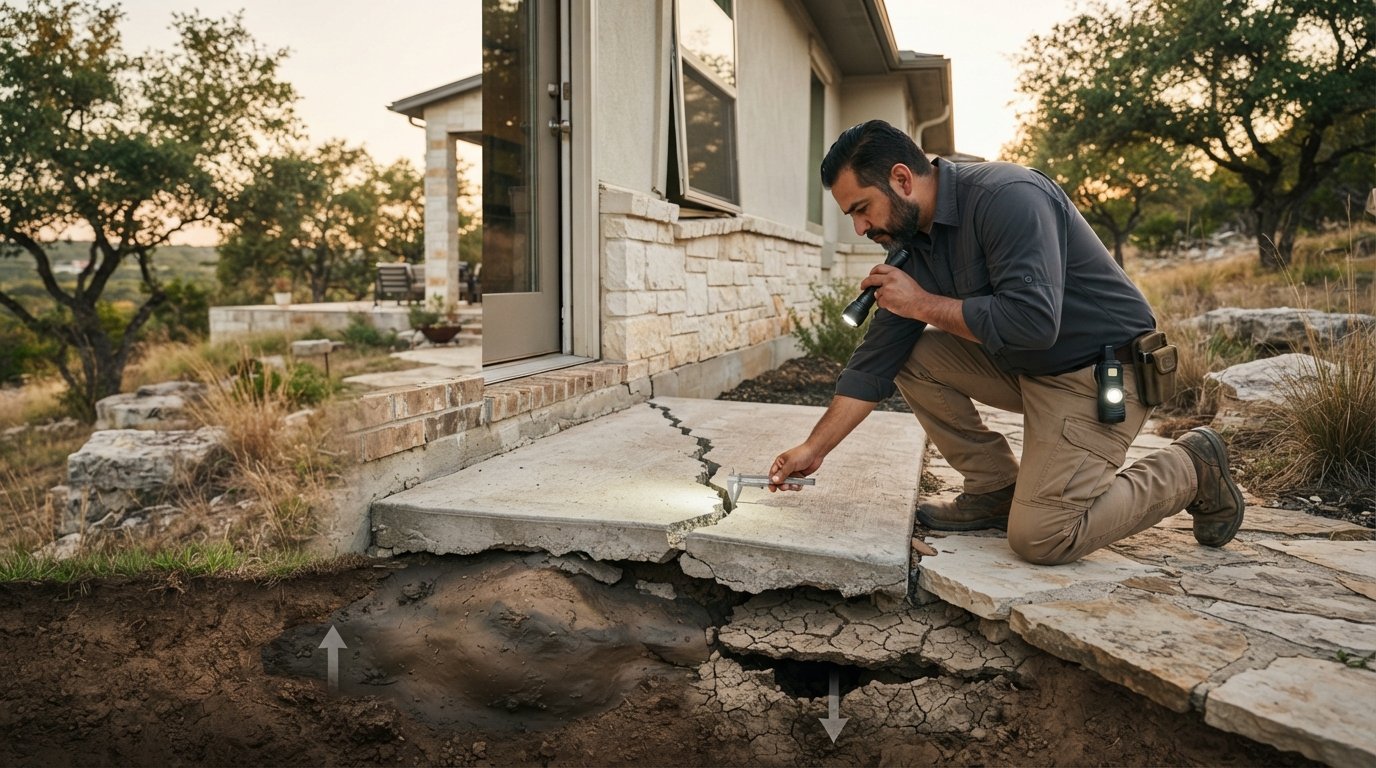
A foundation report doesn’t automatically end a home purchase; it can give buyers a basis to negotiate repairs or a credit with the seller. Clay-soil foundation problems in Austin often follow swings in soil moisture: expansive clay can change volume by as much as 15 percent between dry and saturated conditions, putting pressure on a home’s foundation.
It’s understandable to feel concerned when you notice a new crack or a door that suddenly sticks. Knowing how local clay behaves can help you distinguish signs worth monitoring from patterns that call for a closer look. This article explains how expansive soil affects foundations, what warning signs to watch for, how geology varies across Austin-area neighborhoods, and how steady moisture and drainage practices can help protect your home.
Key Takeaways
- Austin’s expansive clay swells when wet and shrinks when dry, creating repeated movement beneath foundations.
- Track patterns such as sticking doors, uneven floors, and widening cracks rather than judging a single small flaw in isolation.
- Steady soil moisture and good drainage can help reduce the effects of seasonal changes around your home.
- Local geology, nearby trees, and foundation design all influence how a home responds to shifting soil.
- Foundation repair needs depend on the type of foundation and the movement involved, so recommendations should address the home’s specific condition.
How common are foundation problems in Austin, Texas?
Foundation movement is a recognized concern in Austin because expansive clay reacts to changing moisture. A repair warranty sets out written coverage terms, while contractor licensing is a separate matter tied to the work and location.
Blackland Prairie Expansive Clay
Blackland Prairie clay is a fine-grained soil that can change volume as its moisture content shifts. In the Austin area, its plasticity index frequently exceeds 40, indicating a strong capacity to change shape when wet. Montmorillonite-rich expansive clay can absorb water between mineral layers, swelling beneath homes. That soil behavior helps explain why location and drainage matter when assessing foundation movement.
Seasonal Shrink-Swell Behavior
Seasonal shrink-swell behavior describes clay expanding when it takes in water and contracting as it dries. Austin’s expansive clay can change volume by as much as 15 percent between dry and saturated states. Summer drought can dry the soil, while heavy spring rain may deliver several inches in one storm and rehydrate it. Repeated cycles can cause uneven support beneath a foundation.
Moisture-Driven Foundation Movement
Moisture-driven movement occurs when changing water levels make clay swell or shrink below a structure. When clay expands, upward pressure can lift foundation sections. When it dries, soil contraction can reduce support and contribute to settling. Movement may be uneven rather than affecting the whole house uniformly. In Austin and San Antonio, these moisture changes can create pressure beneath foundations and visible distress.
The local pattern is not identical across the region. Expansive clay is most common in Austin areas east of I-35, while North Austin Blackland Prairie soils often have plasticity indexes exceeding 50. A neighborhood’s underlying soil can therefore affect how strongly moisture changes influence a home.
Texas Vertisols, a soil category defined by extreme shrink-swell behavior, occur across much of central and eastern Texas. When saturated, these soils can expand, though the degree varies. That figure describes soil behavior, not a guaranteed amount of movement at any individual house; foundation response also depends on moisture distribution and how the structure is supported.
Central Texas homes can show movement over time: about one-third show noticeable foundation movement within the first 20 years. This does not mean every home has damage or needs repair. It does make recurring changes worth tracking, especially when seasonal dryness and rainfall repeatedly alter the moisture in expansive clay beneath the property.
Interior and exterior warning signs of foundation movement
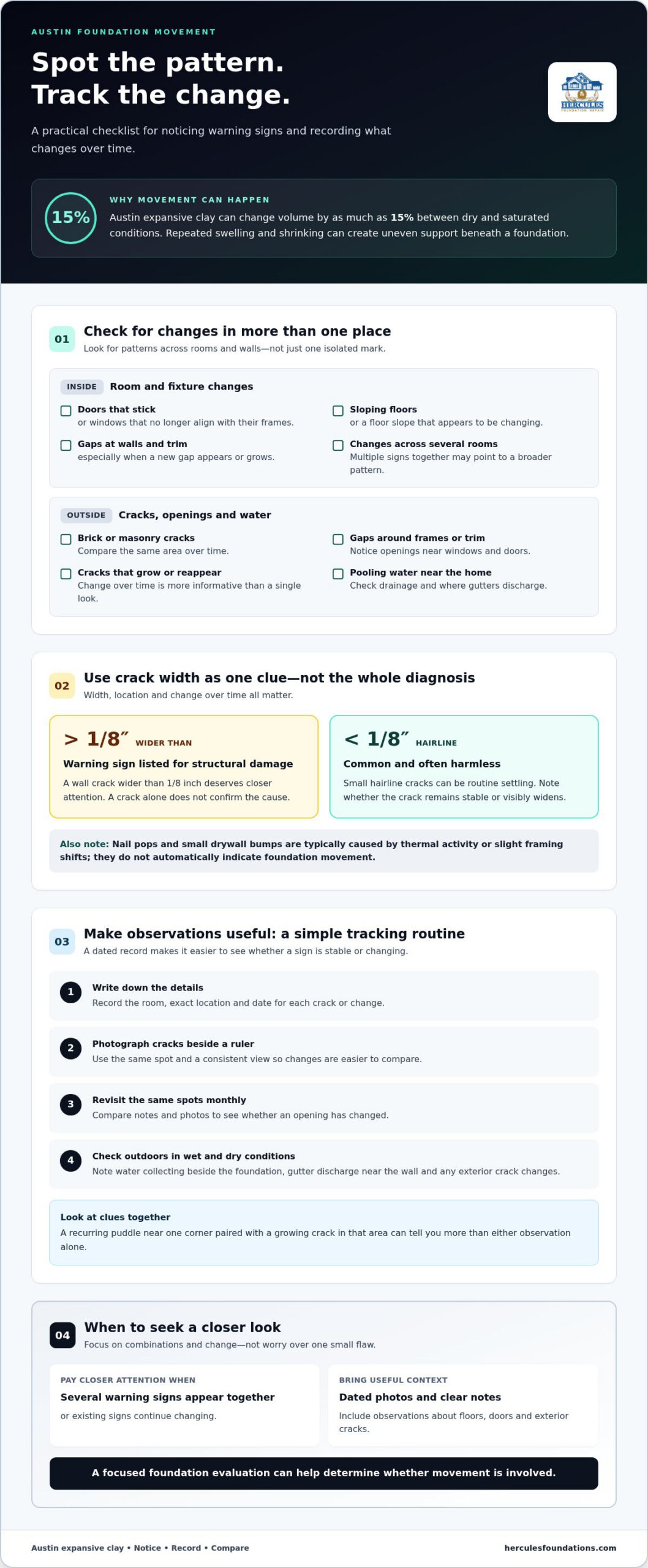
Foundation movement can show up inside the home, outside, or in both places. Look for patterns across rooms and walls, rather than focusing on one isolated mark.
Interior Signs of Foundation Movement
Interior signs are changes to rooms or fixtures that may reflect shifting support beneath the house. A door that sticks or a window that no longer aligns with its frame can follow foundation movement. Sloping floors and gaps between walls and trim are also worth watching. Several changes appearing together may point to a broader pattern.
Exterior Signs of Foundation Movement
Exterior signs include changes to visible surfaces and openings around the home. Check brick or masonry walls for cracks, and look for gaps near window frames, doors, or trim. Compare the same areas over time: a crack that grows or reappears deserves attention. Also note water pooling near the house, since drainage and gutters affect moisture around the foundation.
Visible Foundation Damage
Visible damage means cracking or separation that may reflect movement, though not every crack indicates structural trouble. In Austin homes, a wall crack wider than 1/8 inch is a warning sign listed for structural damage. Hairline cracks less than 1/8 inch wide are common and often harmless signs of routine settling. Width, location, and change over time help distinguish what needs closer attention.
Early Warning Signs
Early warning signs are small changes that can reveal a developing pattern before damage becomes more obvious. A slight floor slope, a new gap between trim and wall, or a sticking door can be useful observations. Nail pops and small drywall bumps are typically caused by thermal activity or slight framing shifts, so they don’t automatically indicate foundation movement.
Keep a simple record: note the room, location, and date, then photograph cracks beside a ruler. Revisit the same spots monthly to see whether openings change. A stable hairline crack, for example, differs from one that visibly widens in later photos. This record makes patterns easier to describe during an evaluation.
Look outdoors after rain and during dry weather. Note whether water collects beside the foundation, whether gutters discharge near the wall, and whether exterior cracks change. A recurring puddle near one corner, paired with a growing crack in that area, is more informative than either observation alone.
If several warning signs appear together or continue changing, a focused foundation repair evaluation can help identify whether movement is involved. Clear observations, including dated photographs and notes about floors, doors, and exterior cracks, give the assessment useful context.
How can I protect my home from expansive clay soil damage?
Protecting a foundation starts with steady moisture, good drainage, and attention to changes around the home. Piers and slab foundation repair are options for Austin homes, with the approach shaped by the foundation type and observed movement.
Foundation Evaluations and Repair Recommendations
A foundation evaluation documents the home’s condition and connects observed movement with a repair recommendation. In Texas, WPI-8 is an industry-standard format for foundation evaluation reports. Use the report to understand which areas need attention and how the proposed work relates to the findings. Annual foundation evaluations can also help identify developing concerns before they become more extensive.
For a useful record, keep dated photographs and notes about drainage changes or repairs together. If a new crack appears near a low spot where water collects, include both details. That context helps distinguish a surface issue from a pattern involving moisture, soil, and foundation movement.
Limits of Surface Crack Repairs and Mudjacking
Surface crack repair addresses the visible opening, but it doesn’t correct soil movement beneath the foundation. If moisture changes continue, cracks can reappear or widen, so patching alone may not resolve the underlying cause. Mudjacking can raise settled concrete, but it doesn’t stabilize expansive clay or correct drainage by itself. The method should match the condition being addressed.
For example, a repaired crack beside a persistently wet area may return if water continues collecting there. Correcting drainage and maintaining consistent soil moisture address contributing conditions, while structural movement may call for a different repair recommendation.
Piers and Slab Repair Methods
Piers and slab repair address different foundation conditions. Pier installation supports areas affected by significant movement, while slab foundation repair addresses problems involving a concrete slab. An evaluation should explain where movement occurs and why the recommended method suits that foundation. Concrete leveling is not interchangeable with structural foundation repair.
Water escaping beneath a home can saturate nearby soil, causing additional expansion and movement. An unexplained water-bill increase of 20% or more is a warning sign of possible plumbing damage. Multiple slow or gurgling drains can also indicate potential pipe misalignment. Prompt attention to these clues can help limit ongoing moisture exposure.
Buyers negotiating documented foundation issues may discuss repair credits with sellers. These figures describe reported credits, not repair prices or a guaranteed negotiation outcome. A clear evaluation report helps connect a requested credit to specific findings and recommended work.
Neighborhood geology and construction-related risks
In Austin and Travis County, foundation plans must account for applicable building-code requirements, the lot’s soil conditions, and the structure. A neighborhood name alone cannot determine the right foundation design for an individual property.
Neighborhood Geology
Neighborhood geology describes the soil and ground conditions beneath homes, which can vary across the Austin area. In Cedar Park, Round Rock, and Leander, clay soil can expand up to 10% in volume. That difference matters to homeowners because two nearby properties may respond differently to moisture, depending on their specific soil and drainage conditions.
Location provides useful context, not a diagnosis. Austin homes east of MoPac and built before 1990 are identified as higher risk for foundation problems. Large mature oaks or cedars within 20 feet of a foundation also create a higher-risk condition, as nearby roots can affect soil moisture. An evaluation should consider both the property’s setting and visible changes to the structure.
Foundation Age and Construction Quality
Foundation age and construction quality help explain how a home may respond to ground movement over time. Pier-and-beam homes in older Austin neighborhoods commonly date from the early 1900s through the 1960s. Their support system differs from a concrete slab, so homeowners should consider foundation type when uneven floors, shifting frames, or other changes appear.
Newer construction has its own timing considerations. Homes three to seven years old in Austin’s northern and eastern suburbs deserve particular attention because post-construction settlement issues typically appear during this window. A visible change in a newer home is useful information for an evaluation, but the home’s age alone does not establish the cause.
Post-tension slabs use high-strength steel cables that are tensioned after the concrete cures. This design accounts for forces from expansive soil and became more common in Texas residential construction over time. It is a different foundation system, not proof that a home cannot experience movement. The home’s plans, construction details, and observed condition provide relevant context.
When comparing properties, note the foundation type, approximate build era, nearby mature trees, and drainage conditions. An older pier-and-beam home with a large oak close to its foundation, for example, presents different considerations from a newer post-tension slab. Those details help frame a focused evaluation without treating every Austin neighborhood or house as identical.
How does Austin expansive clay soil affect home foundations?
In Austin, expansive clay affects a foundation by changing the support beneath it as soil moisture changes. Wet clay can push upward against a slab, while drying clay can contract and leave some areas less supported. The structure responds to those forces through its foundation, walls, and connections. The key issue is often uneven support, not simply the presence of soil.
Consider a slab over Blackland Prairie clay with one side exposed to concentrated runoff. Soil beneath that side may become wetter than soil beneath the opposite edge. This difference creates uneven pressure, so one section may lift while another remains comparatively stable. The foundation can then bend or rotate slightly, transferring stress to connected building materials.
Dry conditions create a different pattern. As clay loses moisture, it contracts and may pull away from parts of a foundation. If support decreases more beneath one area, that section can settle relative to the rest. In an Austin home, this uneven response can affect load distribution even when the whole structure does not move in the same direction.
Movement travels through connected components. A slab supports walls and interior framing, so a change at the base can place stress on those elements. In a pier-and-beam home, shifting soil can affect the ground beneath individual supports. The foundation system shapes how forces reach the structure, which is why a repair assessment considers the home’s construction as well as visible symptoms.
Repeated movement can create a cycle of stress and adjustment. One corner, for example, may rise during wetter conditions and lose support as the surrounding clay dries. The foundation may not return to precisely the same position after each change. These repeated differences can gradually affect doors, floor surfaces, and wall finishes, even when each seasonal shift seems modest.
Moisture patterns around an Austin home help explain where movement may concentrate. A leaking downspout, poor grading, or a persistently wet patch can create different soil conditions on one side. Compare those locations with areas where interior changes appear. This helps connect an observed symptom to possible conditions beneath the structure, instead of treating each crack as a separate problem.
Understanding the movement mechanism helps clarify the next step: identify whether the concern involves uneven support, soil moisture, or both. A surface patch can conceal a crack without changing the force beneath the foundation. For movement that affects structural support, discuss foundation repair options based on the home’s foundation type and observed condition.
Hercules Foundation Repair: Foundation Repair
Hercules Foundation Repair helps homeowners address foundation movement with repair options suited to the structure and observed condition. If cracks continue to change, floors feel uneven, or doors and windows remain misaligned, Foundation Repair can address structural concerns. For concrete slab homes, Slab Foundation Repair focuses on the slab system. Pier and Beam Foundation Repair serves homes built with that support system, while Commercial Foundation Repair addresses commercial properties.
Discuss the visible changes and any evaluation findings so the repair conversation starts with your home’s specific needs. Share when symptoms appeared and whether they have changed over time. Contact Hercules Foundation Repair to discuss foundation repair for your property.
Choose a Clear Next Step for Your Home
Foundation decisions are easier when they focus on the structure’s needs, not fear about what a crack might mean. Before choosing a repair, consider whether the recommendation addresses underlying movement or only changes what’s visible. A sound plan should explain why the work is recommended and how it relates to the home’s foundation system.
If you’re weighing clay soil foundation problems Austin homeowners face, start with the specific changes you’ve observed and the evaluation findings. Questions about clay soil foundation problems Austin residents notice deserve clear explanations of the proposed approach and how it fits the property. Hercules Foundation Repair offers foundation repair, including slab and pier and beam foundation repair.
Contact Hercules Foundation Repair to discuss your home’s foundation concerns. A thoughtful next step can help you move forward with greater clarity and confidence.
Frequently Asked Questions
Can I negotiate repairs if the foundation inspection finds problems?
Yes. A documented foundation concern can support a request for repairs or a seller credit, though the agreement depends on negotiations. Use the evaluation findings to describe the concern and requested remedy clearly. Texas law requires sellers to disclose known foundation repairs, and the TREC Seller’s Disclosure Notice asks about them.
Do I need a separate foundation inspection when buying a home in Austin?
A separate foundation evaluation is useful when a general inspection identifies movement or the home has a history of repairs. It’s particularly important when buying an established in-town Austin home over 30 years old. A focused evaluation can examine foundation performance beyond a general home inspection’s broader review. Keep any report with the seller’s disclosures and repair records, so you can compare documented history with the home’s current condition.
Does homeowner’s insurance cover foundation repair in Texas?
Coverage depends on the policy language and what caused the damage. Soil expansion or gradual settling may be treated differently from damage tied to a covered event or a sudden plumbing leak. Read the policy sections on foundation damage, exclusions, and water-related losses, then document the cause and resulting damage. A leaking line beneath a slab, for example, may affect nearby soil, but that fact alone doesn’t establish coverage.
What preventive measures can save me money in the long run?
Reduce avoidable stress by keeping water distribution consistent and preventing runoff from collecting beside the house. Check soil moisture about 3-4 feet from foundation walls, and use soaker hoses to spread water evenly during dry periods. Keep gutters and downspout extensions working, and fix drainage problems promptly. Choose moderate-water landscaping near the foundation, rather than plants that need frequent heavy watering.
What are signs of foundation problems caused by clay soil in Austin homes?
Look for a combination of changes, such as a vertical crack that widens, a floor that feels newly uneven, and doors that begin binding in the same area. In Austin and San Antonio, vertical cracks wider than 1/4 inch can indicate significant settling or shifting. Record where each change appears and whether it progresses. A cluster of changes gives a clearer picture than one isolated flaw.
How do droughts and heavy rain in Central Texas cause foundation movement?
Drought dries clay, while heavy rain adds moisture. These opposite conditions can alter support beneath different parts of a home. A roof overhang may keep soil near one wall drier, while runoff saturates a corner elsewhere. Uneven moisture creates uneven soil response, which can shift support and stress the foundation. Tracking where water drains after storms can help explain why movement concentrates in one area.
How can homeowners manage soil moisture around an Austin foundation?
Aim for steady moisture rather than alternating between very dry soil and sudden saturation. During extended dry spells, distribute water evenly around the perimeter instead of soaking one isolated spot. Check whether downspouts discharge near the house, and watch for standing water after rain. Keep a simple monthly record of soil conditions and visible changes, so a new drainage pattern or recurring dry patch doesn’t go unnoticed.
How can buyers inspect a house for clay-related foundation damage in Austin?
Look at the whole property, not only the rooms shown during a tour. Walk the exterior for unusual grading, pooled water, and repaired cracks; inside, compare door operation and floor transitions between rooms. Review seller disclosures for known foundation repairs and request available evaluation records. If the home is an established in-town property over 30 years old, make a dedicated foundation evaluation part of your purchase decision.