
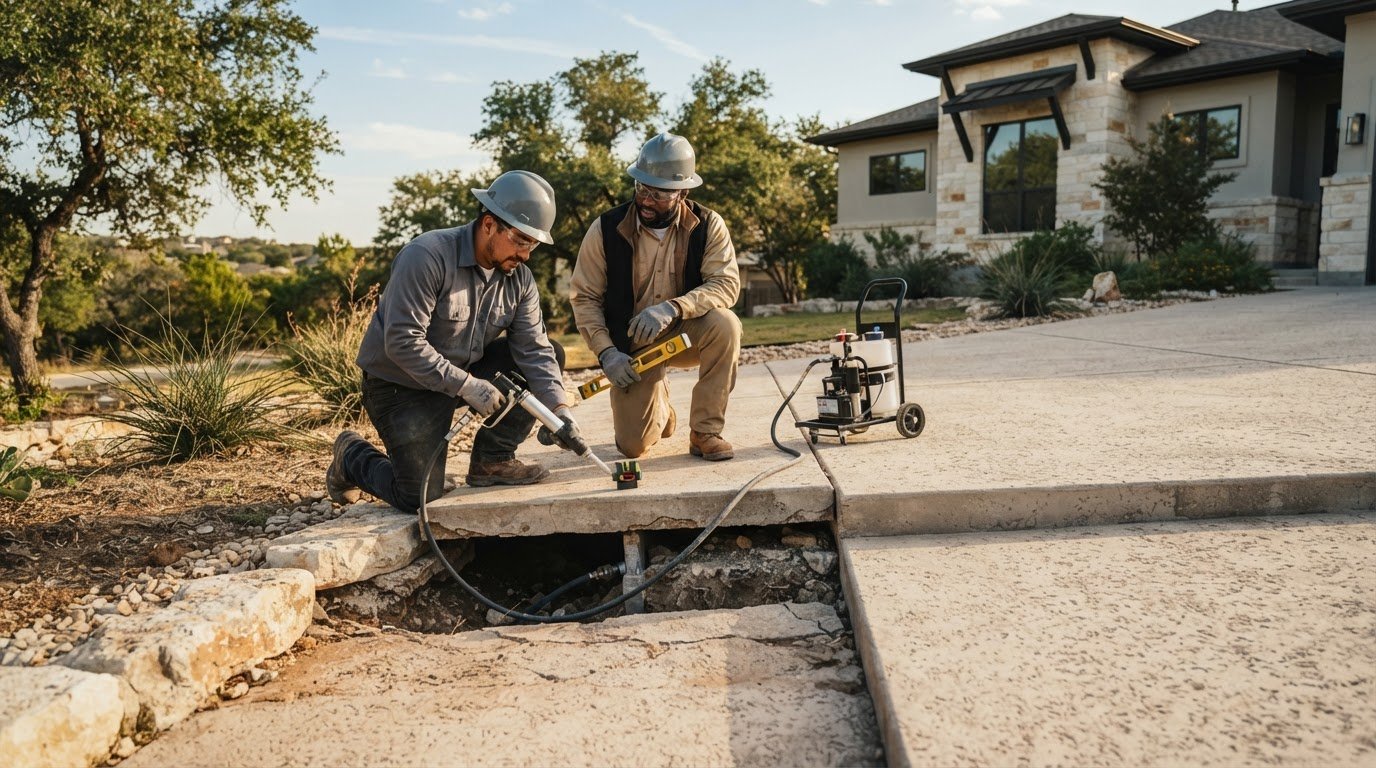
The lighter lifting method isn’t automatically the right choice for every sunken driveway. In Austin, foam injection uses 5/8-inch holes and cures in 15 minutes, while mudjacking uses 1 to 2 inch holes and needs 24 to 48 hours before heavy use. The best fit for driveway leveling in Austin depends on the slab’s condition, the space beneath it, and the cause of the settling.
A dip, crack, or uneven joint can make a driveway feel like a bigger problem than it first seems. It’s reasonable to want a durable repair and a clear understanding of the cost before deciding what to do.
This guide explains how concrete lifting methods compare, what affects project costs, and when a settled driveway may be a candidate for lifting rather than replacement. You’ll also learn how Austin’s changing soil and water conditions can contribute to sinking and cracking, helping you understand what may be happening beneath the concrete.
Key Takeaways
- Compare lifting methods by the driveway’s condition, the void beneath the slab, and how soon you need the concrete ready for use.
- Project costs depend on factors such as the area being raised, the extent of settlement, site access, and the repair method.
- A structurally sound slab that has settled may be a candidate for lifting; severe damage can point toward a different repair approach.
- Dry-weather soil shrinkage and rainwater-related soil erosion can both contribute to sinking or cracking, so drainage and soil support matter.
- Learn which details help distinguish a localized concrete problem from a broader foundation concern.
How much does concrete leveling cost in Austin, TX?
Concrete leveling costs depend on the slab’s area, degree of settlement, site access, and repair method. A careful evaluation connects these conditions to the work required.
Driveway and Walkway Leveling
Driveway and walkway work addresses uneven concrete panels that create abrupt changes in height. The estimate should identify the affected sections, access for equipment, and whether the concrete remains sound enough to lift. For example, an Austin sidewalk repair request described one section as 1-3 inches higher than its neighbor. That difference shows why the affected area and height matter when planning the repair.
Sunken Concrete Panel Repair
A sunken panel may be lifted when the concrete is structurally sound and the space below can support it. An evaluation should map the low areas, note cracks and panel edges, and look for movement beyond the driveway. A local customer’s 167-square-foot shed slab illustrates how project size can vary. The slab’s condition and settlement pattern matter alongside its square footage.
Mudjacking Beneath Concrete Panels
Mudjacking fills voids beneath a panel by pumping cement-based slurry through 1 to 2 inch holes. The material fills gaps and raises settled concrete toward the surrounding grade. A reviewer described workers mud-jacking a couple of voids beneath driveway panels. That example highlights the importance of locating unsupported areas, rather than treating every crack as evidence that the whole driveway needs lifting.
Cost comparisons should account for the full repair, not just the concrete area. Access, the number of affected panels, settlement depth, and the material used all shape the scope. A 167-square-foot slab and a few isolated driveway voids are different jobs. The price depends on these site conditions and repair needs, and is given after a quote request. An evaluation should document those factors so the proposed work matches the problem.
Concrete leveling in Austin typically does not require a building permit because it is classified as a repair rather than new construction. The project’s scope still matters, especially if it changes drainage or includes work beyond the slab.
Homeowners insurance coverage for driveway leveling in Texas depends on the policy and the cause of damage. Review the policy’s exclusions and covered causes before assuming leveling is an insured repair.
Before hiring, understand the lifting method, how the crew will locate voids, and what conditions could limit the repair. Austin contractors commonly offer workmanship warranties of 1 to 5 years. Read the written terms for coverage, exclusions, and whether they address future settlement; an evaluation should also distinguish a concrete issue from a broader foundation concern.
Is mudjacking or foam lifting better in Austin, TX?
Both methods lift settled concrete by filling space beneath the slab, but they use different materials. Compare hole size, material weight, cure time, and the driveway’s condition.
Mudjacking and Foam Injection
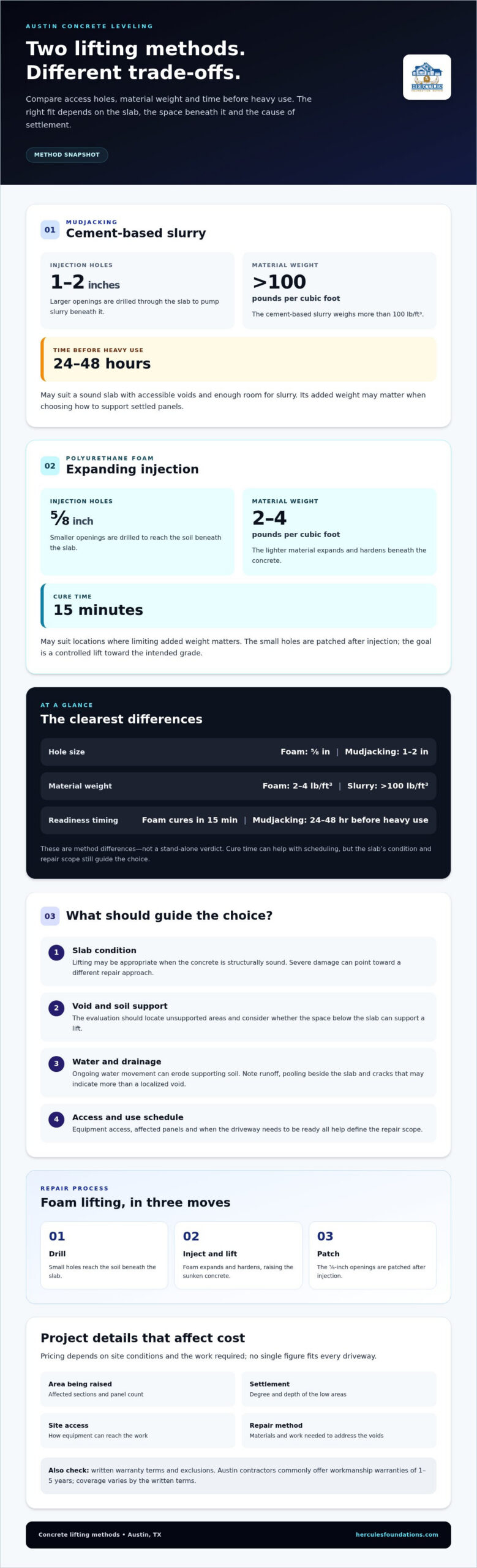
Mudjacking pumps cement-based slurry through 1 to 2 inch holes beneath the concrete. Polyurethane foam injection uses smaller 5/8 inch holes and places expanding material under the slab. The foam weighs 2 to 4 pounds per cubic foot; mudjacking slurry weighs more than 100 pounds per cubic foot. That weight difference can matter when limiting added load beneath settled panels.
Choose a method based on site conditions, not hole size alone. Mudjacking may suit a sound slab with accessible voids and enough room for slurry. Foam’s lighter material may suit locations where added weight matters. Austin foam injection costs vary by project, but price should not be the only factor. The repair needs to support the affected area and raise the panel without worsening existing cracks.
Cure time also affects driveway use. Mudjacking requires 24 to 48 hours before heavy use. Polyurethane foam used for Austin concrete leveling cures in 15 minutes. Injection repairs often take just a few hours. These timings can help with scheduling, but the slab’s condition and repair scope still guide the method.
Polyurethane Foam Lifting Process
The crew drills small holes through the slab to reach soil beneath it. They inject polyurethane foam, which expands and hardens, raising the sunken concrete. The 5/8 inch openings are then patched. A controlled lift matters: the goal is to bring the panel toward the intended grade while avoiding unnecessary pressure on surrounding concrete.
Hydrophobic polyurethane foam is designed to repel water, which may matter when moisture is present beneath a driveway. However, lifting does not resolve every drainage or soil problem. Ongoing water movement can erode supporting soil and contribute to renewed settlement. Note where runoff flows, whether water pools beside the slab, and whether cracks suggest damage beyond a localized void.
Recycled content is a separate material consideration, not a shortcut for judging lifting performance. Compare the foam’s stated density, expansion behavior, and cure time with the job’s needs. The research facts here establish foam’s weight and cure time, but not recycled content for every formulation. Don’t assume recycled content based on the word “polyurethane.”
For an Austin driveway, match the method to the slab, soil support, and use schedule. A focused concrete repair overview can help you continue comparing options.
Can a sunken driveway be raised in Austin?
Yes. Austin contractors recommend leveling structurally sound slabs that have settled less than 4 to 6 inches. The key first step is distinguishing a liftable panel from concrete with damage that calls for another repair.
An on-site evaluation examines the driveway’s surface, panel edges, cracks, and low areas. It also considers whether the slab remains intact and how the ground beneath it supports the concrete. An Austin concrete-leveling assessment typically takes 30 to 45 minutes. That time allows the evaluator to consider the repair area and the conditions affecting the proposed work.
A documented estimate should connect the observed problem to a defined repair plan. Look for the panels included, the lifting method, and any preparation or follow-up work. For example, an estimate for one sunken section should explain whether neighboring panels also need attention. A clear scope makes it easier to compare the proposed work with the driveway’s actual condition.
A free estimate describes proposed work and its cost. It is not the same as financing approval or a promise that every panel can be raised. One Austin reviewer reported requesting a free estimate and receiving a representative visit within a day or two. That is one customer’s experience, not a standard timetable for every residential project. Use the written estimate to understand the work before deciding.
Financing is separate from deciding whether lifting suits the slab. If you’re considering a payment plan, compare the total repayment, interest, fees, and payment schedule with the written project scope. Don’t judge the repair by the monthly payment alone. The central technical question is whether the concrete is sound and its underlying support can be restored.
A residential driveway raised 6 inches using cementitious slurry provides an example of substantial lifting. It doesn’t mean every driveway can be raised by that amount. Slab condition, settlement, and the support beneath the concrete determine the appropriate repair. An evaluation should identify those conditions before the estimate defines the work.
Prepare by photographing the low area, marking where water collects, and noting which panels have moved. Share those observations during the on-site assessment, then compare them with the written repair scope. A clear estimate should explain the recommended approach, including what the work addresses and what it doesn’t. That gives you a practical basis for deciding how to restore safe, even access to your residential driveway.
Causes of sinking and cracking in Austin
Austin driveways can sink when supporting soil shrinks, compresses, or washes away. Soil shrinkage during dry weather can leave concrete without even support, causing it to drop or fracture. Rainwater can weaken or erode soil beneath a slab. Both processes can create voids, but a visible crack alone doesn’t show which process is active.
Poorly compacted backfill can compress over time, too. As the soil settles, gaps may form beneath a driveway panel, leaving parts of the slab unsupported. You might notice one corner sitting lower than the next panel, or a crack crossing the panel near the settled area. These patterns help describe the problem but don’t prove its cause.
Water can offer a useful clue. After rain, note where runoff travels, whether it pools beside the driveway, and whether soil appears washed away from an edge. During dry weather, watch for changes in uneven areas or cracks. Record locations with photos and dates. These observations give an evaluator a clearer timeline and help distinguish recurring movement from an isolated surface defect.
Cracks and changes in height can create hazards for people walking across a driveway or sidewalk. A raised edge, sunken panel, or gap between sections can interrupt a smooth path. At commercial properties, uneven concrete can also affect entrances, walkways, and routine access. Identifying the affected route helps prioritize work and plan around disruption.
Consider the extent of the movement before choosing a repair. If one driveway panel has settled while nearby concrete remains steady, the issue may be localized. If movement spans several areas or cracks extend beyond the driveway, broader soil or structural conditions may be involved. This distinction matters: concrete leveling addresses settled slabs, while foundation repair addresses foundation problems.
Use a simple observation process: photograph each crack, compare panel heights, note nearby water flow, and record any changes. Include the driveway edge, walkway, and adjacent ground. This gives the evaluator specific examples instead of a general description such as “the concrete is moving.” It also helps track whether the same area changes after wet or dry conditions.
Don’t treat every crack as proof that a foundation is failing. A driveway slab and a home’s foundation serve different structural roles, even when soil conditions affect both. Repeated movement near the house, widening cracks, or uneven areas across several surfaces deserve attention as a combined pattern. The right repair depends on identifying what moved and what lost support.
For Austin properties, drainage and soil support matter alongside correcting the concrete. If runoff continues eroding the same area, lifting the slab alone won’t resolve that contributing condition. A careful evaluation should connect visible cracks, raised edges, soil changes, and water movement, then match the repair to the cause. This helps homeowners and commercial property managers reduce avoidable disruption.
Austin driveway leveling costs
The cost of driveway leveling in Austin depends on the work each slab needs. The price varies by project and is provided after a quote request. Key factors include the affected surface area, degree of settlement, concrete condition, site access, and lifting method. A narrow, sunken panel and a driveway with several uneven sections require different scopes.
Start by separating the visible symptom from the area that needs repair. Mark each sunken panel, note cracks, and check whether adjoining surfaces have shifted. For example, a low panel near the garage may need different work from a walkway with raised edges. An estimate should identify the areas included and explain how the proposed work addresses them.
The lifting material also affects the scope. Mudjacking places cement-based slurry beneath the concrete, while polyurethane foam expands beneath the slab. The estimate should identify the method and explain why it suits the panel and supporting soil. Compare proposals by the work specified, not by the method’s name alone. A detailed scope makes it easier to see whether the plan covers every affected section.
Access matters, too. The crew needs room to reach the slab and position equipment. Tight spaces beside a home, landscaping, gates, or parked vehicles can affect setup. Before the estimate, clear the driveway where practical and point out obstacles. This gives the evaluator a more accurate view of access and helps prevent surprises in the proposed work.
Concrete leveling can preserve existing surfaces when the slab is suitable for lifting. Replacement is a different kind of work: it removes and rebuilds concrete rather than raising existing panels. Compare the options based on the slab’s condition, the extent of damage, and the work needed beneath it. A sound panel with settlement presents a different repair question from badly fractured concrete.
Ask for an estimate that makes the work easy to understand. It should identify the panels, lifting method, preparation, and any stated limits. Read warranty terms alongside the scope because coverage and exclusions can differ. If water has washed soil from beneath the driveway, mention it. Continued erosion may affect how well the repair addresses the underlying issue.
Concrete leveling projects in Austin commonly take 1 to 3 hours, though the actual work depends on the site and scope. Timing alone doesn’t measure value. A clear plan explains what will be lifted, how the method fits the concrete, and what conditions the work addresses. That helps homeowners compare repair with replacement without relying on a single headline number.
For a project-specific scope, request a concrete-leveling evaluation and describe the affected driveway surfaces, visible cracks, and access conditions.
Hercules Foundation Repair: Foundation Repair
Hercules Foundation Repair helps homeowners address foundation movement that extends beyond a settled driveway panel. If cracks or uneven areas affect multiple parts of the home, Foundation Repair or Slab Foundation Repair may suit the broader structural concern. For pier-and-beam construction, Pier and Beam Foundation Repair addresses that foundation type. Commercial Foundation Repair addresses structural concerns at commercial properties.
A driveway slab and a home’s foundation are different structures, but movement across multiple areas makes it important to understand the distinction. Share where you see cracks, settlement, or changes in level so the concern can be discussed in context. To discuss foundation repair for your property, contact Hercules Foundation Repair.
Choose the Right Next Step for Your Property
Before arranging work, decide what you want the repair to accomplish: smoother vehicle access, a safer walking path, or a clearer understanding of movement near your home. For driveway leveling in Austin, this distinction keeps the conversation focused on the affected concrete and the results that matter to you.
If the concern appears limited to the driveway, discuss the slab’s condition and the areas that have shifted. If cracks or movement also affect the home, share those observations, too. Hercules Foundation Repair offers Foundation Repair, Slab Foundation Repair, and Pier and Beam Foundation Repair, each addressing a different structural concern. Focusing the conversation on the problem is a practical first step toward a suitable plan.
Bring your notes and photos together, then take the next step at your pace. Contact Hercules Foundation Repair to discuss your property and the foundation concerns you’ve noticed. A clear description of what has changed can help start a focused conversation and move you closer to a sound decision.
Frequently Asked Questions
When should I repair instead of replace?
Repair is a practical option when the slab remains structurally sound and has settled less than 4 to 6 inches. Extensive fractures, crumbling edges, or panels that have broken apart may make replacement a better fit. Look at whether cracks cross panels, sections move underfoot, or nearby concrete shows similar damage. These signs help distinguish liftable settlement from concrete that has deteriorated too extensively for lifting.
How big are the injection holes?
Mudjacking holes are 1 to 2 inches wide, while polyurethane foam injection uses 5/8 inch holes. The openings let the material reach the void beneath the slab, then crews patch them after lifting. Hole size is one difference between the methods, but it doesn’t determine the best choice by itself. Consider the slab’s condition, the injection material, and how the driveway will be used after repair.
How long does the job take?
Most concrete leveling projects in Austin take 1 to 3 hours. The schedule depends on the affected panels, site access, and lifting method. A driveway with several separated low areas may require more setup than one isolated panel. Before work starts, plan where to park and how to reach the garage or walkway while the crew works. The project scope determines how much access needs to be kept clear.
How long will the results last?
Properly leveled concrete can last 8 to 15 years or longer in Austin when underlying drainage and soil issues are addressed. Continued water erosion or soil movement can affect slab support after lifting. Keep an eye on runoff near the repaired area and note any new pooling or soil loss. These observations can help you identify changes early and understand whether conditions beneath the concrete have shifted again.
What affects the price?
The price depends on the specific project and is provided after a quote request. Key factors include the area being lifted, the degree of settlement, the concrete’s condition, equipment access, and the selected material. Several separated panels may require a different scope from one low section. Compare written estimates by the work and surfaces they include, not just the total.
What driveway leveling methods are available in Austin, Texas?
The main lifting options are mudjacking and polyurethane foam injection. Mudjacking pumps cement-based slurry beneath settled concrete; foam injection uses expanding polyurethane material. Their hole sizes, material weights, and cure times differ. For Austin homeowners, the slab’s condition and the soil beneath it help determine the method. The same considerations apply to concrete leveling in San Antonio, Houston, and Victoria.
How much does a typical project cost per square foot or overall?
There isn’t one price for every driveway. The project cost depends on size, affected panels, settlement, access, and lifting method, and is provided after a quote request. Per-square-foot figures don’t reflect every site condition. For driveway leveling in Austin, a project estimate should describe the repair area and included work, giving you a clear basis for understanding the proposed scope.
Which details change the estimate?
The estimate reflects how much concrete needs lifting, the slab’s condition, access to the work area, and the repair method. Drainage or soil problems may also affect the work required. Before requesting an estimate, note the affected sections and where water collects. For driveway leveling in Austin, sharing these observations helps tailor the proposed scope to your property rather than relying on a general description.