

What if the crack you’re watching signals foundation movement, or is simply a reason to take a closer look? A foundation inspection Austin homeowners arrange can help put visible cracks, uneven floors, and sticking doors in context, but no single symptom tells the whole story. Expansive clay in parts of the Austin area can shrink and swell as moisture changes, while shallow limestone creates different ground conditions farther west.
Before deciding whether repairs are needed, it helps to understand what each type of review can tell you. An independent structural engineer’s assessment focuses on structural analysis, while a foundation repair contractor’s evaluation connects observed conditions with potential repair planning. Neither means every crack needs work. This guide explains what an evaluation can establish, what to document, and how Austin soil and moisture conditions may fit into the picture. You’ll also learn how to choose a practical next step, from tracking a change to discussing repair options.
Key Takeaways
- A foundation inspection Austin homeowners arrange can connect observed symptoms with possible structural concerns, but a visible crack alone doesn’t establish its cause.
- An independent structural engineer’s written opinion and a contractor’s repair evaluation serve different purposes. Choose the review that fits the question you need answered.
- Austin soil and changing moisture conditions provide context for foundation movement, but property-specific findings matter most.
- Photos, a timeline of changes, and relevant property records help make evaluation findings easier to understand and act on.
- Findings and foundation type can guide next steps, including slab or pier-and-beam repair and concrete leveling with Hercules Foundation Repair.
What Does a Foundation Inspection in Austin Actually Tell You?
A foundation inspection reviews visible conditions, signs of movement, and potential structural concerns. It helps organize what has been observed and determine whether further review may be useful. It does not mean every crack signals foundation failure or that repairs are automatically necessary.
What you learn depends on the purpose and scope of the evaluation. A visual review may document cracks or uneven areas. A more detailed structural assessment may include measurements and a written opinion. General information about foundation integrity testing explains some ways foundations can be evaluated, but specialized testing is not part of every homeowner inspection.
Which foundation conditions may prompt an inspection?
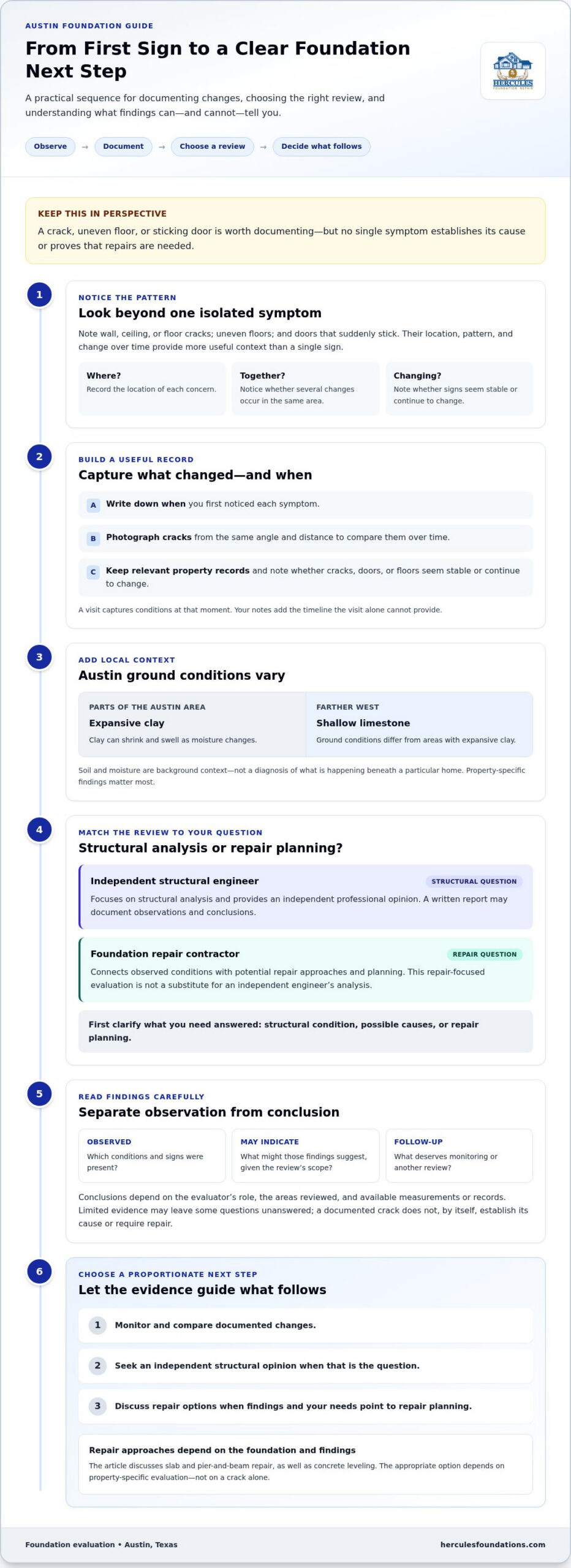
Uneven floors, doors that suddenly stick, and cracks in walls, ceilings, or floors are worth documenting. None proves foundation failure on its own. The pattern, location, and changes over time provide more useful context than an isolated symptom. For example, note whether several changes appear in the same area or whether a crack seems to be widening.
- Record when you first noticed each symptom.
- Photograph cracks from the same angle and distance so you can compare them over time.
- Note whether doors, floors, or cracks seem stable or continue to change.
A simple record helps an evaluator understand what changed and when. It can also distinguish a longstanding cosmetic mark from a developing pattern that merits closer attention. A single visit captures conditions at that moment; your notes provide a timeline that the visit alone cannot.
What an inspection can and cannot conclude
Findings depend on the evaluator’s role, the areas reviewed, and the measurements or records available. A licensed structural engineer provides an independent opinion on structural questions. A foundation repair contractor evaluates observed conditions in relation to potential repair needs and planning. These reviews address different questions and are not interchangeable.
An inspection finding is not automatically a repair recommendation. A crack can be documented without establishing its cause, and a concern can merit follow-up without proving that repairs are needed. The scope also matters: when evidence is incomplete or the review is limited, some questions may remain unanswered.
For homeowners searching for a foundation inspection Austin, a useful outcome separates what was observed, what it may indicate, and what deserves another look. Findings are easier to act on when they explain which signs were present and whether the next step is monitoring, an independent structural opinion, or a discussion of repair options. That clarity helps you respond to evidence rather than assume every crack calls for work.
Engineer Inspection or Contractor Evaluation: Which Austin Foundation Review Fits?
A structural engineer and a foundation repair contractor approach foundation concerns from different directions. An engineer focuses on structural analysis and an independent professional opinion. A contractor considers observed conditions in relation to potential repair needs and how work might be planned. Neither review automatically confirms a specific cause or means repairs are required.
Start with the decision you need to make. If you need an engineering-focused assessment of structural conditions, an engineer’s opinion may fit. If you’re considering repair options, a contractor’s evaluation can connect observations to possible solutions.
- Engineering-focused review: Addresses questions about structural condition and may provide a written report documenting observations and conclusions.
- Repair-focused evaluation: Relates observed conditions to potential repair approaches and planning.
For a foundation inspection Austin homeowners can use to make an informed decision, match the reviewer’s role and scope to your question. First identify what you want the review to clarify: structural condition, possible causes, or repair planning.
When an engineering opinion is the central question
An engineering-focused assessment is appropriate when you want structural analysis rather than a repair plan. A written report can record the conditions observed and the engineer’s conclusions, helping you understand the basis for the opinion. Its usefulness depends on the scope and information available, so it may not resolve every underlying cause.
Soil and moisture conditions can also help frame questions about movement. Texas A&M AgriLife Extension’s overview of soil types provides general background on soil characteristics, including clay. That information offers context, but it cannot establish what is happening beneath a specific home.
When repair planning is the central question
If your main question is how to address observed concerns, a foundation contractor’s evaluation can connect those conditions with potential repair options. The contractor’s role is repair-focused, not a substitute for an independent structural engineer’s analysis. Hercules Foundation Repair evaluates residential and commercial foundations, including slab and pier-and-beam systems, and provides concrete leveling.
The next step should reflect the evidence, not the assumption that every crack needs work. If you’re considering structural stabilization or repairs, explore foundation repair options to understand how repair planning may relate to your home’s conditions. A clear scope keeps the review focused on the question you need answered.
How Austin’s Clay Soil and Moisture Changes Can Affect Foundation Findings
Soil conditions are useful context when foundation movement is being evaluated. Expansive clay can change volume as its moisture content changes. Clay is a relevant consideration around Austin, although ground conditions vary between properties. As Texas A&M AgriLife Extension explains in its overview of soil types, soil characteristics differ. A general description of the area cannot establish what is happening beneath a particular home.
Clay can shrink as it dries and swell as it absorbs moisture. These changes may affect the ground supporting a foundation and provide context for movement an evaluator observes. Drought, rainfall, drainage, and irrigation history can be useful details to record. A change in moisture near a crack, however, does not prove that it caused the crack. Foundation type, site conditions, and the timing and pattern of symptoms also matter.
Why moisture history matters when reviewing Austin homes
Moisture history helps describe conditions around the time a symptom appeared or changed. A long dry period followed by heavy rainfall, for example, is useful context, not a diagnosis. Expansive clay’s response to moisture is an established soil behavior, but deciding whether it explains movement at an individual home requires a property-specific evaluation. Weather patterns alone cannot explain a particular finding.
Which observations help put movement in context?
Keep a straightforward record connecting symptoms with changes around the home. The goal is not to prove a cause. It is to give the reviewer a clearer timeline and picture of site conditions.
- Location: Note where cracks or uneven areas appear, such as a specific room, wall, or section of floor.
- Timing: Record when you first noticed a symptom and whether it appears stable or has changed.
- Drainage: Note changes to grading, downspouts, or other drainage features, along with places where water collects.
- Landscaping and irrigation: Record new planting beds, removed trees, irrigation adjustments, or other changes near the home.
- Weather context: Note significant dry or rainy periods around the time you observed a change, without assuming they caused it.
Keep photos and notes together so you can compare conditions and share a concise history during a foundation inspection Austin homeowners arrange. Consistent observations are more useful than guessing at a cause from one snapshot.
Moisture management is worth noting, but a watering schedule or drainage adjustment is not a guaranteed foundation remedy. Site changes can affect properties differently. Document what has happened so the evaluation can distinguish relevant context from conclusions supported by the findings.
How to Prepare for an Austin Foundation Inspection and Use the Findings
A little preparation can make an evaluation more useful. You don’t need to diagnose the problem yourself. Bring clear observations and relevant history so the evaluator can consider what you’ve noticed alongside the conditions present during the visit.
What to document before the appointment
Put the information in one place, such as a folder or phone note. A concise record is easier to review than scattered photos and memories.
- Photograph visible concerns. Capture cracks, uneven areas, or doors that stick. Note each location and approximately when you first noticed it. Take follow-up photos from a similar angle to make changes easier to compare.
- Gather previous records. Collect earlier inspection reports, repair documents, and relevant property history you have available. Include notes about past work or changes around the home that may help explain the timeline.
- Write a short symptom timeline. List what appeared first, what changed, and where you noticed it. Add related observations, such as a door beginning to bind or a new crack appearing in another area. Stick to what you saw rather than guessing at the cause.
- Prepare questions. Note what you want the evaluation to address, what the observations indicate, and whether follow-up is recommended. Point out specific concerns and explain when you first noticed them.
How to turn findings into a measured next step
Read the report or summary in parts. Start with the scope: what the evaluator reviewed and what fell outside the review. Then look at the observations, which record what was seen or measured, and the conclusions, which explain what those findings may mean. Review any stated limitations too. They clarify where information was incomplete or a firm conclusion was not possible.
Keep facts separate from assumptions. “A crack was observed near the living room window” is a documented observation. “The foundation caused it” is a conclusion that needs supporting evidence. Look for a clear next step: monitor a condition, pursue further evaluation, or discuss possible repairs. If a recommendation is unclear, identify which finding supports it and what question the follow-up is meant to answer.
A foundation inspection Austin homeowners arrange is most useful when findings lead to a proportionate response, not an automatic repair decision. If the evaluation identifies a slab-related concern, the slab foundation repair guide can help you understand repair considerations. The right next step depends on the documented conditions and your home’s foundation type.
Once you understand what was observed and what remains uncertain, repair planning can be more focused. Explore Hercules foundation repair services to learn about options for foundation concerns, including slab and pier-and-beam repair and concrete leveling.
From Foundation Findings to Repair Options with Hercules in Austin
Inspection findings are a starting point, not an automatic repair order. The next step depends on what was observed, the foundation type, and conditions at the property. Some findings may support monitoring or further evaluation; others may lead to a discussion of repairs. A crack or uneven area alone does not determine which path is right.
Match the concern to the foundation and service
Foundation type shapes repair planning. Slab and pier-and-beam foundations have different structures, so concerns involving one are not automatically addressed the same way as concerns involving the other. Hercules repairs both slab and pier-and-beam foundations, with planning based on the reported findings and conditions at the property.
It’s also useful to distinguish foundation movement from uneven concrete. Concrete leveling corrects uneven concrete surfaces, while foundation repair addresses concerns with the foundation itself. The right service depends on what the evaluation identifies, not simply on how a surface looks. A concrete leveling options guide can help explain how leveling differs from foundation repair.
For businesses and other non-residential properties, commercial foundation repair may be appropriate when findings point to a foundation concern. In every case, the method should follow an understanding of the structure, the conditions, and the scope of the concern.
What homeowners can expect from a repair-focused conversation
A useful repair discussion starts with what’s known: the findings or report you have, the conditions you’ve observed, and the questions you want answered. Photos, a symptom timeline, and previous repair records can help keep the conversation grounded. A repair-focused evaluation relates those observations to potential repair needs, while serving a different purpose from an independent engineering opinion.
Hercules Foundation Repair is a family-owned contractor that has served South Texas for more than 45 years. Its work includes residential and commercial foundation repair, structural stabilization, and concrete leveling for properties in Austin, San Antonio, Houston, and Victoria.
If findings point toward possible movement, focus the repair discussion on the conditions that support it and how proposed work relates to your foundation type. If findings remain uncertain, clarify what question still needs an answer before deciding. A measured conversation should help you understand the concern and options, not treat every crack as a failure.
If you’re ready to discuss foundation repair needs, share your findings and questions with Hercules. The team can help you consider a practical next step based on the conditions at your property.
Choose Your Next Step With Confidence
Once you have an inspection in hand, make your decision based on what it says. Uncertainty does not automatically mean you need repairs, and a small-looking concern is not a reason to dismiss changing symptoms. The right next step answers the question still in front of you, whether that means clarifying a finding or discussing repair options for your property.
A foundation inspection Austin homeowners arrange can start a more informed conversation, but the findings should guide what happens next. Bring your report, photos, and questions so the discussion can focus on your home’s conditions and potential options.
Hercules Foundation Repair helps residential and commercial property owners discuss foundation repair and concrete leveling in Austin, San Antonio, Houston, and Victoria. Discuss your foundation repair needs with Hercules and take the next step with a clearer understanding of your options.
With useful information and a measured plan, you can move forward with greater confidence in caring for your home.
Frequently Asked Questions
Can Austin clay soil cause foundation movement?
Yes. Expansive clay can change volume as its moisture content changes, which may contribute to foundation movement. That regional soil behavior does not establish the cause of a particular home’s symptoms. An evaluation considers the structure and observed conditions, while moisture history and symptom timing provide context. For example, note whether a crack appeared before or after a drainage change, but do not treat that sequence or one weather event as a diagnosis.
Is a foundation inspection the same as a home inspection?
Not necessarily. A general home inspection reviews visible conditions across multiple parts of a property, while a foundation-focused evaluation concentrates on structural observations and possible movement concerns. The scope and qualifications depend on the service. If you’re buying or selling, identify whether the report addresses the specific structural question you need answered. A broad home inspection may flag an issue without providing the detailed analysis you want from a foundation inspection Austin homeowners arrange.
How much does a foundation inspection in Austin cost?
Fees vary with the evaluator, property, location, and scope, so one price does not apply to every Austin home. A structural engineering report and a repair-focused evaluation may involve different services and deliverables. Compare the scope of each evaluation, whether it includes a written report, and which questions it is designed to answer.
What happens if an inspection finds foundation movement?
A finding of movement does not automatically mean repairs should begin. First, review which conditions were documented, what conclusions were drawn, and whether the report recommends monitoring or further evaluation. A report may identify movement but leave its cause unresolved. The appropriate next step then depends on the foundation type, observed pattern, and whether conditions are changing. A repair-focused discussion can explain potential solutions when the findings support that conversation.
Can I monitor foundation cracks myself before arranging an evaluation?
You can keep a dated record, but monitoring will not establish the cause of a crack. Photograph it from the same position and distance, and note its location and any changes. Record other relevant symptoms, such as a door that begins rubbing against its frame, along with significant site changes. If symptoms change or you have safety concerns, seek professional guidance rather than relying on photos alone.
Does an inspection always recommend foundation repair?
No. An inspection evaluates conditions within its stated scope, and its findings may point to monitoring or further evaluation rather than repairs. Separate what the evaluator observed from conclusions about cause, then review the reasoning behind any recommended follow-up. Homeowners in Austin, San Antonio, Houston, and Victoria can discuss repair options with Hercules when the findings and property conditions support that conversation. A recommendation should relate to the evidence, not just the presence of a crack.