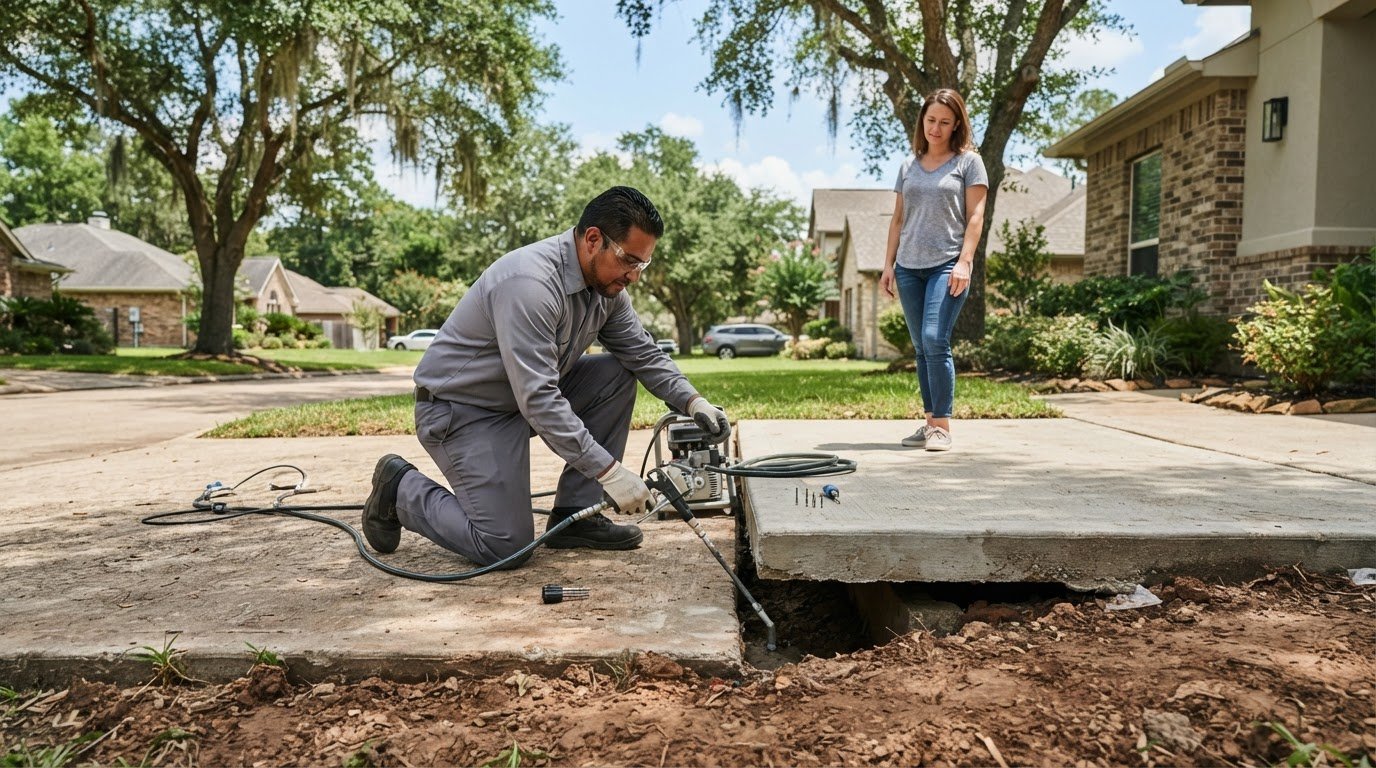
What if the right repair for a sunken walkway has nothing to do with your home’s foundation? Uneven concrete can create trip hazards and make everyday spaces harder to use, but the visible dip doesn’t always point to the same cause. Concrete lifting Houston homeowners consider can raise and stabilize a settled slab when the movement is limited to the concrete surface.
It’s understandable to want a durable fix without taking on a larger repair than the problem calls for. Houston’s clay soil can shrink and swell as moisture changes, which may contribute to concrete movement. But a driveway or patio that has settled is different from movement affecting the home’s foundation. Choosing the right scope starts with understanding that distinction.
This article explains when concrete lifting may suit a sunken driveway, sidewalk, or patio, how it differs from structural foundation repair, and what to expect from a Houston-area project. You’ll also learn why the cause of settlement matters when considering a repair. Hercules Foundation Repair provides concrete leveling and structural foundation repair in Houston, San Antonio, Austin, and Victoria.
Key Takeaways
- Use uneven joints, sloping surfaces, and gaps as clues to document, not as a diagnosis on their own.
- Learn how concrete lifting Houston projects assess a slab and plan a lift to raise and stabilize the surface.
- Compare the repair goals: leveling addresses uneven concrete, while foundation repair addresses structural settling or instability.
- Know which slab conditions and surrounding factors may be reviewed before work begins, including access and drainage.
- Match the repair scope to the movement to identify a practical next step.
Concrete Lifting in Houston: What Sunken Slabs Can Tell You
A dip in a driveway or walkway can look like a straightforward concrete problem, but the slab’s position is only one clue. Start by distinguishing movement in an exterior concrete surface from movement in the building’s structural foundation. Concrete lifting is a focused repair for a settled slab; it doesn’t, by itself, diagnose or correct movement in the house’s foundation.
Concrete lifting raises and stabilizes an existing settled slab; slab replacement removes the old concrete and installs a new slab. The right approach depends on the slab’s condition and the cause of its movement. Slabjacking, also known as concrete lifting, describes the general practice of raising settled concrete, though the methods used can differ.
Which concrete surfaces may become uneven?
Residential and commercial properties can have settled walkways, driveways, patios, and other concrete slabs. Look for uneven joints where sections no longer meet evenly, a surface that slopes differently than expected, or a gap between concrete and an adjoining step or structure. A height change can catch a foot, complicate moving bins or equipment, or make an entrance less comfortable to use.
These observations help describe the issue, but one clue doesn’t reveal its cause. Note where the unevenness begins and whether it appears limited to one section or spans several areas. Concrete leveling options can vary, so this concrete leveling options guide explains the choices at a high level.
What can cause a slab to sink in Houston?
A concrete slab depends on the ground beneath it for support. If that support shifts, compresses, or washes away, a section may settle and leave a height difference. Water is one possible influence: drainage that directs runoff toward a slab, or changing moisture conditions in the surrounding soil, may affect support. Construction and site conditions can also play a role.
Houston-area soils can include expansive clay, which may change volume as moisture levels change. That regional context can be relevant, but soil and drainage conditions vary from property to property; it shouldn’t be treated as a diagnosis for every slab. A visible gap or slope alone can’t confirm whether soil movement, water, or another site factor is responsible.
For a useful assessment, consider the pattern and location of the movement alongside the slab’s condition and surrounding area. A surface-level issue may call for concrete leveling, while movement affecting the building’s structural foundation calls for a different repair scope. The distinction matters: addressing the concrete surface is not the same as stabilizing the structure.
How Concrete Lifting Raises and Stabilizes a Sunken Slab
A lifting project is a sequence of decisions, not simply an attempt to push concrete back into place. The slab and its surroundings inform the plan, including the intended correction and the approach suited to the surface and its support. For concrete lifting Houston property owners, understanding these stages helps set practical expectations without assuming every slab or site will respond in the same way.
What happens during a concrete lifting project?
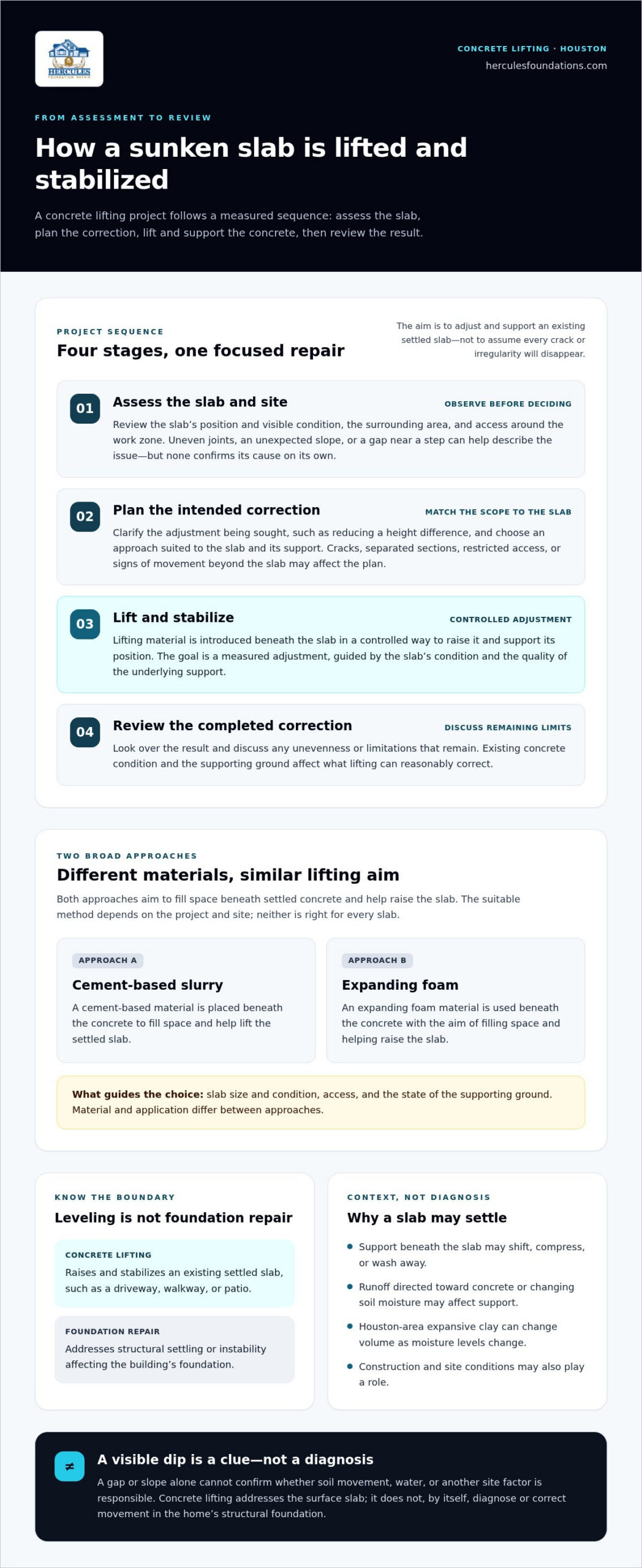
Before work begins, Hercules Foundation Repair considers the slab’s position, visible condition, and access around the work area. The discussion should clarify the correction you’re seeking, such as reducing a height difference, and identify conditions that could affect the work. Cracks, separated sections, restricted access, or signs of movement beyond the slab may influence the plan.
The general sequence is straightforward:
- Assess: Review the slab, surrounding area, and available access.
- Plan: Determine the intended adjustment and a suitable lifting approach.
- Lift and stabilize: Introduce lifting material beneath the slab in a controlled way to raise it and support its position.
- Review: Look over the completed correction and discuss any remaining unevenness or limitations.
The goal is a measured adjustment, not an assumption that every crack or irregularity will disappear. Existing concrete condition and the quality of underlying support affect what can reasonably be corrected.
How do lifting methods differ?
Broadly, some approaches place a cement-based slurry beneath the concrete, while others use an expanding foam material. Both aim to fill space below a settled slab and help raise it, but they differ in material and application. The International Concrete Repair Institute offers broader resources on concrete repair practices; the right method for a particular slab depends on its condition and site.
Neither category is automatically right for every project. The slab’s size, condition, access, and the state of the supporting ground all matter. A damaged or unstable slab may have limitations that lifting alone won’t address, while site constraints may shape how the work can be carried out. The approach should follow the project’s needs, not a one-size-fits-all claim.
In brief: Concrete lifting assesses a settled slab, plans a suitable adjustment, raises and supports the concrete, then reviews the result and any remaining limitations. It does not establish that the surrounding soil or building foundation is stable forever, and no particular outcome should be assumed before the site is evaluated.
If you’re weighing the next step for a sunken slab, learn about Hercules Foundation Repair’s concrete leveling and how the project can be matched to the property’s conditions.
Concrete Lifting vs. Foundation Repair: Which Problem Needs Which Fix?
The repair should match where movement is occurring. A settled patio or walkway is a concrete-surface concern; movement affecting the home’s structural foundation calls for a different kind of repair. For concrete lifting Houston property owners, that distinction helps keep the project focused while making room for a broader assessment if signs point beyond one slab.
| Comparison | Concrete lifting | Structural foundation repair |
|---|---|---|
| Problem area | An uneven driveway, patio, walkway, or other concrete slab. | The home or building’s structural foundation. |
| Typical visible clues | A height difference between slab sections, a sloping surface, or a gap at an edge. | Movement that appears to affect the structure, potentially alongside changes in more than one area. |
| Repair objective | Raise and stabilize the affected concrete surface. | Address structural settling or instability in the foundation. |
| When further assessment matters | When slab condition, surrounding ground, or the source of movement is unclear. | When signs extend beyond an isolated surface or raise concern about the building itself. |
The clues in the table are starting points, not diagnoses. A crack, gap, or sticking door can have more than one explanation; no single symptom proves that a foundation has failed. Consider where the change appears, whether it is isolated to one concrete area, and whether other parts of the property show movement too. The overall pattern helps clarify what should be assessed.
Concrete lifting is relevant when the primary concern is a settled, uneven slab. The practical aim is to restore a more even surface and stabilize the concrete, based on its condition and supporting site. An assessment helps determine whether the visible problem fits concrete leveling and what correction is appropriate. Lifting a slab doesn’t automatically correct cracks, drainage conditions, or movement beyond the treated area.
Foundation repair addresses a different concern: structural settling or instability affecting the building’s foundation. A change in a walkway alone doesn’t establish that the house has a foundation problem. But if concerns involve the structure itself or appear across multiple areas, the repair scope may need to extend beyond surface leveling. A slab foundation repair guide offers more context on structural repair.
Hercules Foundation Repair provides both concrete leveling and structural foundation repair, so the work can be matched to whether the concern is a surface slab or the building foundation. The goal is to identify the right scope, not assume that one type of repair fits every sign of movement.
What to Expect Before and During Concrete Lifting in Houston
A useful assessment starts with the slab and the site around it. Hercules Foundation Repair considers the concrete’s condition, the area that needs attention, access to the work space, and the result you’re hoping for. For concrete lifting Houston projects, drainage and soil conditions may also be relevant, but local conditions don’t reveal exactly what is happening beneath every property.
What information helps assess a Houston property?
Before the assessment, note which slabs seem uneven and when you first noticed the change. Mention visible changes such as a widening gap or a new slope, along with nearby drainage patterns or construction that may have altered the site. These details provide useful context. You don’t need to identify the soil type or choose a lifting method; those conclusions depend on the property’s actual conditions.
- Point out each affected slab and the areas where height changes are noticeable.
- Share what you’ve observed about water flow, pooling, or changes nearby.
- Describe the correction you’re hoping for, such as a more even transition.
Houston-area soils can include clay that responds to changing moisture, and drainage can influence conditions around concrete. These are possibilities to consider, not automatic explanations for a particular sunken slab. An assessment connects your observations with the slab’s condition and surrounding site, rather than treating one symptom as proof of its cause.
How can property owners prepare for the work?
Before work begins, clear vehicles, furniture, and stored items from the concrete area where practical. Point out access constraints and nearby features, including landscaping or other site elements around the slab. Sharing these details early helps Hercules Foundation Repair plan around the work area and explain project-specific preparation and next steps.
- Move items that block access to the affected concrete, if practical.
- Identify gates, narrow paths, landscaping, or other features near the work area.
- Discuss which surface you want addressed and what result matters most to you.
During the project, the work follows the agreed scope and the conditions found at the site. Slab condition, access, and underlying support can affect the approach and the correction that is reasonable to expect. Hercules Foundation Repair can review the completed work with you and explain any remaining limitations. Lifting a slab doesn’t automatically resolve drainage issues or movement beyond the treated area.
Scope, scheduling, and cost depend on the individual project, so discuss them in relation to the site and requested work. A clear conversation about what is included helps distinguish the planned slab correction from any separate concerns that may need attention.
For a project-specific discussion of an uneven slab, contact Hercules Foundation Repair about concrete leveling.
Concrete Lifting in Houston with Hercules Foundation Repair
A sunken driveway or uneven patio can be frustrating, especially when it’s unclear whether the problem belongs to the slab or the building’s foundation. The repair scope should follow the movement. Hercules Foundation Repair provides concrete leveling for settled slabs and structural foundation repair when the concern involves the structure, serving property owners in Houston, San Antonio, Austin, and Victoria.
A local foundation and concrete leveling contractor
Hercules is family-owned and operated, with over 45 years of experience serving South Texas. That regional experience supports a practical approach: understand what has moved, consider the condition of the concrete and surrounding site, then match the repair to the concern. A surface-level slab issue and structural foundation movement aren’t interchangeable problems, so they shouldn’t be treated as if they call for the same repair.
For a driveway, walkway, patio, or other settled slab, concrete leveling is a focused service intended to lift and stabilize the concrete. If signs point to movement affecting the home or building’s foundation, structural repair may be the more relevant scope. A careful discussion considers the visible condition and the property’s needs rather than assuming that lifting will address every crack, drainage issue, or movement beyond the slab.
How to take the next step
Start by describing the uneven surface and the main concern it creates. For example, explain where the height change occurs, when you noticed it, and whether you’re concerned about safe access, continued movement, or possible structural signs elsewhere. You don’t need to identify the cause or select a repair method in advance.
A project discussion can focus on the affected slab, access and surrounding site conditions, and the correction you’re seeking. That context helps clarify whether concrete leveling fits the visible problem or whether structural foundation repair is the more appropriate approach. It also gives you a clearer understanding of the proposed scope before deciding how to proceed.
- Identify the slab or surface that appears uneven.
- Describe the change you’ve noticed and the practical issue it causes.
- Mention nearby site conditions or other areas of concern.
If you’re considering concrete lifting Houston service for a settled slab, share those details with Hercules Foundation Repair to discuss a project-specific approach. Discuss concrete lifting for your Houston property.
Take the Next Step Toward a More Usable Surface
A small, clear record of what you’ve noticed can make the next conversation more productive. Note where the concrete feels uneven, what daily activity it affects, and any changes you’ve observed around the area. You don’t need to decide what caused the movement or choose a repair in advance. The purpose is to focus the discussion on the property and the result that matters to you.
For concrete lifting Houston homeowners and property managers, the right next step is a project-specific conversation about the slab and its conditions. A measured assessment can help clarify what repair scope makes sense, without assuming a broader fix before the issue is understood.
Talk with Hercules Foundation Repair about your concrete leveling needs and take a practical step toward making the space easier to use again.
Frequently Asked Questions
Can concrete lifting fix a cracked slab?
Concrete lifting may raise and support a settled slab, but it doesn’t repair the concrete itself or guarantee a crack will close. A narrow crack in a slab that remains sound may be different from wide separation, crumbling edges, or broken sections. Before choosing a repair, have the slab’s condition considered along with its position. The assessment helps clarify whether leveling is suitable or the damage calls for another approach.
How long does concrete lifting take?
The time required depends on the size and condition of the slab, access to the area, the lifting approach, and the work involved. A small section of walkway may have a different scope from a larger driveway or several connected surfaces. Discuss the expected work sequence and project-specific timing during the assessment. That gives you a clearer plan without relying on a generic duration that may not fit your property.
Can I use my driveway or walkway immediately after concrete lifting?
Don’t assume the surface is ready for use immediately. The appropriate wait can depend on the materials and methods used, site conditions, and the project’s instructions. Before work begins, ask Hercules Foundation Repair what access restrictions will apply and how you’ll know when the area can be used. This is especially helpful if you need to plan vehicle access, deliveries, or a safe route to an entrance during the work.
Does concrete lifting prevent a slab from sinking again?
No lifting method can guarantee that a slab will never move again. Leveling raises and supports concrete, but future movement may depend on conditions beyond the treated area, including changes in soil support or water flow. If runoff is directed toward the slab, that site condition may still need attention. Discuss what the lifting work addresses and what it doesn’t, so expectations are clear for your property.
Is concrete lifting the same as foundation repair?
No. Concrete lifting addresses an uneven concrete surface, such as a driveway or patio, while foundation repair addresses structural settling or instability in a building’s foundation. A crack or slope by itself doesn’t establish which issue is present; the location and pattern of movement matter. Hercules Foundation Repair provides concrete leveling and structural foundation repair for residential and commercial properties in Houston, San Antonio, Austin, and Victoria.
Can concrete lifting correct drainage problems around a Houston home?
No. Lifting can adjust a settled slab, but it doesn’t redirect runoff or correct a drainage system. If water pools near a driveway or repeatedly flows across a walkway, mention that during the assessment. The relationship between drainage and the slab depends on the property, so don’t assume leveling alone will change where water goes. Keeping the slab concern and the water-flow concern distinct helps clarify the repair scope.
What happens if the concrete slab is badly damaged?
A badly damaged slab may not be a suitable candidate for lifting. Extensive cracking, crumbling, or separated pieces can limit how well the concrete can be adjusted or supported. The slab’s condition needs to be assessed before selecting a repair; in some cases, another type of work may be more appropriate. Describe the damage and how the surface is used so the discussion can focus on a practical scope for the property.