

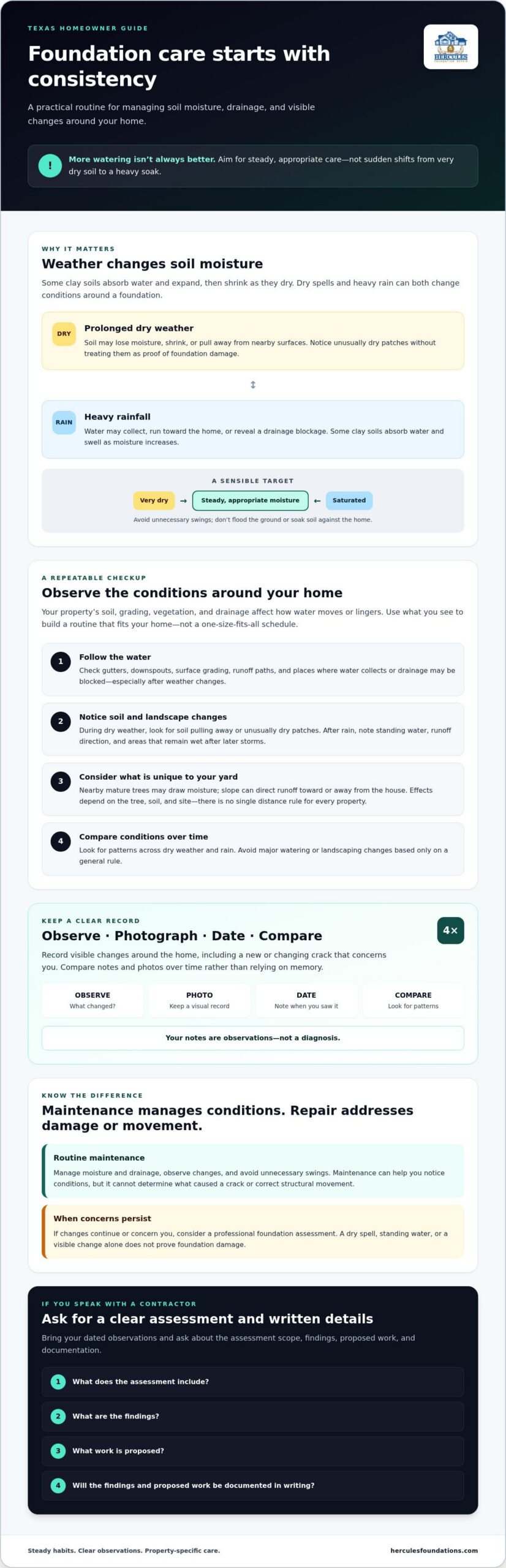
More watering isn’t always better for your foundation. In Texas, long dry spells and heavy rain can both change moisture levels in expansive clay soil, causing it to shrink or swell. That’s why foundation maintenance tips for Texas homeowners focus on consistency, not drastic corrections.
If you’re unsure whether to adjust your watering, change your landscaping, or pay attention to a new crack, you’re not alone. Foundation care can feel complicated when weather shifts and small changes around the house are hard to interpret. A steady routine helps you notice patterns without overreacting to every mark or dry week.
This practical checklist explains how to manage drainage and soil moisture, what changes to record, and how to compare conditions over time. You’ll also learn which warning signs deserve a closer look and when a professional foundation assessment may be appropriate. With repeatable habits and clear observations, you can take sensible steps to care for your home and know when to ask an experienced contractor for guidance.
Key Takeaways
- Use foundation maintenance tips for Texas homeowners as a repeatable routine, adjusted for your property’s soil, grading, vegetation, and drainage.
- After weather changes, check gutters, downspouts, surface grading, and areas where water collects or drainage may be blocked.
- Record visible changes by observing, photographing, dating, and comparing them over time. Treat your notes as observations, not a diagnosis.
- If changes continue or concern you, ask a foundation contractor about the assessment scope, findings, proposed work, and written documentation.
Foundation Maintenance Tips for Texas Homeowners Start with Consistent Moisture
Foundation maintenance means managing moisture, drainage, and changes around your home. The goal isn’t to keep soil perfectly wet or prevent all movement. It’s to avoid unnecessary swings where you can. Consistent conditions may reduce avoidable stress on a foundation, but they can’t guarantee it will never move.
Try not to let the ground become extremely dry and then respond with sudden, excessive watering. A rapid change from very dry to saturated soil can create another moisture shift instead of a steady environment. Your foundation maintenance tips for Texas homeowners should focus on measured, consistent care that suits your property, not a one-size-fits-all watering plan.
Routine maintenance helps manage conditions around a foundation. Structural repair addresses damage or movement that maintenance cannot correct. Keeping that distinction in mind can help you respond sensibly without treating every yard change as proof of a structural problem.
Why Texas soil moisture deserves steady attention
Some soils contain clay minerals that absorb water and expand, then shrink as they dry. Learn more about the behavior of expansive clay soils and why changing moisture can affect the ground around a home. During prolonged dry weather, soil may lose moisture; heavy rainfall can add water quickly. The effects vary by property and location, depending on soil, grading, vegetation, and drainage.
What consistent care means around a home
Steady care means paying attention to moisture without flooding the ground or soaking soil against the home. If you water landscaping, aim for even, appropriate moisture rather than alternating between neglect and a heavy soak. Observe where rainwater flows, whether it drains away, and whether water collects near the house. Check these patterns during dry spells, too, when soil and plants may show signs of drying.
Use those observations to build a routine, not to diagnose the foundation. A maintenance check can help you notice changes and track conditions, but it can’t determine what caused a crack or correct structural movement. If a concern persists or develops, record what has changed and consider whether a professional assessment is appropriate.
How Texas Weather and Soil Conditions Shape Foundation Maintenance
Texas weather creates different challenges for the ground around a home. During a prolonged dry spell, soil can lose moisture and pull away from nearby surfaces. Intense rainfall brings the opposite concern: water may collect, run toward the house, or reveal drainage problems. Neither condition alone proves there’s foundation damage. The useful question is how your property responds as conditions change.
Because soil moisture changes with the weather, consistent observation matters more than following a single statewide schedule. Local soil, grading, vegetation, and drainage all affect how quickly water moves or lingers. Practical foundation maintenance tips for Texas homeowners start with watching conditions around your specific home, rather than assuming every yard needs the same routine.
Adjust observations for dry spells and heavy rain
During dry periods, look for soil pulling away from the foundation or patches that seem unusually dry compared with the surrounding yard. Treat these as observations, not a diagnosis, and don’t respond by suddenly soaking the ground. After heavy rain, check for standing water, visible runoff paths, and leaves or other debris blocking drainage routes. Note where water travels and whether the same areas stay wet after later storms.
Consider property-specific soil, trees, and slope
Nearby mature trees can draw moisture from the soil, but their influence depends on the tree, soil, and site conditions. There’s no one distance rule that fits every property. Slope matters, too: a yard that directs runoff toward the home behaves differently from one that carries water away. Observe what happens rather than making major landscaping or watering changes based on a general rule.
If you’re unsure how your yard’s slope, soil, or drainage affects the home, seek local professional advice before attempting a substantial correction. Texas A&M AgriLife Extension offers lawn and garden guidance that can help inform yard-care decisions; foundation concerns may call for a separate assessment. For information about structural concerns and possible next steps, explore foundation repair information.
Keep notes on what you see during both dry weather and rain. Comparing observations over time can help you recognize a recurring drainage pattern or a change worth discussing with a professional, without mistaking normal weather effects for a confirmed foundation problem.
A Texas Foundation Checkup: What to Observe and Record
A useful checkup doesn’t require you to diagnose your foundation. It gives you a clear record of what you can see, so you can tell whether a change is isolated or appears to be developing. Use the same simple process indoors and outside: observe, photograph, date, and compare.
- Observe: Look for visible changes around the exterior and inside the home. Note areas such as the foundation perimeter, walls, floors, doors, and finishes.
- Photograph: Take a clear picture of anything that looks different. Include enough surrounding detail to identify its location.
- Date: Record when you noticed it and the weather context, such as a dry spell or recent heavy rain.
- Compare: Revisit the same locations and compare new observations with older notes and photos.
One mark or a door that feels different on a single day doesn’t establish a foundation problem by itself. Context matters: whether a change persists, appears to progress, or develops alongside other concerns can help you decide whether it warrants further attention. These foundation maintenance tips for Texas homeowners support careful observation, not a homeowner diagnosis.
Keep a simple home foundation log
Use a notebook or digital note to record the date, location, weather conditions, and a brief description of each visible change. Specify which room or exterior wall you checked and what looked different. Take photos from comparable viewpoints each time instead of relying on memory. You can also note whether a door, floor, or finish seems to have changed without assuming that the change proves settlement.
Know when observations merit a professional opinion
Consider seeking a professional assessment if a change continues to develop or several concerns appear together. Sudden, substantial changes, especially anything that affects safe use of the home, deserve prompt attention. Don’t wait to build a long record if a change is severe or creates an immediate safety concern.
Your log can help explain what you’ve noticed and when it began, but it can’t identify the cause or replace an on-site assessment. Share dated photos and notes with a qualified foundation professional, who can evaluate the conditions in context and explain whether further steps are appropriate.
The Texas Homeowner’s Seasonal Foundation Maintenance Checklist
A useful checklist follows conditions around your home, not a calendar that assumes every Texas property has the same soil, drainage, or landscaping. Check routinely, then take another look after heavy rain, an extended dry spell, or a noticeable yard change. These foundation maintenance tips for Texas homeowners help you spot conditions that may need attention, not make unassessed structural changes.
Check drainage, gutters, and the ground around the home
Start with visible, accessible areas. Look for clogged gutters or downspouts, confirm that water can discharge away from the home, and note whether runoff leaves standing water near the foundation. Watch for settled areas or surface grading that appear to channel water toward the structure. Avoid choosing a specific slope, drainage product, or construction fix based on a quick visual check. Site conditions differ, and a lasting change may need professional guidance.
Manage watering, trees, and landscaping carefully
Aim for steady, appropriate soil moisture where watering is needed, but don’t saturate soil next to the foundation or try to correct dry ground with a sudden, heavy soak. Think carefully before changing irrigation, removing substantial landscaping, or making other major yard adjustments. Mature trees may influence nearby soil moisture, though the effect depends on the tree and property. If pooling persists or you’re unsure how vegetation and drainage interact, consult a qualified local professional.
Save this simple checklist and use it when conditions prompt a closer look:
- After heavy rain: Check for standing water, runoff flowing toward the house, and visible drainage obstructions.
- During dry spells: Note unusually dry areas or soil pulling away, without treating either as a diagnosis.
- As part of routine upkeep: Clear accessible gutter and downspout obstructions, then observe where discharged water goes.
- After yard changes: Recheck how water moves around the home after landscaping or irrigation adjustments.
- If a pattern persists: Record what you observe and ask a qualified professional whether the site needs closer evaluation.
Use the list to guide observation, not prescribe a repair. A drainage solution or landscape change that suits one lot may not suit another. If you’ve documented persistent drainage concerns or visible changes around your home, learn about foundation repair options and consider whether a professional assessment is an appropriate next step.
When Foundation Maintenance Is Not Enough: Choosing a Texas Foundation Contractor
A maintenance routine helps you track moisture and drainage, but it can’t correct structural movement or determine its cause. If changes continue, become more pronounced, or appear alongside other concerns, a qualified evaluation can help clarify what’s happening and whether work is warranted. Don’t assume every crack or sticky door means the foundation needs repair. Ask for an explanation based on conditions observed at your home.
Keep the scope clear. Foundation repair addresses foundation concerns, while concrete leveling addresses uneven concrete surfaces. Plumbing and roofing are separate areas of work, as are other unrelated home services. If a contractor’s recommendation involves issues outside foundation repair or concrete leveling, ask which professional is qualified to address that part.
What to ask before agreeing to foundation work
Good questions help you understand a recommendation before making a decision. Ask the contractor to connect the observed conditions to the proposed work and explain what the evaluation covers. Request written documentation so you can review the scope and compare recommendations if you’re unsure.
- What conditions did you observe, and how do they support the recommendation?
- What does the assessment cover, and what can’t it determine?
- What work is proposed, and which method applies to my home?
- What property-specific factors could affect the recommendation or work scope?
- Can I receive the findings and proposed scope in writing?
If written recommendations differ, ask each contractor to explain the reasons behind their conclusions. Compare the stated conditions, proposed work, and scope rather than choosing based on a method name alone. If questions remain, consider seeking another qualified opinion before agreeing to structural work.
When to contact Hercules Foundation Repair
For homeowners in San Antonio, Austin, Houston, and Victoria with documented foundation concerns, Hercules Foundation Repair provides residential and commercial foundation repair, including slab and pier-and-beam services, as well as concrete leveling. The appropriate next step depends on what you’ve observed and whether the concern fits those services.
Your notes and dated photos can help explain what has changed, but an on-site evaluation is needed to assess site-specific conditions. If you’re in San Antonio, Austin, Houston, or Victoria and want to discuss foundation repair or concrete leveling, Talk with Hercules Foundation Repair.
Build a Steady Foundation Care Routine
Protecting your home starts with consistent, practical habits. Manage moisture without overcorrecting, check how water drains after dry spells and heavy rain, and keep dated notes and photos when you notice changes. These foundation maintenance tips for Texas homeowners can help you spot patterns, but routine care can’t diagnose or repair structural movement.
If changes appear to progress or several concerns develop together, a professional assessment can help you understand what’s happening and what steps, if any, make sense. Bring your observations and questions so you can discuss the findings and proposed work clearly.
Hercules Foundation Repair provides residential slab and pier-and-beam foundation repair, commercial foundation repair, and concrete leveling in San Antonio, Austin, Houston, and Victoria. If you’d like to learn more, explore foundation repair and concrete leveling.
A manageable routine and clear records can make foundation care feel less uncertain. Keep observing, make measured choices, and seek experienced guidance when changes call for it.
Frequently Asked Questions
How often should Texas homeowners check their foundation?
Check your foundation on a consistent, manageable routine, then look again after a notable dry spell or heavy rain. That steady approach is central to foundation maintenance tips for Texas homeowners, but there’s no single schedule that fits every property. Soil, drainage, landscaping, and visible conditions all matter. In San Antonio, Austin, Houston, and Victoria, conditions can vary from one property to another. Keep dated notes and photos, and seek an on-site assessment if changes progress or several concerns appear together.
Should I water the soil around my foundation in Texas?
You can water nearby landscaping when appropriate, but don’t flood the soil or keep it saturated. Consistent moisture may help avoid abrupt drying and wetting, yet the right approach depends on your soil, plants, irrigation, and property conditions. Make sure watering doesn’t direct runoff toward the house. If you’re unsure how to manage irrigation or persistent dry areas, ask a qualified local professional for advice based on your specific site.
Can trees affect a home’s foundation in Texas?
Yes, trees can influence nearby soil moisture, but their effect depends on the species, size, soil, and site conditions. There’s no universal safe distance that applies to every tree and home. Note changes to trees or landscaping alongside any foundation observations, and avoid removing a mature tree or making major changes near the home based on general advice alone. A qualified local professional can help you consider the property’s specific conditions before you act.
What should I do after heavy rain if water pools near my foundation?
Note where the water collects and check for visible obstructions in gutters, downspouts, or drainage paths. Record the conditions and observe whether runoff appears to flow toward the house. Don’t redirect water toward the structure or make major drainage changes without understanding the site. If pooling persists, drainage patterns change, or new foundation concerns develop, seek advice from an appropriate local professional. Your notes and photos can make that conversation more useful.
Are small foundation cracks always a sign of serious damage?
No, a small crack alone doesn’t establish the cause or seriousness of a problem. Photograph and date what you see, then compare it over time instead of assuming every crack signals structural failure. Pay attention to whether it appears to change or accompanies other developing concerns. Progression, several concerns appearing together, or a sudden substantial change warrants professional attention. An on-site assessment is needed to interpret the condition in the context of the home and its surroundings.
When should I call a foundation repair contractor?
Consider contacting a contractor when documented changes appear to progress, several concerns develop together, or a sudden substantial change affects the home. Your observations can help explain what’s changed, but they can’t diagnose the cause or determine the right repair. Ask the contractor to explain the observed conditions, assessment findings, proposed work, and written scope before deciding. Hercules Foundation Repair provides residential slab and pier-and-beam repair, commercial foundation repair, and concrete leveling in San Antonio, Austin, Houston, and Victoria.
Does foundation maintenance prevent all foundation problems in Texas?
No, maintenance can’t guarantee that foundation movement or damage will never occur. Managing moisture, observing drainage, and keeping records can support responsible home care and help you notice changes, but they don’t replace professional assessment when concerns arise. Soil, weather, construction, and property conditions vary, including across San Antonio, Austin, Houston, and Victoria. Treat routine care as a way to reduce avoidable stress and track changes, not as a promise of a problem-free foundation.